This article is published in Aviation Daily part of Aviation Week Intelligence Network (AWIN), and is complimentary through Mar 30, 2026. For information on becoming an AWIN Member to access more content like this, click here.

Trump Signals Plan To Deploy ICE Agents At U.S. Airports
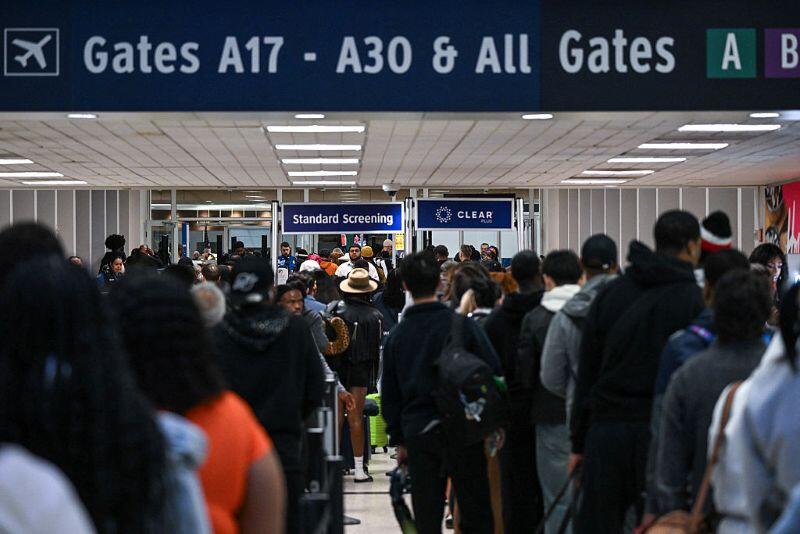
TSA HOU Mar 20  2026

TSA security checkpoint at George Bush Intercontinental Airport in Houston, March 20, 2026

Credit: Ronoldo Schemidt/AFP via Getty Images

With a partial U.S. government shutdown causing screening delays over a busy travel weekend, President Donald Trump said he is prepared to deploy U.S. Immigration and Customs Enforcement (ICE) to provide security at U.S. airports.

Trump did not detail the specific airport security tasks ICE agents would perform, but his messages suggest they would supplement a depleted Transportation Security Administration (TSA) workforce that is not being paid amid the funding impasse. Airport security checkpoints are under federal jurisdiction.

The White House referred questions to the president’s Truth Social account where he issued the statement. The Department of Homeland Security (DHS) did not immediately respond to a request for comment.

Trump in a March 21 post said ICE agents would move in and “do security like no one has ever seen before.” The action would come unless there is “immediately” an agreement on DHS funding, he said.

Staffing airport checkpoints is more than a numbers exercise. TSA officers are specially trained and not easily replaced, taking weeks to train an individual on the carry-on bag screening equipment alone, aviation security expert Jeff Price said. Using ICE agents in airport security roles has the potential to introduce delays from secondary questioning, intimidate passengers out of traveling and trigger mission creep, he added.

The president also said ICE agents would arrest any undocumented aliens in the country. “I look forward to moving ICE in on Monday, and have already told them to ‘GET READY,’” he said in a second post.

“Making an airport checkpoint into an immigration enforcement center risks shifting focus away from detecting weapons/explosives and people who are a threat to aviation, and towards identifying individuals who might be in the country illegally; this can dilute the effectiveness of aviation security,” Price, head of consultancy Leading Edge Strategies, said in an email.

There are other questions the president’s statement raises, including the reporting chain for ICE officers, Price said. TSA Federal Security directors oversee security at commercial airports, including the screening of passengers and baggage. “That has not been clearly articulated, nor has any of this plan been articulated," he said.

Funding for DHS lapsed on Feb. 14, with Democrats and Republicans in a stalemate over immigration policy and ICE enforcement practices. TSA officers, among those federal employees working without pay, missed their first full paycheck on March 13.

More than 350 TSA agents have resigned since the shutdown began, according to DHS. Staff calling in sick have led to long security lines during the spring-break travel period just ahead of the Easter holiday. On March 15 and March 16, callouts rose over 50% in Houston and over 30% in New Orleans and Atlanta, according to DHS. Airport delay trackers by 9:30 a.m. on March 21 showed maximum wait times at Houston’s George Bush Intercontinental Airport reached 2 hr. and stood at 95 min. at Hartsfield-Jackson Atlanta International and 60 min. at New York LaGuardia.

“I think the system is already in a compromised state,” Price said. “Once airports start having to close due to a lack of TSA personnel, and line waits at many airports start averaging 4 to 5 hr. plus, Congress will have to do something to break this shutdown, before it costs the industry billions of dollars and compromises even more the security of aviation and the United States.”

The American Federation of Government Employees (AFGE), the union representing TSA staff, has urged lawmakers to reach an agreement, calling for enactment of at least a short-term funding measure. Members are struggling to pay for bills and basic necessities, the union told lawmakers.

The next scheduled pay date for affected DHS workers is March 27.

“Tens of thousands of families turning to food banks because Congress refuses to do its job is a national disgrace,” AFGE National President Everett Kelley said on March 19.

U.S. airlines and advocacy groups including Airlines for America (A4A), the U.S. Travel Association, and Airports Council International-North America have also demanded action from Congress to pay federal aviation workers.

A4A bemoaned that air travel has again been caught in the political crosshairs. “With spring break travel in full swing, FIFA World Cup 2026 right around the corner and celebrations for America’s 250th birthday throughout the year, the stakes are especially high,” the industry lobby group wrote in a March 15 letter to Congress.

Several CEOs of A4A member airlines also signed the letter. The bosses of Alaska Air Group, American Airlines, Delta Air Lines, JetBlue Airways, Southwest Airlines and United Airlines urged lawmakers to pass legislation guaranteeing pay for essential federal aviation workers during future funding lapses. “Leaders should immediately come together to reach an agreement to fund the Department of Homeland Security,” it states. “Then they need to act so this problem never happens again.”

Christine Boynton

Christine Boynton is a Senior Editor covering air transport in the Americas for Aviation Week Network.

Sean Broderick

Senior Air Transport & Safety Editor Sean Broderick covers aviation safety, MRO, and the airline business from Aviation Week Network's Washington, D.C. office.