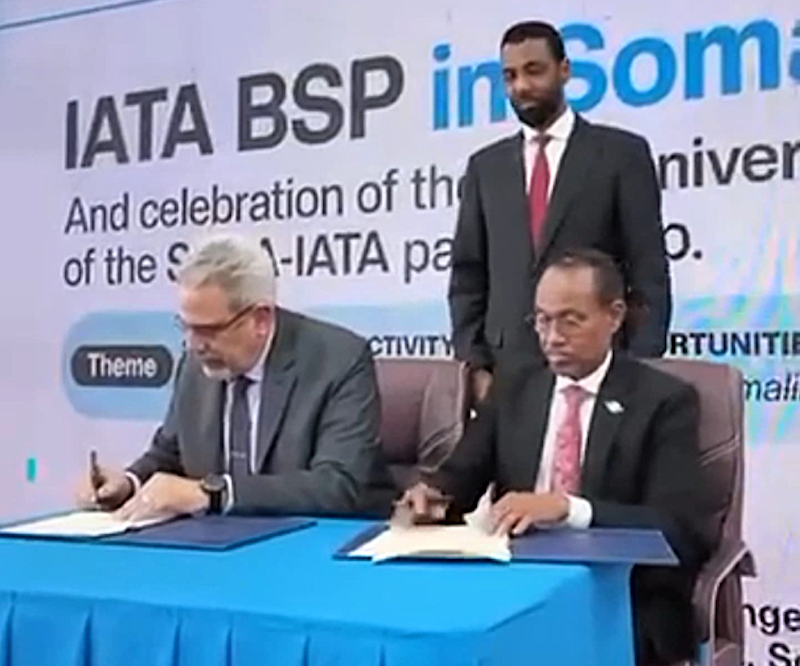
The memorandum-of-understanding signing in Mogadishu, Somalia, on Oct. 18, 2026.
The International Air Transport Association (IATA) has signed a pact with Somalia’s Ministry of Transport and the Somali Civil Aviation Authority to strengthen cooperation on aviation safety.
The memorandum of understanding is a step toward a single set of internationally recognized audit standards across Africa.
Under the agreement, the Somali Civil Aviation Authority (SCAA) will accept the IATA Operational Safety Audit (IOSA) and the IATA Safety Audit for Ground Operations (ISAGO) as acceptable means of compliance with national regulations. The audits will complement the regulator’s own oversight functions.
“Global safety standards are the cornerstone of efficient and safe operations,” says Kamil Al-Awadhi, IATA’s regional vice president for Africa and Middle East. He says the partnership will promote industry best practice and foster a culture of safety “for the benefit of passengers, operators and the wider aviation industry in Somalia and Africa.”
Safety is a priority area under IATA’s Focus Africa initiative, which pools resources from across the aviation value chain to tackle the continent’s most pressing challenges. The program also covers infrastructure, connectivity through the Single African Air Transport Market (SAATM), finance and distribution, sustainability in line with the Net Zero by 2050 target and future skills.
The agreement comes as Somalia’s aviation sector, long disrupted by conflict, shows signs of gradual recovery. Growth is being driven largely by private operators meeting demand for domestic and regional travel, alongside improvements to airport infrastructure, particularly at Mogadishu, the country's capital.
The government’s plan to revive its national carrier, however, has stalled. It was suggested that Somali Airlines would relaunch in September 2026. That deadline passed without a first commercial flight, raising fresh questions about repeated government commitments.
Somali Airlines was the country’s flagship carrier, operating international and domestic services from its Mogadishu hub with a mixed fleet of narrowbody, widebody, turboprop and fixed-wing aircraft. The state-owned airline ceased operations in 1991.

Related Content