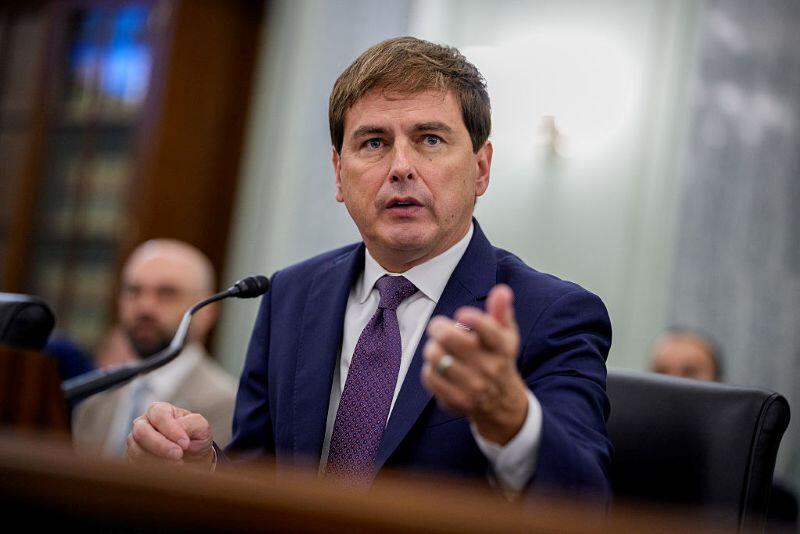
TSA Administrator David Cummins
The new head of the U.S. Transportation Security Administration (TSA) said the agency faces another possible federal government shutdown on Oct. 1 that could once again leave airport checkpoint screeners unpaid, which adds urgency to the agency’s push to privatize airport security.
TSA Administrator David Cummins, sworn in on Aug. 7 following Senate confirmation after a career in the private sector and two months as a TSA senior advisor, said he plans to continue upgrading technology at checkpoints while seeking to expand the agency’s Screening Partnership Program (SPP). However, he notably is dropping the “TSA Gold Plus” initiative unveiled in May.
SPP, in place since 2002, allows airports to opt out of federalized security in favor of a TSA-vetted private firm. Only 20 mostly smaller airports are part of the program, but San Francisco International Airport has been an SPP airport from the start and avoided the exceptionally long checkpoint lines that disrupted air travel during the partial government shutdown earlier this year.
At Cummins’ July confirmation hearing, Senate Commerce, Science and Transportation Committee chairman Ted Cruz (R-Texas) said a lapse in federal funding at the end of the government’s fiscal year on Sept. 30 is “very likely,” which would trigger a shutdown starting Oct. 1.
A 76-day shutdown of the Department of Homeland Security (DHS) that ended April 30 forced more than 47,000 TSA screeners—who have an average annual salary of $65,000—to go unpaid for weeks. Screeners were declining to report to work at rates as high as 40%-50% at some major airports, causing TSA to close numerous security lanes and checkpoint lines to stretch for hours, in some cases spilling out of airport doors.
Thousands of screeners reported severe financial hardship during the DHS shutdown. Around 1,100 left the agency, according to Cummins. The 2026 DHS shutdown followed an extended government-wide shutdown that occurred in late 2025, during which checkpoint screeners also went unpaid.
Airport security screeners “have a zero fail national security mission,” Cummins told senators during his confirmation hearing. “There is too much at stake to have them distracted by months without pay.”
He said TSA workers struggled to meet basic financial needs during the shutdowns.
Cummins added he would “explore various ways to protect our people, including expansion of the Screening Partnership Program. Some will suggest that the SPP is all about privatization and that it is anti-worker. I hold that it is in fact pro-worker to pay your employees, as the SPP airports did during the last shutdowns.”
In an Aug. 24 statement outlining his priorities, Cummins said an “evolved Screening Partnership Program will replace TSA Gold Plus to better harness the role of the private sector in delivering a safer, more secure and more efficient aviation system.” In May, TSA said the Gold Plus program would be a “public-private partnership” in which an expanded SPP would be paired with “TSA’s innovation authorities” to enable “cutting-edge aviation security solutions.”
On the same day Cummins said TSA was dropping Gold Plus, Tampa International Airport (TPA)—one of the airports that had opted into Gold Plus—said that after evaluating SPP and Gold Plus it will now opt out and use federal screeners going forward.
TPA “opted in to evaluate the TSA Gold Plus program with the goal of preventing disruptions from future government shutdowns, improving access to the latest screening technology and enhancing the passenger experience,” the airport said in an Aug. 24 statement. “[TPA] conducted an extensive review and evaluation over several months, which resulted in its decision to keep screening operations exclusively with the TSA.”
Cummins said current TSA airport screeners would have the right of first refusal to accept jobs with private firms taking over security as part of an expanded SPP.
He added that TSA checkpoint screeners’ “morale is very, very low right now” as another possible shutdown nears.
“They’re feeling very underappreciated by the American public and specifically by this government,” Cummins said. “They fear the prospect [of another shutdown]. They watch the news. They hear about the prospect of another shutdown ... We’ve had significant attrition because of the last two shutdowns, and not just entry-level workers, but folks that have been with the agency for 20 years or more. And so, I am deeply concerned that, in the face of another shutdown, we’re going to start seeing attrition pick up.”
The loss of screeners during the last shutdown “was substantial in as much as we also lost a lot of highly tenured folks,” Cummins said, adding the agency “struggled for quite a while in replacing them because people just frankly didn’t want to come work for an agency that wouldn’t pay them.”
Beyond staffing issues, Cummins is pushing for accelerated technology deployment at checkpoints. He has scheduled a September conference to “bring together innovators and groundbreakers from across the agency, including field and headquarters personnel,” to discuss moving forward with wider technology upgrades at airports.
TSA has made a number of changes to checkpoints since early 2025, including rescinding the shoes-off policy, installing computed tomography (CT) scanners in many airports and advancing an initiative to allow passengers to use biometric facial recognition as their sole form of identification.
“We really do have the opportunity to put in [new] technology,” Cummins said. “And to be clear, this is mostly about improved security. The good thing is, with this new technology, you also get improved throughput. The bags go through quicker; the people go through quicker, and our checkpoints become more secure.”
Cummins replaces Ha Nguyen McNeill, who served as acting administrator for nearly 18 months. She steered TSA through the 2025 and 2026 shutdowns, warning of long-term negative consequences for airport security caused by repeated lapses in federal spending. McNeill has said she will leave TSA on Sept. 3.