This article is published in Aviation Daily part of Aviation Week Intelligence Network (AWIN), and is complimentary through Jan 14, 2026. For information on becoming an AWIN Member to access more content like this, click here.

KLM Secures De-Icing Fluid At Schiphol As Snow Disruption Continues
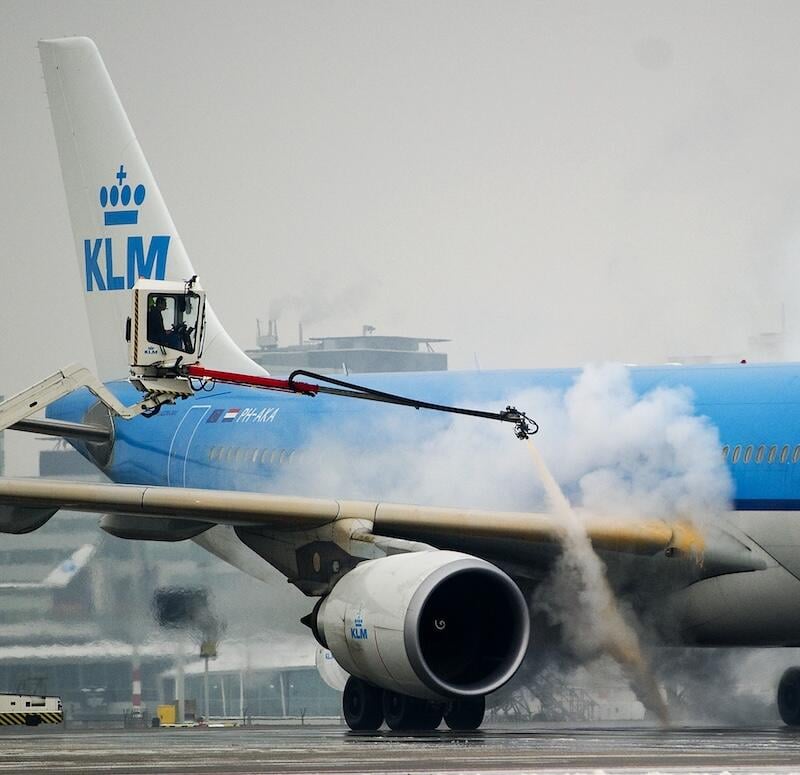
klm jet getting de-iced
Credit: Robin Van Lonkhuijsen/AFP/Getty

KLM Royal Dutch Airlines said it has now secured more de-icing fluid, after warning that supplies needed to de-ice aircraft at Amsterdam Airport Schiphol were running low, as snow and ice continue to cause disruption.

Schiphol's airport operator said the number of canceled flights, already standing at more than 700, would likely rise. Snow and ice have been causing disruption at Schiphol and Paris Charles de Gaulle Airport, two of Europe’s busiest air gateways, as well as at Paris Orly.

In a Jan. 7 update at 10 a.m. local time, KLM said: “The first supply of de-icing fluid has now arrived. We will continue to replenish our inventory to ensure that the flights we operate can depart safely.” KLM collected the fluid in Germany.

“Today is another disrupted day at the airport,” Schiphol Airport said in a separate Jan. 7 update. “Our snow plow is working continuously to ensure as much air traffic as possible can proceed safely. However, the ongoing wintry weather conditions and strong winds are limiting air traffic. Currently, over 700 flights have been canceled, and we expect this number to rise. Last night, over a thousand travelers spent the night at Schiphol, many of whom used the provided sleeping accommodations.”

The airport operator urged travelers to check their flight status before heading to the airport. KLM had warned on Jan. 6 that stocks of de-icing fluid were running low and said it had sent a team to collect extra de-icing fluid from Germany.

The shortage fears are due to a combination of extreme weather conditions and delays in supply from the provider, KLM said, with the Germany-based supplier unable to guarantee timely replenishment of stocks.

“This challenge is currently widespread across Europe,” the airline said Jan. 6, noting that it was “doing everything possible to secure additional supply, for example, KLM will collect the fluid itself in Germany.”

KLM had to cancel 600 flights for Jan. 7. The airline said it would continue to monitor the de-icing fluid situation closely in the coming days.

The carrier said it is responsible for de-icing most aircraft at Schiphol, a process that uses a mixture of heated water and glycol. The de-icing team of more than 100 KLM employees has used approximately 85,000 liters per day over the past few days to clear aircraft.

“Every departing aircraft must be completely free of snow and ice before it can safely take off,” KLM said, noting that it operates a fleet of 25 de-icing trucks, all of which have been in continuous use since Jan. 2.

Elsewhere in Europe, snow and ice caused disruption to air traffic, with France’s civil aviation authority, DGAC, saying Jan. 6 it had asked airlines at Paris Charles de Gaulle to cancel 40% of flights between 9 a.m. and 2 p.m. local time on Jan. 7, and 25% of flights at Paris Orly, the French capital’s second airport, on the same day between 6 a.m. and 2 p.m.

The DGAC said that traffic had also been disrupted at Nantes Atlantique Airport in the west of France since Jan. 5 and that would continue through Jan. 7.

Helen Massy-Beresford

Based in Paris, Helen Massy-Beresford covers European and Middle Eastern airlines, the European Commission’s air transport policy and the air cargo industry for Aviation Week & Space Technology and Aviation Daily.