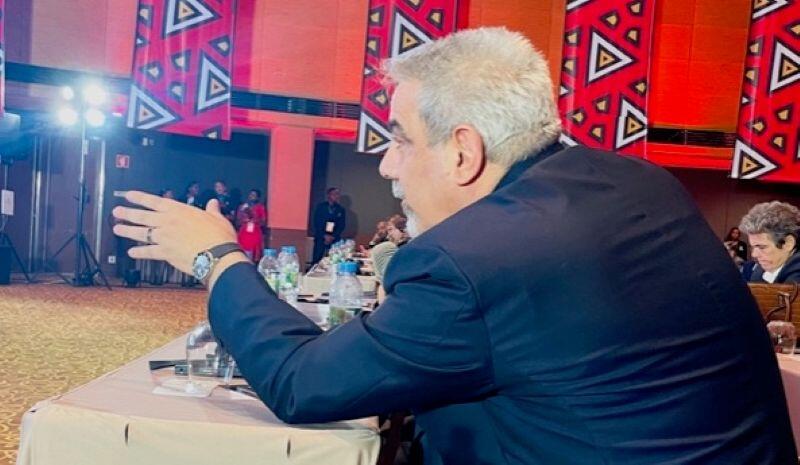
Kamil Alawadhi, IATA’s Regional Vice President for Africa and the Middle East.
African airlines remain under mounting financial pressure from high taxes and fees, according to Kamil Alawadhi, IATA’s Regional Vice President for Africa and the Middle East, who is urging governments across the continent to rethink how they treat the industry.
Speaking at Aviation Africa in Kenya, Alawadhi said governments are increasingly “squeezing and milking” aviation, arguing that air travel should be seen as a driver of economic growth rather than a source of revenue.
“Aviation should not be treated primarily as a source of revenue but as an engine of economic development,” he said.
Alawadhi acknowledged progress since IATA launched its Focus Africa initiative in 2023, a program bringing together governments, regulators, airlines and airports to address practical challenges.
“Safety oversight has expanded, with 47 African carriers now enrolled in IATA’s Operational Safety Audit program, and blocked airline funds—money that carriers are unable to repatriate—have fallen from a peak of $1.5 billion in July 2023 to $624 million in July this year,” he said.
But Alawadhi said the fundamentals remain difficult. “African unit costs run roughly double the global average, taxes and charges sit at least 15% above the global average and fuel remains significantly more expensive in many African markets than anywhere else. It’s 17% higher than the global average, accounting for 40% of operating costs in Africa, compared to 25% globally,” he said.
“Airlines also face a complex mix of taxes, charges and fees. Access to foreign exchange remains challenging in some countries. And many markets are simply too fragmented to deliver the economies of scale that airlines need,” he said.
A particular sticking point is the rollout of advanced passenger information and passenger name record systems, which some governments have used to impose steep passenger levies. Alawadhi cited Tanzania charging $45 per sector, Gabon $30 and Equatorial Guinea $50—fees that can double for return journeys. “That is not sustainable,” he said, urging states to implement the systems in line with ICAO standards.
On blocked funds, Alawadhi said delayed repatriation of airline revenue slows capacity growth and investment. “Ultimately, consumers and economies pay the price,” he said, calling for governments and industry to work together on foreign exchange access.
On infrastructure, Alawadhi pointed to projects such as Ethiopia’s new Bishoftu International Airport and the expansion of Casablanca’s Mohammed V International Airport, stressing that governments must consult closely with airlines to ensure spending is “demand-driven, cost-efficient and aligned with global best practices.”
Alawadhi concluded saying the choice facing governments is clear: “Should aviation be treated primarily as a source of revenue or as an engine of economic development?”
“What matters now is the willingness to act. Africa has the potential, demand and opportunity. The solutions are within reach, and the choice to implement them is ours,” he said.

Related Content