The U.S. Transportation Department (DOT) escalated a long-running dispute with Mexico over alleged violations of the countries’ 2015 open skies agreement, threatening to restrict Mexican airlines' access to the U.S. and end the Aeromexico-Delta Air Lines transborder joint venture (JV).
U.S. Transportation Secretary Sean Duffy accused Mexico of “blatant disregard” for the open skies agreement, pointing to “anti-competitive” behavior related to capacity restrictions implemented at Mexico City Benito Juárez International Airport (MEX) in 2022 and 2023.
The dispute extends back to the previous presidential administrations of Joe Biden in the U.S. and Andrés Manuel López Obrador in Mexico. While U.S. President Donald Trump and Duffy pointedly blamed the Biden administration for the current state of affairs, new DOT filings reiterate and build on arguments put forward in 2024 filings by the previous DOT, led by then-Secretary Pete Buttigieg. The DOT promulgated three new orders on July 19. One requires Mexican airlines to provide detailed information on current operations to the U.S. to determine whether their transborder flights are lawful. The second requires Mexican carriers “to obtain prior approval” from the DOT before operating passenger or cargo charter flights to the U.S. The third is an update to the January 2024 Biden administration DOT “show cause” order that tentatively called for the Delta-Aeromexico antitrust-immunized transborder JV to be terminated.
López Obrador, citing severe congestion at MEX, in 2023 ordered freighter operators, including U.S. carriers FedEx and United Parcel Service, to move Mexico City operations from MEX to Felipe Ángeles International Airport (NLU), which opened in March 2022. NLU, a former military base converted for commercial operations, is located about 30 mi. from MEX and is viewed by carriers as much less desirable for efficiently moving cargo through and around Mexico City.
That came a year after American Airlines, Delta and United Airlines—along with Mexican carriers Aeromexico, Viva Aerobus and Volaris—were forced by the Mexican government to reduce passenger slots at MEX.
The slot reductions were “done under the pretense of capacity constraints and operational limitations at MEX,” the DOT said in a July 19 statement. “In 2023, Mexico unilaterally forced all U.S. all-cargo carriers out of MEX under the same saturation pretenses with only 108 business days advance notice. Mexico has not taken any action to restore the operating rights of U.S. all-cargo carriers guaranteed in the U.S.-Mexico air transport agreement.”
The Mexican government reduced allowed hourly aircraft movements at MEX from 61—a limit in place since 2014—to 52 for the 2022-23 winter season, and then reduced the number again to 43 for the 2023-24 winter season. Those reductions led to reduced slots for passenger flights and the displacement of cargo flights to NLU.
“The basis for these significant operational reductions remains unclear as nothing physically has changed with respect to either the terminals or the runways at MEX,” the DOT said in a July 19 filing.
The DOT is imposing new requirements on Mexican airlines that could enable the agency to restrict flights to the U.S. It is mandating that Mexican airlines submit detailed filings on transborder flight schedules—including equipment used, frequencies and arrival and departure times at each airport—by July 29 so the agency can “determine whether the operation of the services contained in those schedules … may be contrary to applicable law or adversely affect the public interest.”
The DOT also said that Mexican carriers will soon need “to obtain prior approval from the department in the form of a statement of authorization before operating” passenger or cargo charter flights to the U.S.
Aeromexico-Delta Implications
The DOT, in a July 19 “show cause” order, said the Aeromexico-Delta antitrust-immunized JV is no longer in the public interest.
“Based upon the actions of Mexico, which have distorted the market and changed the competitive effects of the Delta-Aeromexico JV materially, we do not assess that there are acceptable alternatives to withdrawing [antitrust immunity] that would be consistent with the public interest and the international aviation policy interests of the U.S,” the filing stated.
The Aeromexico-Delta JV, started in 2017, has been fighting for survival since 2020, when the initial authority granted by DOT in late 2016 expired. Since then, the JV has continued on a tentative basis.
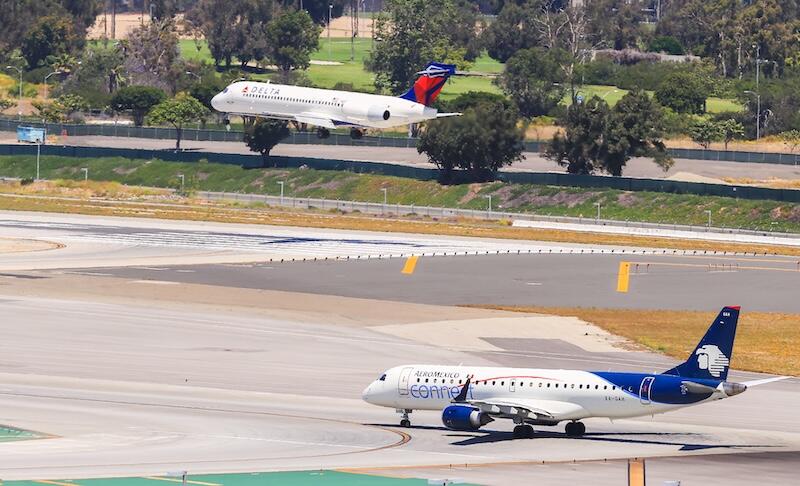
The JV operates on an antitrust-immunized, metal-neutral basis with the airlines jointly scheduling, marketing, operating and sharing revenue on transborder flights. Delta has a 20% ownership stake in Aeromexico.
According to CAPA – Centre for Aviation data, the JV operates 21.8% of two-way seats between Mexico and the U.S., as of March 2025. The two airlines’ combined market share tops American, which has a 19.8% share of two-way transborder seats, and United, which has a 15.2% share.
The DOT said that “the unreliable and nontransparent slot administration practices that reduced capacity at MEX” have created "potential harmful impacts of antitrust immunity in this environment, with specific emphasis on the lack of entry or the possibility of entry in the Mexico City market.”
The agency added that it “sees significant economic harm resulting from the actions of Mexico, including with respect to the continuation of the Delta-Aeromexico JV, and this harm is likely to increase over time given the current distortive marketplace.”
The DOT has tentatively determined that the JV should be ended, but clarified that it “only intends to disapprove those agreements for the purposes of withdrawing the [antitrust immunity] for the alliance. To be clear, the department is encouraging [Delta and Aeromexico] to continue pro-competitive commercial cooperation and is not finding that the kind of arms-length cooperation practiced widely in the airline industry is anti-competitive in this market.”
According to Duffy’s statement, Delta and Aeromexico “would be able to continue their partnership through arms-length activities such as codesharing, marketing and frequent flyer cooperation. Delta will also be able to retain its equity stake in Aeromexico and maintain all of its existing flying in the U.S-Mexico market unimpeded.”
In an initial statement reacting to the DOT’s show cause order, Delta said ending the JV “would cause significant harm to consumers traveling between the U.S. and Mexico.”
Duffy, meanwhile, issued a warning to “multiple other countries that are disregarding the terms of our air transport agreements.” The DOT statement added: “For example, we are monitoring European states to ensure that they apply the balanced approach process for noise abatement at their airports and do not implement unjustified operational restrictions. The department is committed to enforcing our agreements to ensure that aviation markets are fair and pro-competitive.”