This article is published in Aviation Daily part of Aviation Week Intelligence Network (AWIN), and is complimentary through Mar 15, 2026. For information on becoming an AWIN Member to access more content like this, click here.
Airlines impacted by the war between Iran and the U.S. and Israel were scrambling for a second day to adjust their operational plans amid airspace and airport closures in the region and uncertainty over how long the fighting would last.
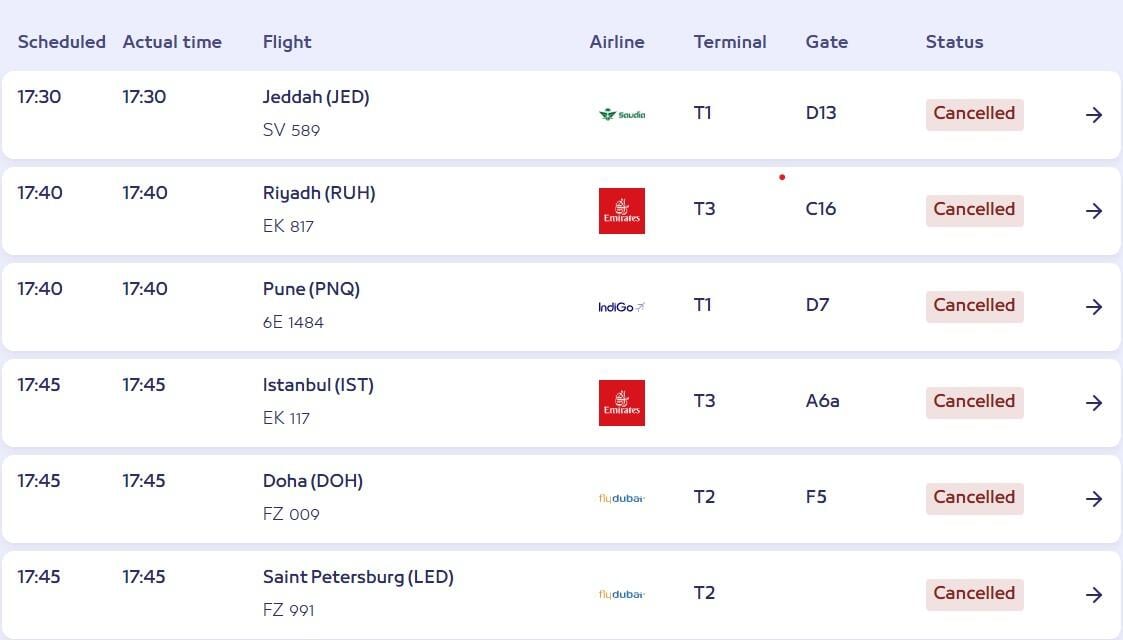
As major Middle Eastern hubs used for connecting flights between North American, European and Asian destinations suspended operations, thousands of flights were cancelled and, in some cases, diverted, leaving passengers stranded.
Flightradar24 said more than 3,400 flights were cancelled March 1 across seven airports in the Middle East with airspace across much of the region remaining closed over security concerns with military operations underway. The flight-tracking site also said GPS was suffering from “severe” spoofing and jamming.
In response to the U.S. and Israeli air strikes, Iran fired ballistic missiles and drones at countries in the Gulf region. It struck airports in Kuwait, Dubai and Bahrain, causing damage. In Abu Dhabi, debris from an intercepted drone targeting Zayed International Airport killed one person and injured others.
Dubai International, one of the world’s busiest airports, was among those hit, causing what the airport authority said was minor damage. “Emergency response teams were immediately deployed and are managing the situation in coordination with the relevant authorities.,” Dubai Airports said, noting four staff sustained injuries and received medical attention.
Flights were suspended “until further notice,” along with those at nearby Dubai World Central–Al Maktoum International airport.
A notice to airmen was issued to airlines that Iran’s airspace would remain closed through at least March 3.
Emirates said flights would be suspended until 3 p.m. local time March 2. Etihad Airways flight suspensions also extended into March 2. Qatar Airways extended its flight suspension through March 1, noting it would update the situation March 2 and reopen operations once flying was safe.
Airlines flying to the region also took action to halt flights. An Air India Express flight from Mangalaru to Doha on Feb. 28 diverted to Mumbai. “In view of the developing situation, flights to the Gulf region are suspended,” said Air India Express in a February 28 update.
The carrier also illustrates how flights not directly to the Middle East were affected with the airspace now off limits. Air India on March 1 called off services linking Mumbai and London, as well as between Delhi and Birmingham, Delhi and Amsterdam, Delhi and Zurich, Delhi and Milan, Delhi and Vienna, Delhi and Copenhagen, Bengaluru and London, Delhi and London and Delhi and Frankfurt.
European airlines, already cut off from Russian airspace because of that country’s unprovoked war on Ukraine, cancelled flights to the region. Lufthansa Group suspended its airlines’ flights to Tel Aviv, Beirut, Amman, Erbil and Tehran until March 7 and said it would avoid airspace of Israel, Lebanon, Jordan, Iran, Iraq, Qatar, and the UAE.
The European Union Aviation Safety Agency (EASA) had already issued a Conflict Zone Information Bulletin (CZIB) advising airlines to not operate in the airspace of Bahrain, Iran, Iraq, Israel, Jordan, Kuwait, Lebanon, Oman, Qatar, the UAE and Saudi Arabia citing a "high risk" to commercial aviation.
“Given the ongoing military intervention, retaliatory actions against U.S. and Israeli assets in the region are likely to occur, introducing additional high risks not only to the airspace of Iran but also to that of neighboring states hosting U.S. military bases or otherwise affected by the hostilities and associated military activities, including interceptions,” EASA stated Feb. 28, in the CZIB which is valid through March 2 unless reviewed earlier.
Air France cancelled its Feb. 28 and March 1 flights to and from Tel Aviv, Beirut, Dubai and Riyadh. British Airways said it had cancelled a number of flights to the Middle East.