This article is published in Aviation Week & Space Technology and is free to read until Jul 22, 2026. If you want to read more articles from this publication, please click the link to subscribe.

Opinion: How To Broaden The Air Traffic Controller Pipeline

students at training site

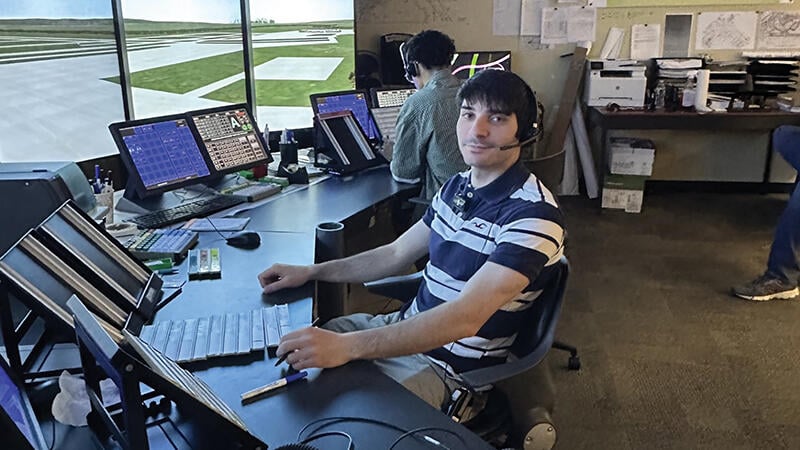
Yanni Agrotis trained as part of the first Enhanced AT-CTI cohort at Vaughn College.

Credit: Vaughn College

The aviation industry has been focused on an urgent question: How do we prepare more air traffic controllers more quickly without compromising readiness? The answer might not be a single solution but one that provides individual learners with an approach that works for them.

The pathway to air traffic control has long been rigorous, and it should remain so. Safety depends on it. But as the industry strives to meet workforce demand—estimated at between 3,000 and 4,000 unfilled positions—that single pathway will not work for every prospective controller.

A significant development is emerging: a set of complementary pathways that expand how we prepare people for this profession.

One example comes from my own institution, Vaughn College, where the first Enhanced Air Traffic-Collegiate Training Initiative (AT-CTI) cohort recently graduated with a 100% success rate. This is a strong early signal—not just of success but of what is possible when training models evolve and expand.

The Enhanced AT-CTI is a rigorous FAA-approved program that allows successful graduates to bypass traditional FAA Academy training in Oklahoma City and move directly to select FAA control towers. Since launching in 2025, the initiative has expanded to approximately a dozen approved sites across the country.

This pathway does not replace existing training. It complements it—offering another way for qualified candidates to reach the same goal: readiness for operational environments.

The traditional pipeline has produced generations of highly capable controllers. That foundation is strong. At the same time, the demand is real, and the number of seats available at the academy is maximized. Expanding the pipeline requires not just more volume but more flexibility—in how candidates are prepared and in the locations that best fits their training needs.

Programs like Enhanced AT-CTI represent one such approach—integrating academic preparation, simulation and evaluation into a more continuous training experience. The success of the first cohort underscores the value of that flexibility. It demonstrates that when training is immersive, sustained and closely aligned with real-world expectations, students can meet—and exceed—high standards.

The outcomes are evident in participants’ descriptions of their experience. One graduate put it simply: “The preparation we got here made us more than ready. . . . We all passed with flying colors. I think the way we were structured was the best way for us to get through.”

This sentiment reflected a consistent theme: Preparation builds confidence through repetition, structure and time on task.

For many students, the value lies not only in access but also in the approach, with support at every step along their educational and training journey. That combination—high expectations with strong support—can make a meaningful difference in how candidates progress through training.

The perspective of experienced evaluators at the end of the training reinforces that point. As one evaluator observed: “It was almost like I was in an air traffic facility—they’re ready to go.”

That level of readiness reflects intentional design. Vaughn’s program features instructors who are all former New York metropolitan region controllers as well as extended training time and a learning environment built on decades of continuous improvement. Likewise, the lessons from this first cohort will help strengthen and expand the model, contributing to ongoing improvement.

As the aviation sector addresses workforce needs, the goal is not to choose one pathway over another but to ensure that multiple, rigorous and well-aligned options will lead to the same outcome: capable, confident professionals who are ready for operational environments.

Programs like Enhanced AT-CTI confirm that this outcome is achievable by demonstrating that:

  • Rigorous standards can be maintained across different training models.
  • Preparation can be tailored to how people learn best.
  • Readiness can be built through structured, immersive experiences.

Most important, flexible learning pathways broaden access to the profession while maintaining the expectations that define it.

The success of early cohorts represents a strong beginning. As these programs grow, they offer a valuable complement to the existing system—expanding capacity while maintaining quality.

Sharon DeVivo

Sharon B. DeVivo is president of Vaughn College of Aeronautics and Technology in Flushing, New York.