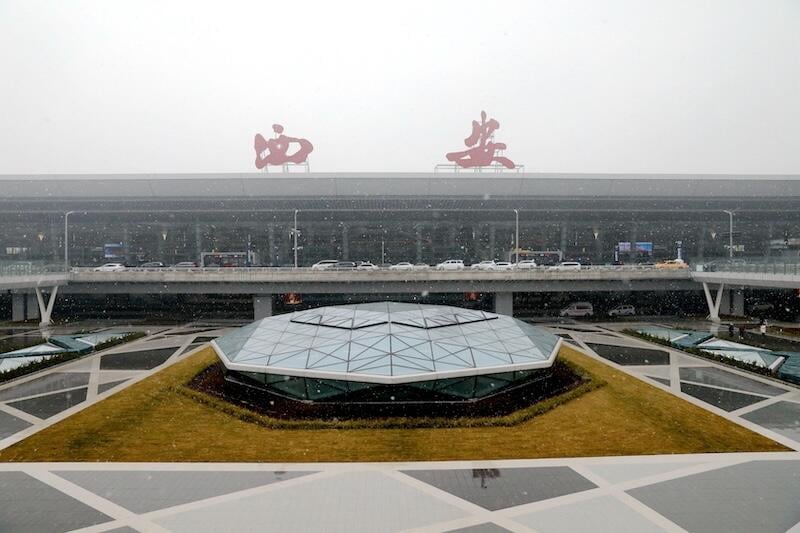
Xi'an Xianyang International Airport.
Xi’an is accelerating efforts to expand its long-haul network as it prepares to host Routes Asia 2026, with new European connectivity—including the launch of flights to Vienna—highlighting the airport’s growing international ambitions.
The northwest China gateway handled more than 48 million passengers in 2025, placing it among the country’s top 10 airports, supported by strong domestic connectivity, infrastructure expansion and policy support. The focus is now shifting toward building out international routes, particularly across Europe, Central Asia and Southeast Asia.
A key milestone is the planned launch of a 3X-weekly service between Xi’an and Vienna by China Eastern Airlines, marking the airport’s first nonstop link to Austria. Flights will begin on April 20 using Airbus A330-200 aircraft. The move comes as demand between Austria and China totaled about 243,400 two-way passengers in 2025, Sabre Market Intelligence data shows, up more than 25% year-on-year.
“As the geographic center of China and a key gateway to the west, Xi’an connects eastern and western China, Central Asia and Europe, supporting strong origin-destination and transfer demand,” says Qiu Jing, senior supervisor of network development at Xi'an Xianyang International Airport operator China West Airport Group.
Xi’an’s international network has expanded steadily in the past year, with new and resumed services including Istanbul, Hanoi and Hong Kong, alongside established routes to major hubs such as London Heathrow, Paris Charles de Gaulle and Milan Malpensa. China Eastern Airlines, the airport’s largest carrier with about 32% of total capacity, has been central to this growth, with its summer 2026 capacity up by about 3% year on year.
More News And Analysis From Routes Asia 2026
However, despite recent progress, the group acknowledges gaps remain in its network. “First, direct long-haul routes to North America are still missing. Second, coverage in South Asia, the Middle East, and Africa is insufficient … Third, direct connections to key economic and tourism hubs in Western Europe and Oceania need to be strengthened,” Jing says.
Currently, Xi’an is served by 41 airlines and connected to 161 destinations, although the majority—133—are domestic. Strengthening the international network is therefore a key priority, particularly as the airport seeks to build transfer traffic flows.
New-generation aircraft are expected to play a major role in enabling expansion. “The A321XLR enables long, thin routes with lower costs, allowing us to open direct services to secondary European cities, Central Asia, the Middle East and South Asia that were not economically viable before,” the group says.
The airport has identified four priority international markets: Central Asia, Europe, Southeast Asia, and the Middle East and South Asia, with North America and Africa seen as longer-term opportunities.
Xi’an’s strategy aligns with China’s broader shift toward a multi-hub aviation system, in which regional gateways complement the country’s major hubs in Beijing, Shanghai and Guangzhou. “As the largest air transportation hub in Northwest China, Xi’an … will become a core hub connecting domestic networks and international routes to Central Asia and Europe,” Jing adds.

Related Content