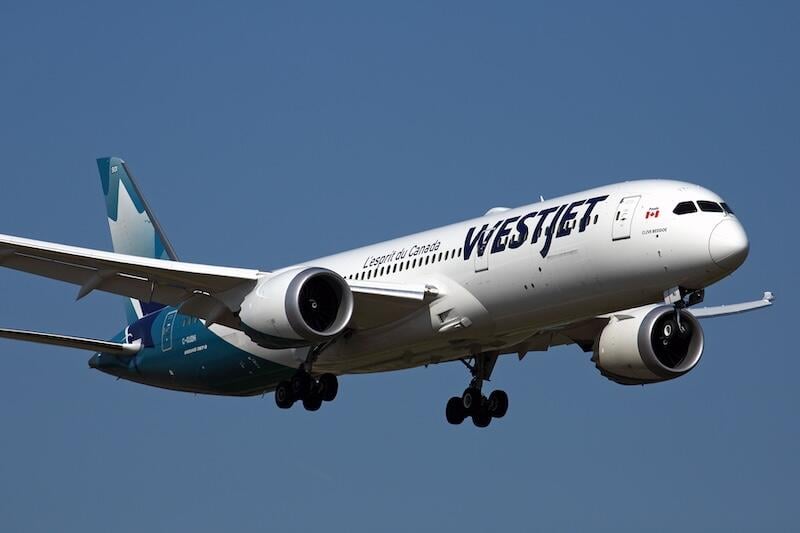
WestJet plans to launch its first route to Brazil in November, marking a broader pivot by Canadian airlines toward Latin America as demand for U.S. leisure travel remains weaker.
The airline will offer three flights per week between Calgary International Airport and Sao Paulo Guarulhos International Airport from Nov. 8, pending government approvals. The route will be operated with Boeing 787-9 aircraft and become the carrier’s 100th nonstop destination from Calgary, its largest hub.
“Our first flight between Western Canada and South America is the beginning of an exciting chapter in WestJet's Calgary story,” WestJet Group CEO Alexis von Hoensbroech says. “From our very first flight in 1996 to 100 nonstop destinations on four continents, this city has stood alongside us every step of the way.”
Through a partnership with LATAM Airlines Group, WestJet says passengers will gain access to more than 30 onward destinations across the continent, including Lima, Santiago, Buenos Aires, Rio de Janeiro and Montevideo.
The move comes amid a wave of new capacity in the Canada-Brazil market. Air Canada launched a winter seasonal service between Toronto Pearson and Routes Americas 2026 host Rio de Janeiro Galeao International Airport (GIG) in December 2025, complementing its existing Sao Paulo flights from Toronto and Montreal. Air Transat is also set to enter the Brazil market for the first time in February with two new routes to GIG from Toronto and Montreal.
By mid-February, total two-way weekly seat capacity between Canada and Brazil is expected to reach about 10,900 seats, a record high, according to OAG Schedules Analyser data. Air Canada will account for roughly 82% of that capacity, with Air Transat accounting for the remainder.
Sabre Market Intelligence data shows that O&D traffic between Canada and Brazil totaled about 348,500 two-way passengers in the year to June 2025, down 3.4% from the previous 12 months. Toronto–Sao Paulo was the largest city pair with about 75,000 two-way passengers, while Calgary–Sao Paulo ranked seventh with roughly 9,700.
WestJet’s entry into the market reflects a broader reallocation of capacity by Canadian carriers toward Latin America and the Caribbean. As demand from Canada to U.S. leisure destinations softened in early 2025 amid trade policy shifts and geopolitical tensions, airlines began redeploying aircraft to warmer-weather destinations farther south.
OAG data shows there will be about 2.35 million two-way seats between Canada and Latin America and the Caribbean in January 2026, up 5.8% year on year. WestJet’s capacity is up 81% compared with a year earlier, driven in part by the integration of Sunwing into its network and the addition of new routes. Air Canada’s Latin America capacity is up 22%, while Porter Airlines has launched its first services to destinations such as Cancun, Puerto Vallarta, Nassau, Grand Cayman and Liberia.
By contrast, transborder capacity between Canada and the U.S. is down 9.7% year on year. WestJet’s U.S. capacity is down 17%, while Air Canada has cut 9% and Air Transat 38%.

Related Content