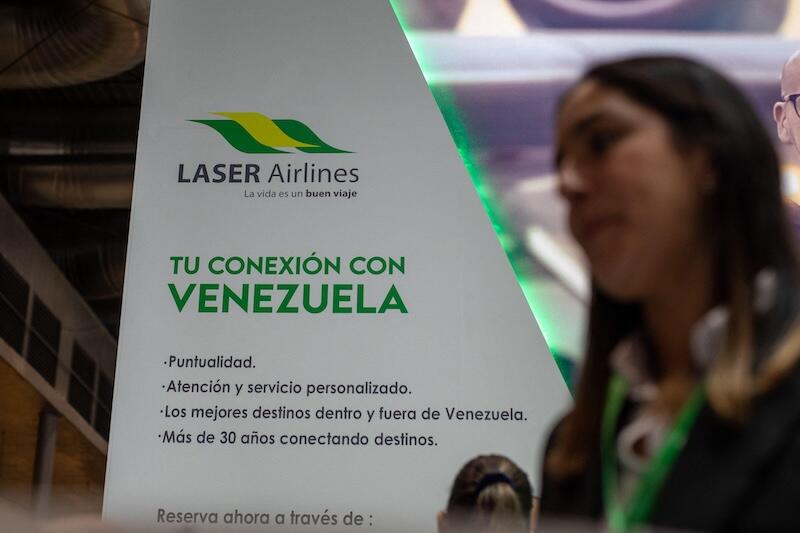
Venezuela’s Laser Airlines has revived a bid to enter the U.S. market, asking federal regulators to act on a longstanding application as Washington reassesses its relationship with Caracas following the recent U.S. military operation in the country.
The carrier said it was seeking renewed consideration of its request for a foreign air carrier permit and a two-year exemption “due to the latest events in the government of Venezuela” after the Jan. 3 U.S. capture of President Nicolás Maduro.
Laser first applied in October 2011 for authority to operate scheduled service between Caracas and Fort Lauderdale and charter flights from several Venezuelan cities to South Florida. “The department did not take action on Laser’s 2011 application,” the airline’s filing said. The carrier updated the request in August 2018 and again in February 2021, also without a U.S. Transportation Department (DOT) decision.
Under the latest update, Laser is seeking authority to operate scheduled and charter flights between Caracas, Valencia and Maracaibo and Miami. It said it would aim to launch 2X-daily nonstop service within 90 to 180 days of approval, using McDonnell Douglas MD-80-series aircraft. Laser added that “depending on the success” of the routes, it may up-gauge to larger-capacity Boeing 767 aircraft at a later date.
The filing comes as U.S.-Venezuela relations are in flux following the capture of Maduro, intensified enforcement of oil sanctions, and a broader reassessment in Washington of diplomatic, economic and security engagement with Caracas.
Commercial air service between the U.S. and Venezuela has remained suspended since 2019, when DOT halted all flights citing safety and security risks. Some U.S. airlines continue to overfly Venezuelan airspace on routes to other parts of South America, but no scheduled passenger service currently links the two countries.
Laser argued that its proposal remains consistent with longstanding bilateral frameworks. The carrier also framed the service as economically and socially beneficial.
“Approving Laser Airlines’ request is also in the public interest, as it would promote aviation relations between the U.S. and Venezuela, as well as provide vital air services to the U.S.-Venezuela traveling public,” the filing said, adding that it would help facilitate “shipments of much-needed humanitarian cargo.”
However, Laser acknowledged that significant regulatory hurdles remain. “Foreign air carriers cannot simply apply on their own to fly to the U.S.—their home government must first designate them under an applicable bilateral or multilateral agreement,” the airline said.
It added that Venezuela would need to secure or update an air transport services agreement with the U.S., regain FAA Category 1 safety status, and meet Transportation Security Administration requirements before the application could move forward.
OAG Schedules Analyser data shows that Laser currently operates eight domestic routes within Venezuela as well as three international services from Caracas to Bogota, Curacao and Madrid. The airline has six aircraft in service, according to the CAPA Fleet Database, comprising one MD-81, four MD-82s and one MD-83.

Related Content