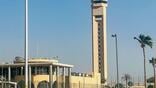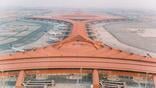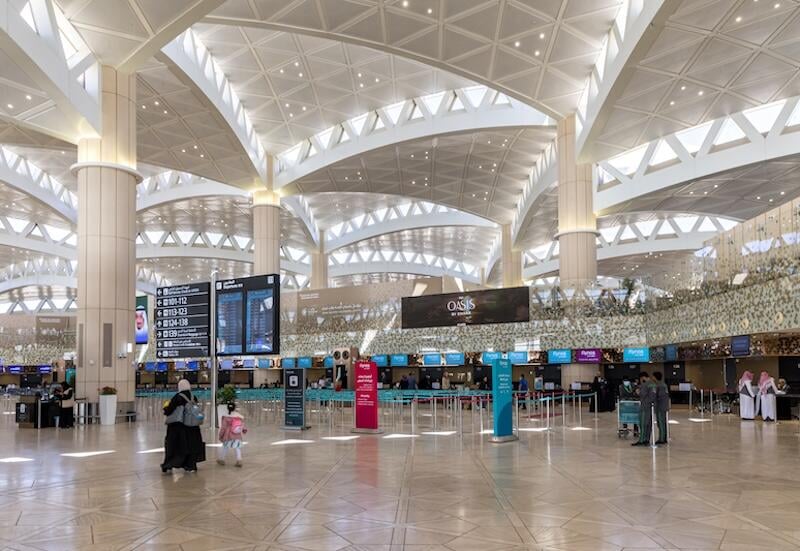
Terminal 1 of King Khalid International Airport in Riyadh, Saudi Arabia.
Airlines are facing mounting disruption across Saudi Arabia after repeated airport missile attacks, with Riyadh’s main gateway still closed, flights canceled at Jeddah and Dammam, and aviation regulators warning of risks to aircraft using Saudi airspace.
Riyadh’s King Khalid International Airport (RUH) remained shut on Oct. 12 after Saudi Arabia’s General Authority of Civil Aviation (GACA) extended the suspension to check the “safety and operational readiness” of airport facilities. The authority gave no indication of when flights would resume.
The decision followed an Oct. 11 strike on Terminal 4 that killed one person and injured 11 others. An attack the previous day killed 13 people and injured more than 300. Yemen’s Iran-aligned Houthis claimed responsibility for the attacks, having previously warned “all global airlines” to avoid Saudi Arabian airspace.
GACA also confirmed an attack on Dammam’s King Fahd International Airport (DMM) late Oct. 11 and said damage assessments and safety inspections were underway.
Disruption has also affected Jeddah’s King Abdulaziz International Airport (JED). FlightAware data on the morning of Oct. 12 showed 116 flights canceled for that day at Jeddah—56 departures and 60 arrivals—as well as 58 at Dammam, comprising 31 departures and 27 arrivals. A total of 665 departures and arrivals had been scheduled at Riyadh.
The Arab Air Carriers’ Organization (AACO) condemned the attacks in an Oct. 12 statement on behalf of its member airlines, their CEOs and employees. It called for urgent Arab and international action to prevent further strikes.
“Civilian airports are not battlefields, civilian aircraft are not military targets, and passengers and aviation workers are not parties to armed conflicts,” AACO said. “Under no circumstances or pretext can endangering their lives, or using civil aviation as a means of pressure, intimidation or the pursuit of military or political objectives, be justified.”
Airlines had planned more than 7,700 departures from 28 Saudi airports during the week beginning Oct. 12, offering almost 1.55 million seats, according to OAG Schedules Analyser data. International flights accounted for 840,000 departure seats and domestic services for 708,900.
Much of that capacity was concentrated at the three airports now experiencing disruption. Riyadh would have accounted for 31.4% of Saudi departure seats this week, Jeddah for 37.8% and Dammam for 9.9%, giving a combined share of 79.1%.
Internationally, regional and South Asian routes account for much of Saudi Arabia’s capacity. Egypt was scheduled to be the country’s biggest overseas market this week, with 154,408 departing seats on 775 flights, followed by the UAE with 120,665 seats on 569 flights. Pakistan accounted for 85,592 seats, India for 79,075 and Turkey for 54,720.
Saudi airlines would have provided 65.1% of departure seats from the kingdom this week, but foreign carriers also have substantial schedules affected by the disruption. The largest included Qatar Airways, with 38,985 departing seats, EgyptAir with 28,789, Emirates with 28,292, Air Cairo with 25,967 and FlyDubai with 25,510.
Lufthansa Group had suspended Riyadh services until Oct. 16. With the airport still closed and security concerns continuing, a return at the end of that period remains uncertain.
The European Union Aviation Safety Agency expanded its Saudi airspace advisory on Oct. 9, widening the area where it recommended airlines avoid operations. The agency said repeated missile and drone attacks, coupled with active air defenses, increased the risk of civilian aircraft being misidentified, as well as exposure to interception activity and falling debris.
Additionally, the FAA has urged U.S. operators to exercise caution when flying to or over Saudi Arabia, citing military activity and interference with navigation systems. Its advisory remains effective through Dec. 10.
“Threats could pose a potential risk to aircraft at all altitudes, including overflight, the arrival and departure phases of flight,” the FAA said. The warning also applies to operators of U.S.-registered aircraft and comes ahead of Delta Air Lines’ planned Oct. 23 launch of Atlanta–Riyadh flights using Airbus A350-900s.

Related Content