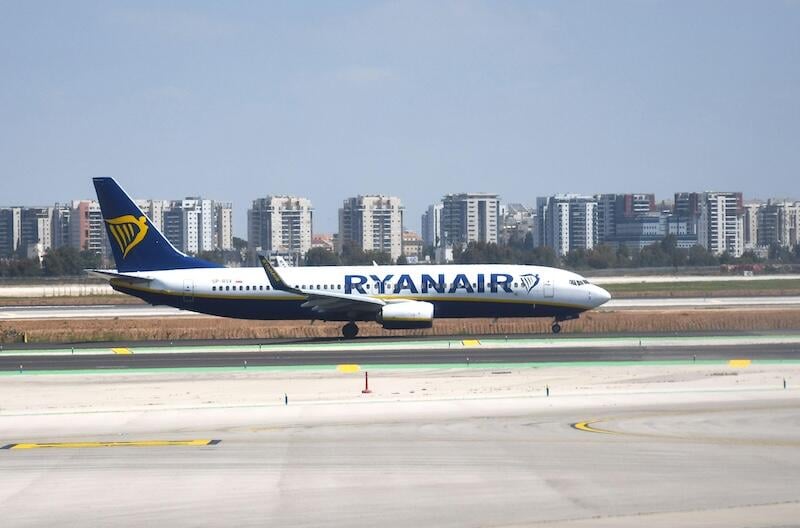
File photo of a Ryanair jet at Tel Aviv Ben Gurion Airport.
Ryanair has confirmed it will not restart flights to Israel this winter, citing unresolved disputes with Tel Aviv’s Ben Gurion Airport (TLV) over slots and the closure of its preferred low-cost terminal.
The Irish ULCC said TLV has refused to confirm its historic slots for the summer 2026 season or guarantee continued access to Terminal 1 (T1), the low-cost facility that has repeatedly been closed since the Oct. 7 attacks in 2023, which triggered widespread suspensions of international service to Israel.
“We are fed up having our low-fare flights repeatedly messed around by Ben Gurion Airport,” a Ryanair spokesperson says. “It is absurd that they refused to confirm our summer 2026 slots, when summer 2026 schedules are already on sale.”
Although Ryanair briefly resumed operations to TLV in early 2024 and again in March 2025, flights were repeatedly pulled amid safety concerns and the airport’s decision to close T1.
The carrier argues that being forced into T3, which carries higher fees, undermines its low-cost model. It says it has no objection to temporarily moving to T3 during crises but insists flights should be charged at T1 rates.
CEO Michael O’Leary previously signaled the airline was losing patience, telling reporters in September there was “a real possibility that we won’t bother going back to Israel when the current violence recedes.”
Ryanair’s ongoing absence from Israel comes at a time when rival Wizz Air has resumed flights and is seeking to establish a Tel Aviv base. The Hungarian carrier hopes to become Israel’s largest inbound European carrier and is targeting April 2026 for the base opening.
However, in August, El Al Israel Airlines called on Israel’s government to reject any plan for the planned base, warning that it would harm national resilience, undermine Israeli carriers and create unfair market conditions. It claimed that foreign carriers are exempt from stringent and costly security requirements that apply to Israeli operators.
According to OAG Schedules Analyser data, Ryanair served 21 Tel Aviv routes in September 2023, offering 26,402 two-way weekly seats and accounting for about 4.2% of Israel’s total capacity. Paphos, Budapest and Vienna were among its highest-frequency markets. Wizz, by comparison, had an 8.1% capacity share.
The latest Tel Aviv decision comes as Ryanair also scales back in Rome. The ULCC says it will reduce its Rome-based fleet from 17 to 16 aircraft for winter 2025-26, blaming a daily cap of 65 flights at Ciampino and rising airport charges at both Ciampino and Fiumicino airports.
Additionally, it cited the Italian government’s increased municipal tax on air travel from April 2025.
Israel Airports Authority and Aeroporti di Roma have been approached for comment.