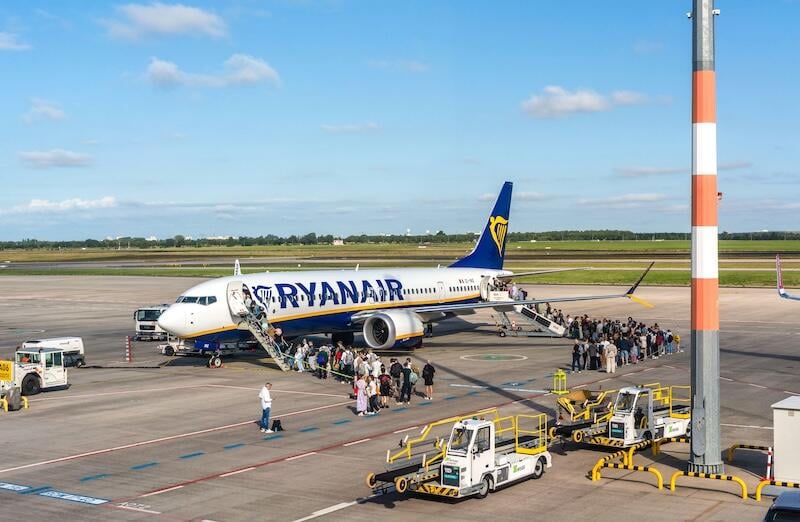
Ryanair passengers boarding at Berlin Brandenburg.
Ryanair plans to close its Berlin base and halve capacity at the airport from winter 2026-27, citing rising costs and an uncompetitive operating environment.
The Irish ULCC says it will shut its seven-aircraft base at Berlin Brandenburg Airport (BER) on Oct. 24 and reduce flights to and from the German capital by 50% in its winter schedule. The airline expects its Berlin traffic will fall from about 4.5 million passengers to 2.2 million in 2027 as a result of the changes.
Ryanair CEO Eddie Wilson attributed the decision to rising airport charges and what the airline describes as a burdensome tax environment. “We regret to announce this planned closure of our seven-aircraft Berlin base ... but we have no alternative following the airport’s latest 10% fee increase to its already high airport fees,” he says.
According to the airline, airport charges at BER have risen by about 50% since 2019, with further increases planned through 2029. Ryanair also pointed to high aviation taxes, security charges and air traffic control fees in Germany, arguing that these costs have undermined the country’s competitiveness.
Germany has recently moved to ease some cost pressures, with the federal government approving a reduction in air passenger taxes from July—cutting taxes by up to about €11 ($12.90) per passenger depending on route length.
However, speaking to Aviation Week in Vienna earlier this week, Ryanair Group CEO Michael O’Leary was blunt in his assessment of the market. “Germany is the least productive economy in Europe,” he said. “In terms of aviation, it is the most expensive aviation economy, it has the highest aviation taxes, the highest [air traffic control] fees and the highest airport fees.”
Ryanair’s withdrawal highlights ongoing challenges in Germany’s aviation sector, where traffic recovery has lagged pre-pandemic levels. BER handled about 26.1 million passengers in 2025, compared with 36 million in 2019. O’Leary was particularly critical of the capital’s outlook, saying, “Berlin is just a waste of time.”
Despite the base closure, Ryanair will continue to serve Berlin using aircraft based elsewhere in its European network. However, the scale of operations will be reduced. During the winter 2025-26 season, the airline offered about 958,000 departure seats from BER across 38 routes, making it the airport’s largest carrier with a 16% market share, according to OAG Schedules Analyser data.
Ryanair says affected Berlin-based staff have been notified, with consultations set to begin. The airline adds that employees will be offered opportunities to transfer to other bases within its network as capacity shifts to what it describes as more competitive markets.
BER said it was “surprised” by the announcement and disputed Ryanair’s claims regarding rising airport charges, stating that its fees are in the European mid-range. However, the airport acknowledged that broader cost pressures—particularly government-imposed taxes and fees—remain a challenge for German aviation.
While describing the cuts as “very regrettable” for passengers, a spokesperson highlighted ongoing growth from carriers such as Eurowings and Wizz Air and added that Ryanair is currently building a maintenance hangar at BER, due to open in August.


Related Content