Germany’s aviation market is set to contract during the northern winter 2026-27 season, with a further reduction in domestic flying outweighing growth on several international markets.
Airlines are scheduled to offer about 47.95 million departure seats from German airports between late October and late March, down 1.3% from 48.56 million during winter 2025-26, according to OAG Schedules Analyser data.
The number of departures will fall more sharply, declining 3.9% to approximately 260,500. As a result, the average number of seats per flight will rise from 179 to 184, pointing to fewer regional services and the use of larger aircraft.
Germany’s domestic market accounts for virtually the entire reduction. Capacity on internal routes will fall 8.8% to 6.43 million seats, while international capacity remains broadly flat at 41.52 million.
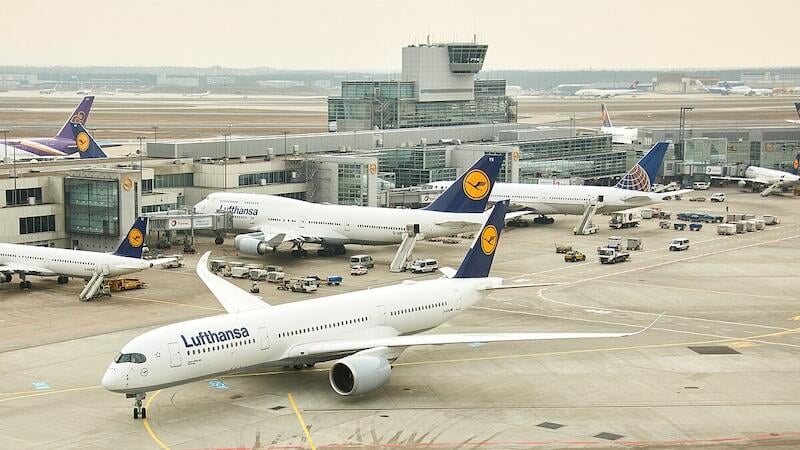
The weakness is reflected at the country’s three largest airports. Frankfurt Airport (FRA) will offer about 14.72 million departure seats, down 2.7%, while Munich Airport (MUC) falls 2.4% to 9.9 million. Capacity at Berlin Brandenburg Airport (BER) declines 1.7% to 5.81 million. Together, the three gateways account for almost 64% of Germany’s scheduled departure capacity.
More News And Analysis From Routes World 2026
However, the picture is more positive at several secondary airports. Dortmund Airport (DTM) records the strongest growth among Germany’s larger gateways, with capacity rising 24.3% to approximately 852,100 seats. Düsseldorf Airport expands 4.2% to 4.5 million seats, while Cologne Bonn Airport grows 6.7% to 1.94 million.
Memmingen and Düsseldorf Weeze also post double-digit increases of 11.3% and 16.7%, respectively. By contrast, Stuttgart contracts 12.8%, Bremen falls 17.7% and Frankfurt Hahn declines 19.1%.
Lufthansa remains Germany’s largest airline by some distance, offering 13.64 million departure seats from/within the country and accounting for 28.4% of the market. However, its mainline capacity is scheduled to fall 9.3%.
Part of the reduction reflects a redistribution of flying within Lufthansa Group, with Eurowings increasing capacity 4.6% to 4.65 million seats. Elsewhere, Condor is growing 5.5% to 2.22 million, but Ryanair is reducing its German capacity 9.9% to 3.16 million departure seats.
International growth is concentrated in leisure and VFR markets. Spain remains the largest international destination country with 5.4 million seats, up 3.3%, while Turkey grows 4.9% to 3.77 million. The UK ranks third despite capacity falling 5.2% to 2.92 million.
Among the fastest-growing country markets are Albania, up 26.2%; Morocco, up 25.1%; China, up 17%; and Portugal, up 8.2%. Those gains are offset by reductions to Switzerland, France and Ireland, where capacity declines 11.4%, 7.9% and 22.3%, respectively.

Related Content