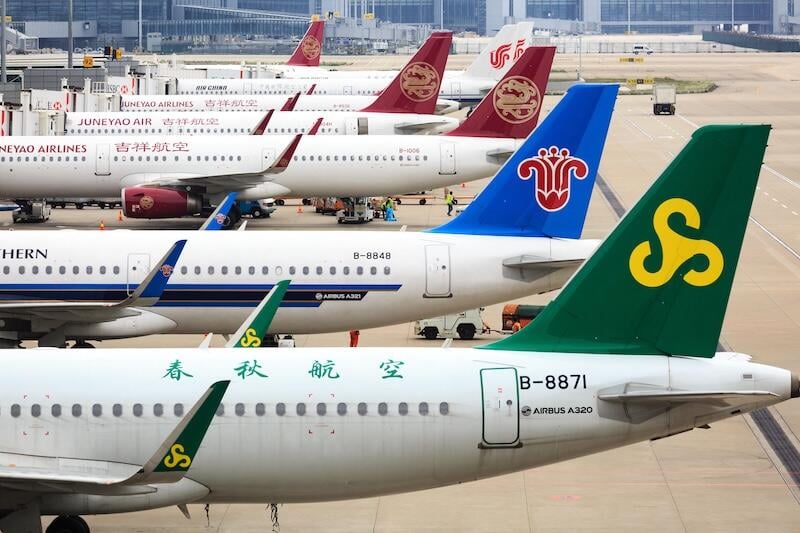
Asia-Pacific airlines have entered the second quarter (Q2) of 2026 facing a mixed operating environment, with strong passenger demand and capacity growth offset by rising fuel costs, airspace constraints and geopolitical uncertainty affecting long-haul operations.
Capacity across the Asia-Pacific region continues to grow steadily. According to OAG Schedules Analyser data, airlines are scheduled to operate about 588.4 million departure seats in Q2 2026, up from 560.9 million a year earlier. Domestic markets remain the largest segment, accounting for more than 422 million seats, with China continuing to dominate regional capacity growth.
China alone accounts for more than 218.9 million domestic seats in the quarter and is scheduled to grow capacity by about 7.2% year on year. Other markets showing strong growth include the Philippines, Thailand and Hong Kong, reflecting continued recovery in leisure travel and regional connectivity.
At the airline level, Chinese and Indian carriers dominate the region by capacity. China Southern Airlines is the largest airline in Asia-Pacific in Q2 2026 by seats, followed by China Eastern Airlines and IndiGo, which has continued rapid expansion and recently named IATA Director General Willie Walsh as CEO. Air China and All Nippon Airways complete the top five carriers in the region.
Demand trends remain broadly positive across both passenger and cargo markets, supported by economic growth and strong leisure travel demand. The Association of Asia Pacific Airlines (AAPA) said international passenger and cargo traffic both grew strongly in early 2026, although the outlook has become more uncertain due to geopolitical developments.
“Against a backdrop of steady global economic growth, combined figures for the first two months of the year showed a firm 6.3% increase in the number of international passengers carried by the region’s airlines to 69 million, supported by strong travel demand across Asian economies,” says Subhas Menon, AAPA director general.
More News And Analysis From Routes Asia 2026
However, the operating environment has become more challenging since late February due to escalating conflict in the Middle East, which has affected fuel prices and airspace availability on key long-haul routes between Asia and Europe.
“Asian airlines are facing increased operational challenges, as the rise in conflicts has reduced the availability of airspace, particularly along key Asia-Europe corridors, effectively constraining capacity on these routes and limiting network flexibility for affected carriers,” Menon says.
Fuel prices have risen sharply as a result of the conflict, increasing operating costs across the region and forcing some airlines to adjust their networks. Cathay Pacific has increased fuel surcharges in response to volatile fuel prices, while Philippine LCC Cebu Pacific has suspended several routes and reduced frequencies on others to mitigate rising fuel costs.
The airline said the adjustments were necessary because fuel costs have “more than doubled” compared with 2025 averages, highlighting the pressure on low-cost carrier business models in particular.
Geopolitical tensions are also affecting capacity deployment within Asia. Capacity between China and Japan has fallen sharply due to political tensions between the two countries, with airlines redeploying aircraft to Southeast Asia markets such as Thailand, Malaysia and Vietnam, where demand growth remains strong.
Overall, the Asia-Pacific airline industry in Q2 2026 is characterized by strong demand and continued capacity growth, particularly in domestic and regional markets, but profitability remains under pressure due to rising fuel prices, longer flight routings and geopolitical uncertainty. Airlines across the region are continuing to expand, but are doing so cautiously as costs rise and the global operating environment becomes more volatile.

Related Content