New York John F. Kennedy International Airport’s (JFK) new Terminal 6 (T6), set to open next year, will be served by all-electric ground handling vehicles to be shared by airlines operating at the passenger terminal.
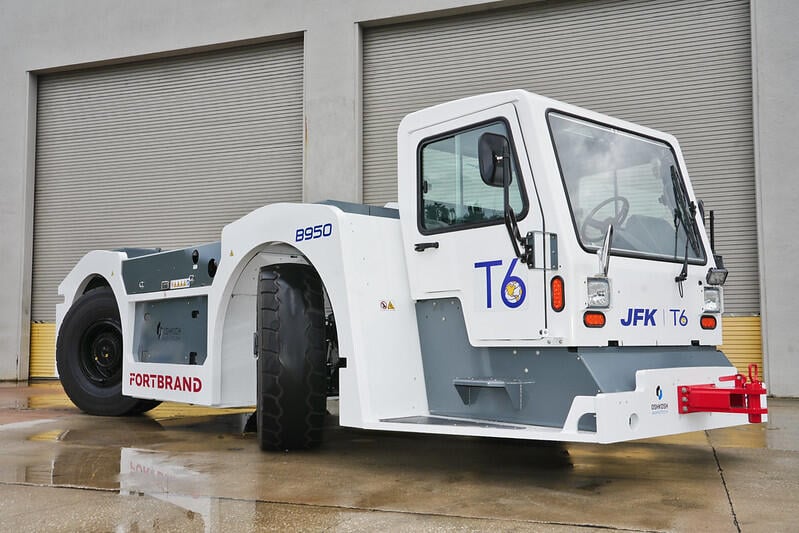
JFK Millennium Partners (JMP), the private consortium building the $4.2 billion T6, signed a contract with airport ground support and airfield maintenance firm Fortbrand for equipment and management services. “Each of the terminal’s 10 gates will have its own set of electric ground support equipment, which will be shared by ground handlers operating at the terminal in a common-use setup,” the Port Authority of New York and New Jersey said. “The equipment will be monitored and tracked by JMP and Fortbrand in real time to ensure operational compliance while maximizing safety and efficiency.”
JMP is a private consortium led by airport developer Vantage Group and including JFK-based JetBlue Airways. Under a private-public partnership (P3) model, JMP will operate T6 under a long-term lease with the port authority.
T6 will replace the current Terminals 6 and 7. The new terminal on JFK’s north side will partially open in 2026 with six gates, with four more added by the time construction is fully completed in 2028. Nine of the 10 gates will be able to accommodate widebody aircraft.
JetBlue will operate from T6, which it sees as complementary to Terminal 5—nearly entirely dedicated to JetBlue operations—to which it will be connected. Other airlines signed on to operate from T6 include U.S. ULCC Frontier Airlines and a host of foreign carriers: Aer Lingus, Air Canada, All Nippon Airways, Austrian Airlines, Avianca, Brussels Airlines, Cathay Pacific, Condor, Kuwait Airways, Lufthansa, Norse and Swiss International Air Lines.
The port authority said the electric T6 ground support fleet “will eliminate around 2,500 metric tons of [carbon dioxide] emissions annually.”
The authority noted Fortbrand’s equipment will be used in place of vehicles traditionally powered by diesel fuel. It added the common-use pool of ground support vehicles will lead to efficiencies beyond emissions reductions.
“Currently, airlines operating in the U.S. contract individual ground handling companies to service their aircraft with their own set of equipment, often leading to duplicate equipment, inefficiencies, airside congestion and unnecessary emissions,” the authority said.
JMP COO Karen Ali said the electric fleet “will be a game changer for our airlines and underlines our company’s commitment to sustainable operating practices throughout our terminal.”
On-site and remote charging stations “will ensure the equipment is fully charged, while innovative telematics software will communicate the equipment’s real-time GPS location, battery life, authorized drivers, speed controls, maintenance reporting and more,” the authority added.