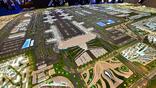
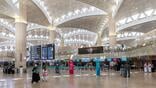
Dubai World Central passenger terminal
The Dubai government awarded a contract to Mitsubishi Heavy Industries (MHI) to build a massive, automated people mover (APM) train system for Al Maktoum International at Dubai World Central (DWC), the hub scheduled to replace Dubai International Airport (DXB) in the early 2030s.
The DWC train will be by far the largest airport APM in the world, extending 50 km (31 mi.) with nine stations. It will have 165 cars.
The Dubai government awarded a contract to Mitsubishi Heavy Industries (MHI) to build a massive, automated people mover (APM) train system for Al Maktoum International at Dubai World Central (DWC), the hub scheduled to replace Dubai International Airport (DXB) in the early 2030s.
The DWC train will be by far the largest airport APM in the world, extending 50 km (31 mi.) with nine stations. It will have 165 cars.
As a point of comparison, Dallas-Fort Worth International Airport’s APM—currently the largest airport train system in the world—stretches 4.8 mi. Hartsfield-Jackson Atlanta International Airport—the only airport in the world that handled more passengers than DXB last year—has a “Plane Train” spanning 2.8 mi with 73 cars. Los Angeles International Airport (LAX) is currently building a $1 billion APM train that will have 2.25 mi. of track and 44 cars.
The specific locations of DWC train stations were not disclosed, including how far from the airport the system could extend. For example, the LAX APM will connect the airport to Los Angeles’ metro rail system. DWC’s master plan calls for the airport to ultimately have an area of 70 km2 (27 mi.2).
System completion is scheduled for December 2031, ahead of the planned full opening of DWC in 2032.
“The APM system will connect the airport’s terminals and major facilities ... [and] shorten travel times, while contributing to efficient airport operations to meet future increases in aviation demand,” MHI said.
DWC opened in 2010 for cargo flights; passenger service started in 2013. The airport currently has one runway and a terminal with capacity for around 26 million passengers annually.
DWC is slated to have 400 aircraft gates and five parallel runways. A 128 billion United Arab Emirates dirham ($35 billion) terminal is being built, which is expected to grow the airport’s capacity to 150 million annual passengers. The airport is targeting an eventual capacity of 260 million annual passengers.
DXB, the home hub of Emirates Airline, was the second busiest passenger airport in the world in 2025, handling 95.2 million passengers, up 3.1% over 2019 and up 10.2% compared to 2019. Dubai officials have said DXB’s growth is constrained by a two-runway system that does not allow parallel arrivals or departures.
DXB passenger numbers this year are depressed by the impact of the Iran war, but Dubai Airports CEO Paul Griffiths said at the recent Farnborough Airshow that he expected traffic to fully recover, adding the expansion of DWC is “firmly on track.”
Larsen & Toubro, an engineering and construction conglomerate based in India, will partner with MHI on the DWC APM project. MHI will handle design, procurement and testing for the 165 cars and signaling equipment and manage overall APM system integration. Larsen & Toubro will be responsible for the construction of other subsystems.
MHI built DXB’s Terminal 3 APM, which went online in 2012.

Related Content