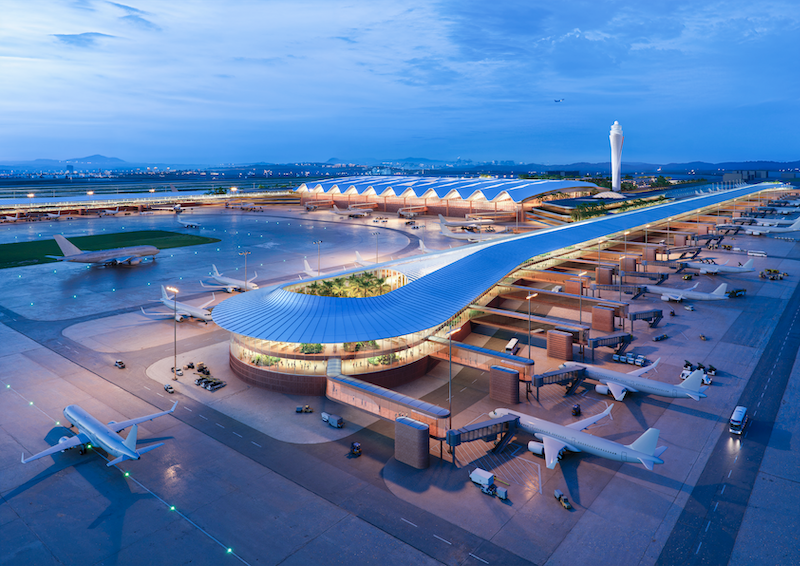
Gia Binh International Airport concept image.
Gia Binh International Airport’s (GBIA) main passenger terminal is targeted to begin commercial operations in 2029, launching with an airline recruitment strategy designed to establish the new Vietnamese gateway as a transfer hub rather than simply an alternative airport for Hanoi.
The airport, under construction in Bac Ninh province about 40 km (25 mi.) east of central Hanoi, is planned to handle 30 million passengers annually during its first phase, rising to 50 million by 2050. Official plans also provide capacity for 1.6 million metric tons of cargo annually by 2030.
A smaller VIP terminal is scheduled to open during the second quarter of 2027 to support Vietnam’s hosting of the Asia-Pacific Economic Cooperation summit. Commercial operations at the main terminal would follow as the wider first phase is completed.
“The main passenger terminal will then commence commercial operations as part of phase one, currently targeted for 2029,” said Denis Bugrov, deputy CEO of the airport’s developer, Masterise Aviation Infrastructure.
Gia Binh’s initial network priorities are expected to include domestic trunk routes to Ho Chi Minh City, Da Nang and other major Vietnamese cities, alongside international service to Northeast Asia, Southeast Asia and India.
However, the longer-term strategy is focused on developing connections to Europe, North America and Australia, addressing gaps in Hanoi’s existing long-haul network. Masterise estimates that the 30 largest unserved international markets from Hanoi generate about 4 million annual passengers, including approximately 2.1 million traveling to and from Europe and 1.9 million in Americas markets.
“GBIA’s ambition is not simply to have more routes,” Bugrov said. “We want to build a network in which domestic routes generate passenger feed, regional routes provide feed traffic and the long-haul network creates international transfer capability.”
The airport is working with McKinsey and daa International on its operating and network model. The strategy calls for a banked schedule centered on an anchor carrier, with domestic and regional arrivals timed to connect with long-haul departures.
Gia Binh is targeting minimum connecting times of no more than 60 min., compared with about 90 min. at Hanoi Noi Bai International Airport. Domestic and international passengers would be able to connect within the same terminal using dedicated airside flows and transfer-security facilities.
“Most importantly, GBIA will build its transit hub through its operating model, not simply through the number of routes,” Bugrov said.
Management expects connecting passengers to represent about 7% of traffic at opening, potentially rising to 20% by 2035. That would equate to more than 10 million transfer passengers annually if the airport reaches its traffic objectives.
The commercial strategy is not limited to a single airline model. Gia Binh is pursuing full-service network carriers, long-haul operators, LCCs and cargo airlines simultaneously. A proposed Founding Airline Program would offer early participants priority access to slots, contact gates and widebody parking positions, as well as assistance with aircraft basing and station development.
Airline incentives will include co-marketing campaigns, route launch support such as inaugural flight events and joint promotion, and destination marketing with tourism and trade partners.
Surface access will be important to positioning Gia Binh as part of the wider Hanoi aviation market. A new expressway is intended to place the airport about 30 min. from central Hanoi, with high-speed rail and metro connections also envisaged.
Technology plans include biometric passenger processing, automated baggage handling and a Total Airport Management Platform intended to integrate airline, airport and ground-handling decisions. The operating model targets a 40-min. narrowbody turnaround and a 60-min. transfer process.
Gia Binh’s passenger terminal is being developed as part of a broader dual-use airport project. Construction of facilities needed for the 2027 APEC summit forms the first immediate milestone, while the full initial phase is officially scheduled for completion by 2030.
By its fifth year of commercial operation, management wants Gia Binh to have established direct service to North America, Europe and Australia, with approximately 10 to 14 long-haul routes.
“The ultimate goal is to establish GBIA as an international connecting point capable of attracting and transferring passenger and cargo flows between Vietnam, the region and the world,” Bugrov said.

Related Content