Higher fuel costs and the challenge of absorbing a 25% increase in seat capacity contributed to a near €200 million ($231 million) first quarter net loss at Wizz Air, which is continuing to shift flying from longer Middle Eastern sectors into European markets.
The Hungarian ULCC reported a net loss of €198.2 million for the three months to June 30, compared with a €38.4 million profit a year earlier. Revenue rose 5.5% to €1.51 billion, but Ebitda fell 50.9% to €147.4 million, and the airline swung to an operating loss of €183.3 million. Fuel expenditure increased 39.4% to €610.5 million.
Bernstein analysts said the net loss was worse than the €142 million consensus forecast, with revenue 1.5% below expectations and Ebitda missing by 13%.
However, the airline carried 21.2 million passengers during the quarter, up 25.1%, on a 25.4% increase in seat capacity. Available seat kilometers rose by 14.9%, reflecting an 8.4% reduction in average stage length to 1,592 km (989 mi.).
Wizz has been reallocating aircraft from longer Middle Eastern sectors to its core Central and Eastern European markets, alongside an expansion of domestic flying in Italy and, from the coming winter season, Spain.
“We are deliberately descaling medium-haul, like Middle Eastern operations, and we are deliberately scaling up domestic flying,” CEO József Váradi said on an earnings call following the publication of Wizz's fiscal 2027 first quarter results.
The move toward shorter routes has enabled Wizz to operate more sectors and offer more seats with each aircraft, but it has also created capacity that requires lower fares to stimulate demand. Chief Commercial Officer Ian Malin said the airline currently has almost 300 routes less than one year old, compared with about 70 to 80 a year ago.
“We have to digest the growth, and we have to deploy it because the alternative of parking capacity is not acceptable because we’re paying for the aircraft,” Malin said. “Growth equals value, and growth today is value tomorrow.”
Load factor held broadly steady at 90.9%, down 0.2 percentage point, but revenue per available seat kilometer fell 8.1%. The company attributed the weakness to the volume of new capacity, competitive pricing, the timing of Easter and disruption caused by the Middle East conflict.
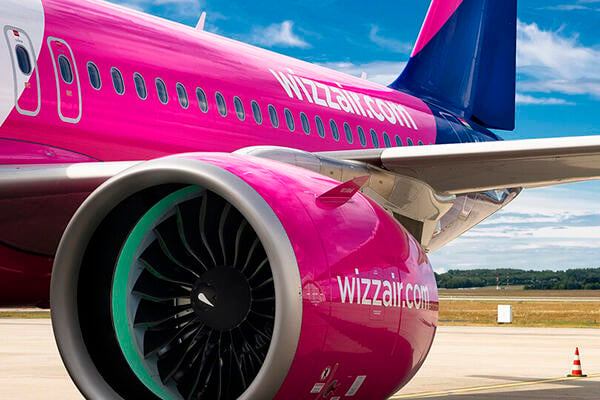
Wizz took delivery of eight Airbus A321neos and two A321XLRs during the quarter and returned two A320ceos. It said its total fleet reached 270 aircraft, of which 78% were new-generation models, with an average age of 4.6 years. Two A321neo deliveries previously expected during the current fiscal year have been deferred until fiscal 2029. Wizz plans to retire or return 24 current-generation A320-family aircraft during fiscal 2027, up from 16 last year.
Pratt & Whitney geared turbofan engine groundings also continued to ease. Wizz had 27 aircraft out of service at the end of June, down from 41 a year earlier. It expects 15-20 aircraft to remain grounded at the end of fiscal 2027 and is targeting the return of the entire affected fleet by the end of the 2027 calendar year.
“The single biggest issue [in recent years] is the GTF grounding,” Váradi said. “If you really think about the level of disruption to the business and the extent to which it has affected financial performance—on the cost side, on the revenue side and on the balance sheet—it has been hugely disruptive. And 18 months from now, we are out of it.”
Network expansion during the coming winter season will include new bases in Madrid, Santiago de Compostela and Valencia, where Wizz plans to station five aircraft and open 15 domestic and three international routes. A base in Pristina, Kosovo, is also scheduled to open in November.
“We’ve embarked on additional domestic flying in Italy, and now with Spain coming online, that capacity will become more mature within less than a year,” Malin said. “That means you will see margin expansion coming from it.”

Related Content