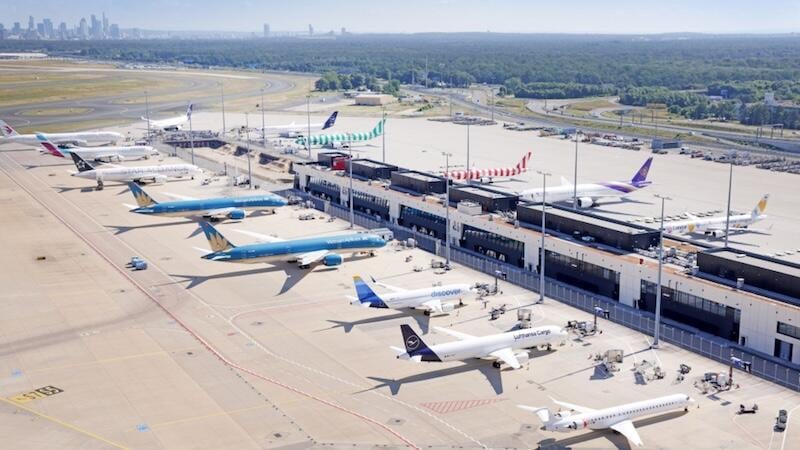
Fraport has established interim emissions targets for 2030 and 2040 as it works toward achieving net-zero Scope 1 and Scope 2 emissions across its fully consolidated airport portfolio by 2045.
The airport operator’s Decarbonization Reference Plan covers emissions generated by assets and energy use under Fraport’s direct control. It does not include aircraft operations or airline fleet decisions.
Under the plan, group-wide Scope 1 and Scope 2 emissions are targeted to fall from a 2023 baseline of 184,733 metric tons of carbon dioxide equivalent to 95,000 tons in 2030. The total would then decline to 40,000 tons in 2040 before reaching net zero five years later.
The 2030 target represents a reduction of approximately 49% from the baseline, while the 2040 goal equates to a decrease of about 78%.
“An airport operator can make direct progress by reducing the emissions it directly controls,” Fraport Chief Operating Officer Dietmar Focke told Routes.
At Frankfurt Airport, Fraport is targeting Scope 1 and Scope 2 emissions of 50,000 tons in 2030 and 25,000 tons in 2040, followed by net zero in 2045.
The planned reductions will rely on lower energy consumption, renewable energy generation and procurement, vehicle and ground-support equipment electrification, and improvements to the energy performance of buildings and technical systems. Fraport also plans to expand infrastructure for alternatively powered vehicles and equipment.
More News And Analysis From Routes World 2026
“Digitalization and automation are not ends in themselves; they must simplify processes and improve the use of shared infrastructure,” Focke said.
The challenge is to deliver the reductions while Fraport continues investing in additional airport capacity. Frankfurt’s new Terminal 3 began operations in April with annual capacity for as many as 19 million passengers, expandable to 25 million.
Other capacity projects across the group include developments at Lima and Antalya, as well as investments in Greece and Brazil. Fraport said passenger growth during the first half of 2026 was particularly strong at Porto Alegre, up 19.2%; Ljubljana, up 14.7%; its Bulgarian airports, up 8.8%; and its Greek portfolio, up 5.4%.
The international portfolio therefore makes a group-wide approach increasingly important. Each airport faces different traffic patterns, infrastructure requirements and energy systems, but Fraport intends to apply common operational and environmental expertise while adapting implementation to local conditions.
Focke acknowledged that airports can address only part of aviation’s total environmental footprint. Airlines control aircraft and fleet decisions, while policy and fuel availability influence the industry’s broader transition.
“Airports do not control aircraft operations or airline fleet decisions, but we can reduce the Scope 1 and Scope 2 emissions under our direct responsibility and provide infrastructure that supports airlines and partners in the wider transformation of aviation,” he said.
Fraport also recognizes that some residual direct emissions could remain in 2045. Under its current assumptions, reaching net zero may therefore require permanent neutralization of those residual emissions alongside further operational reductions.
“These are specific, published targets with a defined scope, baseline, interim milestones and implementation plan,” Focke said.

Related Content