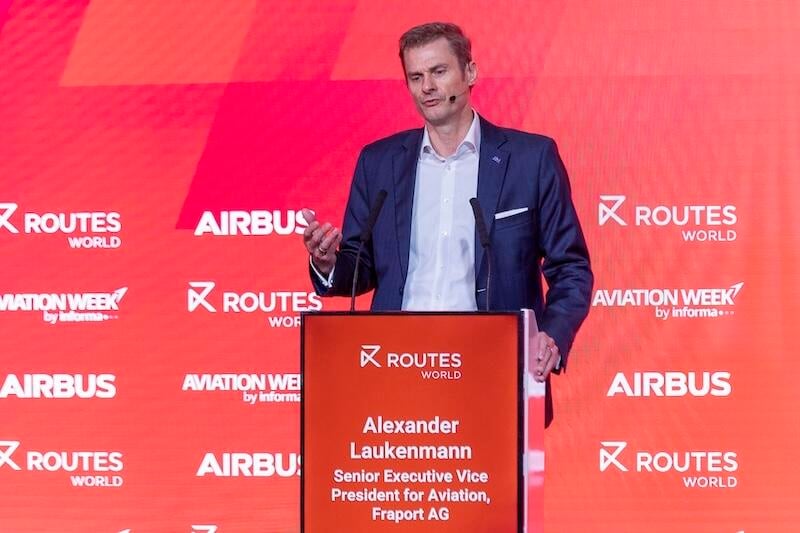
Alexander Laukenmann speaks onstage at Routes World 2026 in Frankfurt.
FRANKFURT—Despite Germany’s notoriously high aviation taxes and regulatory costs, Frankfurt Airport (FRA) is pushing ahead with an ambitious transformation centered on three priorities: growth, efficiency and quality.
Speaking at Routes World 2026 in Frankfurt, Alexander Laukenmann, senior executive vice president for aviation at Fraport AG, acknowledged the cost pressures facing Germany’s largest aviation hub but stressed the importance of focusing on improvements within the airport’s control.
“We have in Germany a special aviation tax nobody else has,” Laukenmann said, highlighting the country's challenging regulatory environment. Rather than dwell on external pressures, Fraport is concentrating on strengthening its competitiveness through investment, innovation and operational improvements.
Central to this strategy is the opening of Terminal 3, which began in April 2026 in four phases. The new terminal is home to 57 carriers from the Oneworld and SkyTeam alliances, and key Middle East connector airlines.
Condor, Frankfurt’s second hub airline, is on the docket to relocate on April 13, 2027. Condor CEO Peter Gerber says this move will be transformational, enabling more seamless operation as the airline builds out its FRA connecting hub, as well as allowing Condor to express its own branding.
More News And Analysis From Routes World 2026
The expansion also enables a wider transformation of FRA’s existing terminal infrastructure. Laukenmann describes Terminal 1, dominated by Lufthansa and Star Alliance carriers, as the airport’s “powerhouse.” It is undergoing phased modernization. Terminal 2, which opened in 1994, will be closed until the mid-2030s for comprehensive refurbishment after ending its lifespan. Laukenmann describes this as a unique gift for FRA to reimagine the new facility.
Growth is a key pillar. “We have capacity, we have possibilities,” he said, inviting airlines to explore new opportunities at the hub.
Connectivity remains Frankfurt’s greatest competitive advantage. With 47% of Germany’s population living within 200 km (124 mi.) of the airport and extensive multimodal rail and road connections, FRA offers a substantial catchment area.
For summer 2026, the airport's network encompassed 88 airlines serving 92 countries and nearly 300 destinations. North America remains its largest long-haul market, while Fraport sees further growth potential across Latin America, Asia, the Middle East and Africa.
The second pillar—efficiency—gains even more importance in a high-cost environment. Automated fast bag-drop facilities already serve around half of passengers, with some airlines achieving adoption rates of 80-90%. Advanced CT security scanners fast-tracking security, AI-powered computer vision, robotics and smart operational systems are helping improve punctuality and control costs.
The third pillar is quality. Terminal 3 introduced a renewed focus on passenger experience through its “Surprisingly German” concept, incorporating distinctive design features, children's playgrounds, stylish seating and art installations. Many of these best practices will be adopted by Terminal 1.
For Laukenmann, the three pillars ultimately support one overriding ambition: reinforcing Frankfurt’s position as a globally competitive connecting hub. “Getting you from anywhere to everywhere,” he said, summarizing the airport’s proposition to existing and prospective airline partners.

Related Content