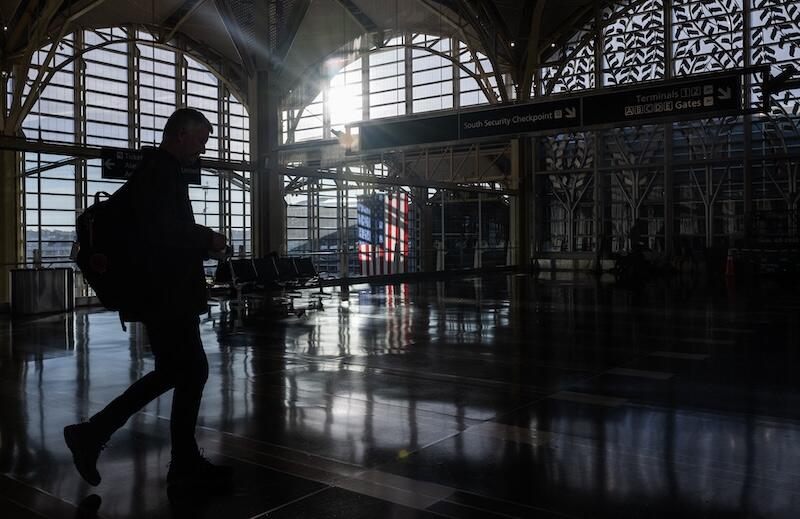
A traveler at Reagan Washington National Airport in Arlington, Virginia, on Nov. 7.
The U.S. aviation system is bracing for a steep escalation in operational disruptions as air traffic flow restrictions take effect at 40 of the nation’s largest airports, with data showing tens of thousands of flights will be cut between Nov. 7 and Nov. 14 alone.
The reductions—outlined in a U.S. Transportation Department (DOT) order issued on Nov. 6—represent the first systemwide traffic-management intervention of the ongoing U.S. federal government shutdown. Cuts begin at 4% on Nov. 7 and deepen to 10% by Nov. 14 “and thereafter,” according to the DOT.
According to analysis of OAG Schedules Analyser data, the 40 airports had 21,515 domestic departures and arrivals scheduled for Nov. 7, meaning a 4% cut equals about 861 flights. FlightAware data for the day showed 821 cancellations across the entire U.S. network as of 7 a.m. ET and nearly 600 delays.
The hardest-hit operators included regional carrier SkyWest with more than 170 cancellations, Southwest Airlines with around 120, regional carriers Republic with 83 and Endeavor Air with 80, and United Airlines with 64. Southwest also logged 125 delays as of 7 a.m. ET.
The FAA says the measures are intended to prevent further strain on the nation’s air traffic controller workforce, which has now gone more than three weeks without pay. Controllers last received a partial paycheck around Oct. 14. Many began calling in sick after their first zero-paycheck period around Oct. 28, echoing patterns from the 35-day shutdown in early 2019.
Airports on the reduction list include all major domestic hubs and international gateways, with Atlanta Hartsfield-Jackson, Chicago O’Hare, New York JFK, Los Angeles International and Dallas-Fort Worth among them.
Traffic cuts intensify through mid-November. Scheduled activity at the 40 airports totals 18,242 domestic flights on Nov. 8, implying between 729 and 1,094 cancellations depending on whether carriers adjust to the 4% or 6% threshold. On Nov. 9, reductions would hit between 887 and 1,332 flights; on Nov. 10, between 877 and 1,315; and on Nov. 11 about 1,175 flights at the mandated 6% level.
By Nov. 14, when a 10% reduction becomes mandatory, the affected 40 airports have 21,868 domestic flights scheduled—meaning 2,187 could be cut that day alone.
While the DOT’s order applies only to 40 airports, the network effects will ripple far wider. Airlines must reposition aircraft, reassign crews and redraw schedules daily—complexities that could push total disruptions well beyond the mandated cuts. Some industry estimates place potential total impacts at 3,500 to 4,000 flights per day.

Related Content