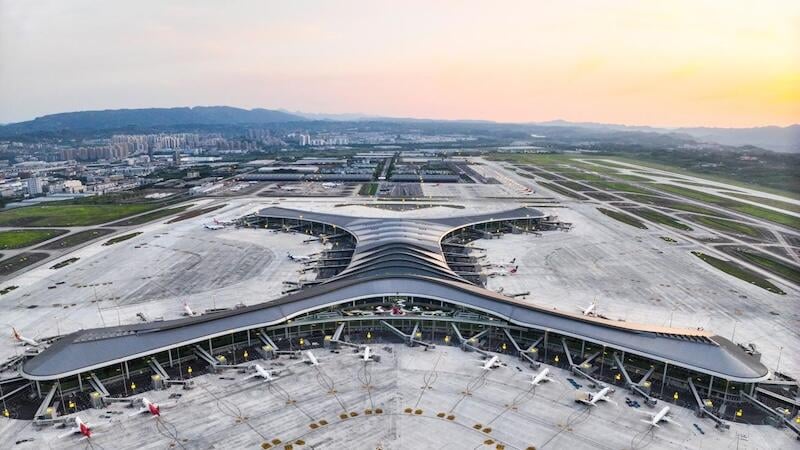
FRANKFURT—Chongqing Jiangbei International Airport (CKG) is seeking to strengthen its role as a connecting gateway between Southeast Asia and Europe, with international transfer traffic rising 50% during the first half of 2026.
The airport handled more than 435,000 international transfer passengers during the six-month period, helping total international and regional traffic increase 40% year over year to about 1.5 million.
New passenger services launched during 2026 connect Chongqing with Almaty, Kota Kinabalu, Chiang Mai and Manila, while frequencies have increased to nine destinations, including Singapore, Bangkok, Kuala Lumpur, Ho Chi Minh City and Jakarta.
The airport’s growing Southeast Asian network provides feed for flights to Europe and supports Chongqing’s ambition to become the main international gateway for central and western China.
“Moving forward, Chongqing Airport Group will prioritize the Asian and European markets, with a strategic focus on intercontinental routes, as well as air services under the Belt and Road Initiative (BRI) and Regional Comprehensive Economic Partnership (RCEP) frameworks,” Lei Biming, Chongqing Airport Group's deputy general manager, told Routes.
More News And Analysis From Routes World 2026
Chongqing is also looking to deepen its European links through partnerships with airports and airlines. During 2026, the airport group signed cooperation agreements with Brussels Airport and Milan airports operator SEA aimed at developing “dual aviation hubs” between China and Europe.
It has also agreed to an air logistics partnership with Liege Airport and established the Chongqing-Liege Overseas Air Cargo Station, its first such facility in Europe. New international freight routes have been added to Budapest, Liege, Delhi and a Cyprus-Tel Aviv routing.
The agreements build on partnerships signed with Air China and Hainan Airlines in 2025. Both carriers have been designated as key hub operators at CKG and are expected to support the development of a more competitive connecting network.
The airport’s route development strategy is closely tied to Chongqing’s position as a manufacturing and logistics center. The city forms an important part of the Chengdu-Chongqing economic region and serves as a hub for the China-Europe Railway Express and the New International Land-Sea Trade Corridor.
Inbound tourism is providing another source of traffic. More than 610,000 foreign passengers used the airport during the first half of 2026, an increase of 86% year over year. Thailand was the largest source market, followed by Malaysia, Singapore, Vietnam and Indonesia.
Chongqing received more than 300 million domestic visitors and 1.8 million international tourists between January and August. International arrivals increased 56.4% from the same period in 2025, which the airport said was the fastest rate among Chinese cities.
However, gaps remain in the airport’s international network. “Currently, the airport has yet to resume flights to South America and Africa, which constrains its position as an international aviation hub in terms of global connectivity,” Lei said.
The airport also sees room for further development in Europe, Asia, Australia and North America. However, changes in demand, tighter visa requirements in some markets and weaker consumer spending continue to affect outbound travel.

Related Content