Chongqing Airport Terminal 3B.
HONG KONG—Backed by a new terminal, a fourth runway and the launch of a second airport project, Chongqing Jiangbei International Airport (CKG) is preparing to expand its intercontinental reach.
The airport opened its Terminal 3B earlier this year, creating the first four-runway, four-terminal operation in central and western China. The expansion boosts annual capacity to 80 million passengers, 580,000 aircraft movements and 1.2 million tons of cargo throughput by 2030.
At the same time, planning is advancing for Bishan Airport, a second international facility in the city, which will focus on cargo and regional operations. Speaking at Routes World 2025 in Hong Kong, General Manager Yin Xiaohua says the dual-airport system will be developed in a complementary way to support Chongqing’s wider ambitions.
The city has also been formally designated by the Civil Aviation Administration of China (CAAC) as one of seven national gateway-composite international aviation hubs under the country’s “3+7+N” system. Yin says the policy support provides “a unique opportunity” to accelerate international expansion, with Europe and Southeast Asia identified as priority corridors for growth.

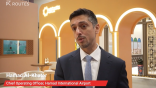
General Manager Yin Xiaohua
This year, CKG has opened five international passenger routes, including services to Auckland, Moscow, Tokyo, Kuching and Kaohsiung, alongside six new cargo links to Europe and Asia. As of September, the airport operates 35 international or regional passenger routes and 16 international or regional cargo routes. In the first half of 2025, international passenger traffic rose 36% year on year to 1.06 million, with foreign travelers accounting for 30% of the total.
Looking ahead, Yin says the airport group is prioritizing Asian and European markets while leveraging China’s Belt and Road Initiative (BRI) and Regional Comprehensive Economic Partnership (RCEP). “By the end of 2025, the group aims to expand the number of international and regional routes to over 40,” he adds.
Partnerships with Air China and Hainan Airlines signed earlier this year are central to that strategy. Yin says the agreements “designate Air China and Hainan Airlines as key hub operators at Chongqing Airport, supporting the development of a competitive route network.”
He also highlights three main opportunities: national policy support, inbound tourism growth and improved operational capacity. “Chongqing’s T3B terminal and the fourth runway have been put into operation,” he said. “The CAAC has granted approval for the airport to elevate its peak-hour capacity from 54 to 60 flights per hour, representing a meaningful improvement in traffic capability.”
Challenges remain, however. Yin says that intercontinental services to South America and Africa have not yet resumed, leaving “a considerable gap” compared to the airport’s pre-2019 five-continent coverage. He also pointed to geopolitical tensions, air traffic rights negotiations and structural changes in demand as constraints on further growth.

Related Content