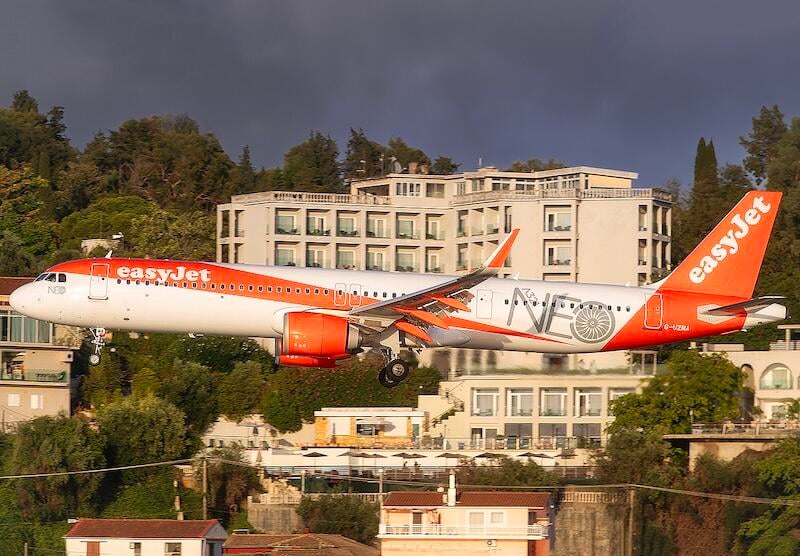
As EasyJet attracts potential takeover interest from investment firm Castlelake, analysis of the UK airline's network highlights both the strengths that may attract investors and the challenges it faces in an increasingly competitive European market.
Data provided by OAG Schedules Analyser for the summer 2026 season shows EasyJet remains Europe's second-largest airline by seat capacity, but its position has weakened compared to rivals despite network growth over the past four years.
Since summer 2022, the LCC has increased capacity from and within Europe by almost 10%, growing from 61.6 million seats to 67.7 million seats. During the period, the airline expanded its route portfolio from 913 airport pairs to 1,170, marking a rise of about 28%.
However, the broader European market has grown faster. While summer 2022 still reflected the industry’s recovery from the COVID-19 pandemic, EasyJet accounted for 7.7% of all departure seats from and within Europe that season. For summer 2026, that share has slipped to 6.9% despite the carrier adding more than 6 million seats. The decline reflects the expansion of competitors, particularly Ryanair.
Irish ULCC Ryanair increased capacity by about 26% between summer 2022 and summer 2026 and now controls 14.5% of capacity from and within Europe, up from 14.1%. Other airlines have also expanded rapidly. Turkish LCC Pegasus Airlines has grown by more than 50% during the period, while Jet2.com has increased capacity by more than 36%.
For EasyJet, growth has been concentrated around a combination of core UK markets and newer bases. Bristol has been a success story, with capacity from the airport increasing by more than 500,000 seats between summer 2022 and summer 2026. The airline now accounts for more than 54% of all European departure seats at Bristol.
The carrier has also expanded at Edinburgh, Liverpool, London Luton and Manchester, opened bases at Birmingham, Newcastle and London Southend, and continued to build its presence in Italy. Milan Linate delivered the largest airport-specific increase in capacity, adding more than 520,000 summer season seats after EasyJet became the short-haul remedy taker during the ITA Airways and Lufthansa merger. EasyJet's share of capacity at the slot-constrained airport rose from 8.5% to more than 18%.
The airline's largest base remains London Gatwick, where it operates almost 7.2 million departure seats during summer 2026. However, EasyJet's share of Gatwick capacity has fallen from 51.3% in summer 2022 to 44.2% as competitors have expanded.
Much of that growth has come from airlines targeting Gatwick's leisure market. Jet2, which launched a base at the airport in March, is currently offering 27 routes, accounting for about 2.7% of total European departure seats. British Airways has also rebuilt its Gatwick operation following its retrenchment during the pandemic, while Wizz Air's base opening in 2020 introduced additional competition on a range of European leisure and VFR routes.
Similar trends are evident at several of EasyJet's traditional strongholds. Within the European market, EasyJet's share of departure seats at Geneva has fallen from 46.7% in summer 2022 to 43.1% in summer 2026. At London Luton, where it remains the largest airline, its share has slipped from 38.3% to 35.4%, while Amsterdam has seen a decline from 8.6% to 6.5%. At Milan Malpensa, EasyJet's share of European capacity has fallen from 29.3% to 23.3%.
Berlin is another notable example. EasyJet significantly expanded its footprint in the German capital after acquiring assets from the collapsed Air Berlin in 2017, becoming the airport's largest airline. However, summer 2026 capacity from Berlin is now about 420,000 seats below summer 2022 levels, or a drop of 22.1%, reflecting both an increasing focus on markets offering stronger returns and the broader challenges facing the German aviation sector.
As reported by Aviation Week, EasyJet’s board noted Castlelake’s takeover interest on June 1, adding that there have been no discussions, approach or proposal so far. The board described the timing as “highly opportunistic,” because the company’s share price has been impacted by the Middle East conflict.
Castlelake currently controls 16.2 million EasyJet shares, equivalent to about 2.14% of the airline. Under UK takeover rules, the firm has until 5 p.m. on June 26 to either make a formal offer or announce that it does not intend to proceed.
From an investor perspective, the EasyJet network highlights several assets that may underpin Castlelake's interest. The LCC remains embedded at some of Europe's most constrained airports, including London Gatwick, Geneva, Amsterdam, Milan Linate, Milan Malpensa and Lisbon. Access to slots at those airports would be difficult and expensive to replicate.
According to the airline, about 73% of its operations are conducted at slot-constrained airports, underlining the strategic value of many of its positions and differentiating its network from many low-cost rivals.
The airline also retains strong positions in major business and leisure markets across the UK, France, Switzerland, Italy and Portugal, giving it a network profile that differs from the more secondary-airport-focused strategies of some other LCCs.

Related Content