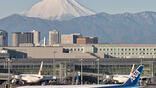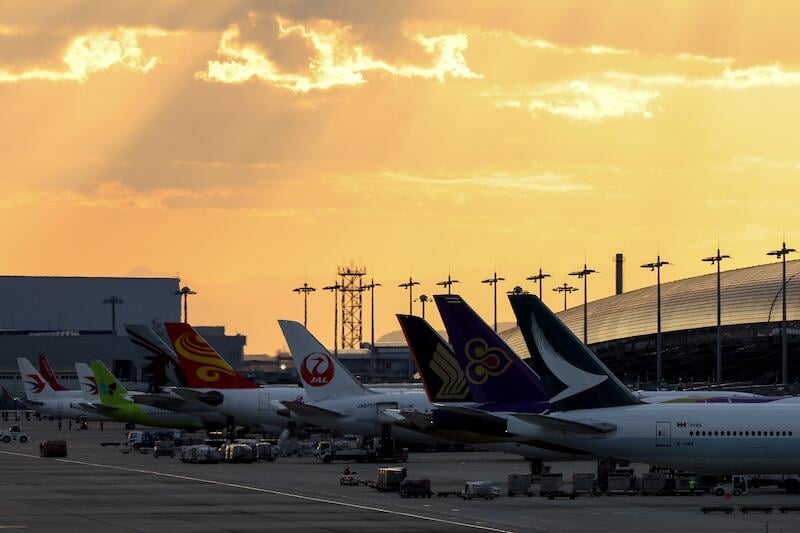
Passenger aircraft at Kansai International Airport (KIX) in Osaka, Japan. KIX has lost more mainland China seats than any other Japanese airport amid the countries' diplomatic spat.
Airlines have cut 4.35 million scheduled seats between mainland China and Japan over two winter seasons, shrinking the market by 42% as carriers in both countries build up service to South Korea.
The winter 2026-27 schedule has just under 6 million two-way seats between mainland China and Japan, down 16% from last winter and from 10.34 million in winter 2024-25, analysis of OAG data shows. The number of nonstop airport pairs has fallen from 112 to 42 over two winters.
The cuts follow a year of diplomatic tensions that began shortly after Japanese Prime Minister Sanae Takaichi and Chinese President Xi Jinping met at last year's Asia-Pacific Economic Cooperation (APEC) summit in Gyeongju, South Korea. A week after the meeting, Takaichi told Japan's parliament that a Chinese blockade of Taiwan could prompt a Japanese military response. Beijing responded by urging its citizens to avoid travel to Japan.
Mainland Chinese visitor arrivals in Japan fell 55.5% to 3.34 million in the first nine months of 2026, according to the Japan National Tourism Organization. The number of Japanese airports with scheduled nonstop flights to mainland China has fallen to seven this winter from 20 last winter.
Both leaders are due to attend this year's APEC summit Nov. 128-19 in Shenzhen, China. Takaichi listed several planned bilateral meetings in a Nov. 16 briefing but no planned meeting with Xi at present.
As the dispute continues, China's largest airlines have built up their schedules to South Korea while cutting flights to Japan. Air China, China Eastern Airlines and China Southern Airlines are offering a combined 2.56 million seats between mainland China and Japan this winter, down 41% from winter 2024-25. Over the same period, they have added 1.16 million seats between mainland China and South Korea, an increase of 46%.
The shift is particularly clear at low-cost carrier (LCC) Spring Airlines. Compared with last winter, it has cut about 222,000 seats to Japan and added almost exactly as many to South Korea. Across all airlines, mainland China-South Korea capacity has grown to 10.37 million seats this winter, up 39% from two years ago.
South Korea has also gained seats from Japan. Airlines are offering 16.17 million seats between the two countries this winter, up 28% from winter 2024-25. Growth to South Korea and Taiwan has helped lift Japan's overall international capacity by 5.3% from last winter.
Osaka Kansai International Airport (KIX) has lost more mainland China seats than any other Japanese airport. Airlines are offering 1.67 million seats on those routes, down 55% from 3.71 million two winters ago. The latest round of cuts removed about 546,000 seats, although KIX's overall international capacity is down just 0.2% from last winter. South Korea accounts for nearly 247,000 extra seats, with additional growth to Vietnam and Taiwan.
All Nippon Airways (ANA) is keeping its KIX flights to Dalian, Qingdao and Hangzhou, China, suspended this winter. Meanwhile, its low-cost sister carrier Peach Aviation has built up service from KIX to Seoul, South Korea's Gimpo International Airport (GMP) to four flights a day. In September, Peach launched flights from Tokyo Narita International Airport (NRT) to Seoul Incheon International Airport (ICN), its first new international route from NRT in seven years. ANA attributed Peach's first-half growth in passenger numbers and revenue to “strong inbound tourism and leisure demand.”
South Korea overtook mainland China as Japan's largest source of visitors in the first nine months of 2026, with 8.26 million arrivals, up 22% year over year.
While KIX has lost mainland China seats, Tokyo Haneda Airport (HND) has added 121,000 since last winter, overtaking Osaka Kansai as Japan's largest gateway to the market. HND now accounts for more than a third of mainland China-Japan capacity, up from about a fifth in winter 2024-25. At NRT, mainland China capacity is down 15% from last winter.
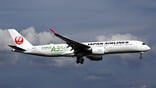
Japan Airlines (JAL) is offering 555,000 seats between Japan and mainland China this winter, up 2.8% from last winter, with most of the increase on HND-PEK. However, its capacity remains 10% below winter 2024-25. JAL-controlled Spring Japan has cut its mainland China seats by 23% year over year, leaving the two carriers' combined capacity down 6.2%.
Spring Japan's results show why an airline might be selective about adding seats back. It carried 22% fewer passengers in the six months through September, but passenger revenue rose 7%. JAL said the carrier “captured the tight supply and demand centered on major Chinese cities.”

Related Content