Ten airports across North America, China, Europe and the Middle East will generate more than a quarter of the aviation industry’s capacity growth during the northern winter 2026-27 season, reflecting contrasting expansion strategies among airlines and hubs.
OAG Schedules Analyser data shows carriers are scheduled to offer approximately 2.54 billion departure seats worldwide between late October and late March, up 2.2% from 2.49 billion during winter 2025-26. The increase equates to about 55.4 million seats.
Ten airports account for almost 15 million of those additional seats, or 27% of the worldwide net increase. The group includes three airports in North America, three in China, two in Europe and two in the Middle East.
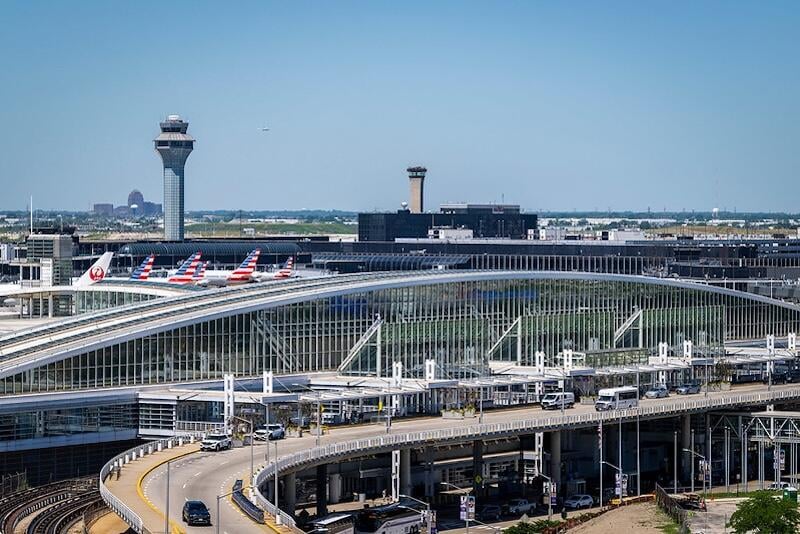
Chicago O’Hare International Airport (ORD) records the largest increase, adding about 2.69 million departure seats. Capacity rises 13% to 23.42 million, driven largely by its two main hub carriers. American Airlines adds approximately 1.66 million seats at O’Hare, while United Airlines increases capacity by 1.57 million.
The expansion comes as construction continues on O’Hare’s Concourse D, its first new concourse in more than 30 years. The development forms part of a wider program intended to increase operational flexibility and improve connections at the hub.
San Francisco International Airport (SFO) ranks third among airports for absolute growth, increasing capacity 11.3% to 14.46 million seats. United contributes about 672,000 additional seats, while American, Southwest Airlines and Alaska Airlines each add more than 200,000.
The schedule includes United’s new nonstop service to Sapporo, Japan, which is due to begin in December. Los Angeles International Airport (LAX) also features among the top 10, growing 7.3% to 19.36 million seats.
More News And Analysis From Routes World 2026
China provides another major source of expansion. Shanghai Pudong International Airport (PVG) adds 1.49 million seats, followed by Beijing Capital International Airport (PEK) with 1.39 million and Chengdu Tianfu International Airport (TFU) with 1.32 million.
Growth at Shanghai is spread across several operators, including Juneyao Airlines, China Eastern Airlines, China Southern Airlines and Air China. At Beijing Capital, Air China alone adds almost 1.1 million seats, while its increase at Chengdu Tianfu amounts to about 557,000.
The figures point to a continuing strengthening of China’s domestic and regional networks alongside the slower rebuilding of some long-haul markets.
In Europe, Rome Fiumicino Airport (FCO) increases capacity 12.9% to 12.47 million seats. Wizz Air accounts for about 618,000 of the 1.43 million-seat gain, alongside expansion by Aeroitalia, ITA Airways and Ryanair.
Madrid Adolfo Suárez-Barajas Airport (MAD) adds 1.31 million seats, taking its winter total to almost 17.5 million. The growth is shared among Air Europa, Wizz Air, Iberia and Ryanair.
The Middle East’s two representatives illustrate the development of competing hub models. Abu Dhabi Zayed International Airport (AUH) grows 16.9% to 9.32 million seats, with Etihad Airways responsible for almost 1.05 million of the airport’s 1.35 million-seat increase.
Part of the increase reflects disruption in the comparison period following the outbreak of the Middle East conflict at the end of February 2026.
However, Etihad’s expansion includes a significant buildup in China. The airline has announced five new mainland routes and 28 additional weekly flights, taking its network to 35X-weekly services across six Chinese destinations.
Riyadh King Khalid International Airport (RUH), meanwhile, expands 10.7% to 12.55 million seats. Although capacity weakened during the conflict, the sharpest reductions came after the winter season. Riyadh’s increase therefore more closely reflects new supply, with startup Riyadh Air contributing approximately 735,500 seats as it scales its network alongside continued expansion by Saudia and Flyadeal.
Elsewhere, capacity is also rising strongly across a broad group of midsized airports.
Tirana International Airport (TIA) grows 37.2% to 3.03 million winter seats, while Palermo Airport (PMO) increases 47.4% to 2.47 million. Catania Airport (CTA) adds 23.7%, reaching 2.8 million seats, and expands its scheduled network from 79 to 103 destinations. Bilbao Airport (BIO) grows 28.2% to approximately 1.91 million seats.
Despite this, figures also show that growth does not always translate into more routes. Several of the largest airports are adding seats while serving fewer destinations, indicating that airlines are often prioritizing greater frequency and capacity in established markets. Worldwide departures rise by only 0.9% compared with the 2.2% increase in seats, lifting the average aircraft capacity from about 160 to 162 seats per departure.

Related Content