This article is published in Air Transport World part of Aviation Week Intelligence Network (AWIN), and is complimentary through Nov 11, 2026. For information on becoming an AWIN Member to access more content like this, click here.
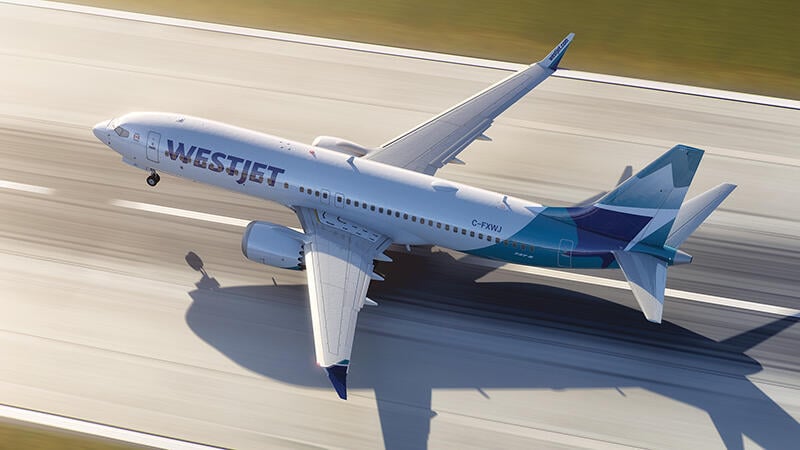
The range of the 737 MAX allows WestJet to create markets that previously would not have supported transatlantic flying.
From his modest open cubicle at WestJet’s headquarters overlooking Calgary International Airport (YYC), WestJet Group CEO Alexis von Hoensbroech has a front-row view of the transformation he was hired to accomplish.
The airline operating today bears little resemblance to the Western Canadian startup that launched three decades ago with three Boeing 737s, a simple business model and a strategy borrowed from Southwest Airlines.
“It was almost an exact copycat: one aircraft type, essentially trying to make flying human and more affordable,” von Hoensbroech told ATW during a visit to the airline in June.
WestJet now operates nearly 200 aircraft, including Boeing 787s, to four continents, up to 130 destinations and 700 flights per day. The carrier also sells premium products, runs Canada’s largest vacation business and has emerged as Canada’s second-largest carrier with a domestic market share of 30%, just behind Air Canada’s 39%. The question facing the airline as it turns 30 is whether the former startup can continue its march into the major leagues of global airlines and recapture its mojo after facing challenges, including a recent head-to-head with its flight attendants’ union (see sidebar).

When von Hoensbroech arrived in February 2022, the former Lufthansa Group executive was a stranger in a strange land. “Canada is just very different to Europe by geography to start with,” von Hoensbroech said. “It’s about twice the size of the European Union with a tenth of its population, which already tells you a lot around how critical aviation is for this country.”
Outside the dense eastern corridor, where nearly 70% of the population is concentrated, flying is often essential transportation rather than a substitute for rail or roads. Routes are longer, communities are farther apart and demand patterns differ from other regions because of Canada’s harsh winters and strong leisure travel flows.
“If you run an airline in Europe, you make money in summer, and then you just try to lose less in winter,” von Hoensbroech said. “If you run an airline in Canada, you have a strong summer business, which is a strong domestic business, but then in winter you have a strong Caribbean business.”
On top of that, he added, “It’s a very competitive market. You have 41 million people [about the population of California], and you have essentially five airlines competing for this. It is far more competitive than you would see in most other markets. We at WestJet have been the poster child of the competitor who broke into the market.”
That market helped create WestJet’s original opportunity. When the airline launched in 1996, the formula was deliberately straightforward: keep costs low, simplify operations and create a more customer-friendly alternative to Canada’s established airlines.
For years, the strategy worked well. WestJet grew from a regional challenger to supplanting Canadian Airlines as the nation’s second-largest carrier after the former was absorbed into Air Canada. But its burst of success and regional roots eventually created a strategic quandary. WestJet had to decide how far beyond its original model it could grow.
“At some point in time WestJet came to its limits just because of the size of the market and then needed to decide to expand into other geographies, but also other segments,” von Hoensbroech said.
WestJet added complexity and moved into competitive waters.
The freewheeling “WestJetter” employee culture that helped define the original airline became harder to maintain at scale, labor relations became rocky, and the company began to draw some customer frustration.
RETRENCH, RENEW, REFOCUS
“I have to admit when I came to Canada, I was skeptical that this transition from being a Southwest Airlines-style low-cost carrier, into an airline that moves more into full service could actually work,” von Hoensbroech acknowledged. “In history, this has failed multiple times around the world.”
The post-pandemic answer was not to reverse WestJet’s evolution but to refocus it. The airline underwent serious corporate soul searching. “Post pandemic, we decided to rethink our business model and focus on those things that are really strong, and where we can be strong,” von Hoensbroech said. “So, we pulled a lot of capacity from Eastern Canada, and we deployed it in the west.”
Before the pandemic, WestJet had expanded heavily into the heart of Air Canada’s turf. “We had expanded significantly into Eastern Canada, and we were flying like 14 times a day between Toronto and Montreal, eight times a day between Toronto and New York,” von Hoensbroech explained. “These are huge markets, but they are incredibly competitive. And if you are not number one, you’re the first loser.”
Most dramatically, WestJet demoted Toronto Pearson Airport (YYZ) capacity by nearly 20% between August 2022 and August 2026, according to OAG data. Boston, Las Vegas, London Gatwick, Los Angeles and New York LaGuardia, along with multiple domestic destinations, were dropped from YYZ.
WestJet instead focused on building a different advantage around its Calgary home base. OAG data confirm the scale of the Calgary build-up, with WestJet increasing the Alberta city’s departure capacity nearly 60% from August 2022 to August 2026 and growing its share of airline capacity at the airport to more than 70%.
BUILDING BANKS
The additional scale allowed WestJet to create true connecting banks and to rethink international flying. Instead of spreading its 787s across multiple gateways, the airline concentrated widebody flying around Calgary. “Instead of flying from everywhere to London, we put all the widebodies into Calgary and fly from Calgary to the world,” von Hoensbroech said. “This move was an absolute game changer.” Calgary also provides a strong economic base through Alberta’s energy industry and corporate demand while allowing WestJet to connect Eastern Canada to Asia, Western Canada to Europe and US West Coast passengers across the Atlantic.

WestJet built capacity share in many other Western Canadian airports, “Places we are now number one include Edmonton, Winnipeg, Saskatoon, Regina, Kelowna and Victoria. Even smaller places like Fort McMurray, we are always by far the largest airline,” he said. The only western Canadian market where the carrier is second is Vancouver, which Von Hoensbroech acknowledged was an issue given Vancouver’s size, but he also pointed out WestJet was strong and growing in the west coast city.
A similar consolidation strategy was applied to inside the airline. “We had three jet AOCs: We had WestJet, Swoop, and we had acquired Sunwing. We decided to merge them all into one,” von Hoensbroech said.
The move increased some labor costs as operations were combined under common agreements, but WestJet believed the efficiencies justified the change. Segmentation became the name of the game. “We decided to offer a product for all customer segments in the same aircraft instead of trying to segment it through different aircraft brands,” the CEO explained. “We had a vacation carrier, an ultra-low-cost carrier, and a sort of hybrid carrier, and we said, ‘Let’s put it all into one and segment the cabin in the right way and segment the products in the right way so we can serve every segment.’”
The Sunwing acquisition bestowed WestJet another major piece of its Canadian strategy. The combined company became Canada’s largest vacation carrier and package holiday operator, creating a stronger position in the winter leisure market that is critical to Canadian airlines. Von Hoensbroech said the company now has about half of Canada’s tour operator market, a business that extends well beyond WestJet’s Western Canadian base.
FLEET PLANS
Toronto remains one of WestJet’s largest gateways to Mexico and the Caribbean, while Calgary anchors the long-haul network. That combination gives WestJet flexibility few airlines have with widebodies. While many global carriers struggle to keep long-haul aircraft productive during winter, WestJet can move widebody capacity from Europe to sun destinations.
“The only year-round destinations that we fly with widebodies are London, Paris and Tokyo. Then in summer we add further widebody destinations. So, we fly to Seoul, but we also fly to Edinburgh, Rome, Barcelona and Dublin,” von Hoensbroech said.
In winter, those aircraft move south to markets including Mexico, Hawaii and the Caribbean, combining a strong summer business with “pretty decent” winter business.
WestJet’s international expansion is outpacing domestic growth. International departure seats from Canada increased more than 70% between August 2024 and August 2025, while domestic capacity grew about 12%, according to OAG. A lot of scope for growth remains; WestJet remains a distant second in international available seats with 11% versus Air Canada’s 37% share.
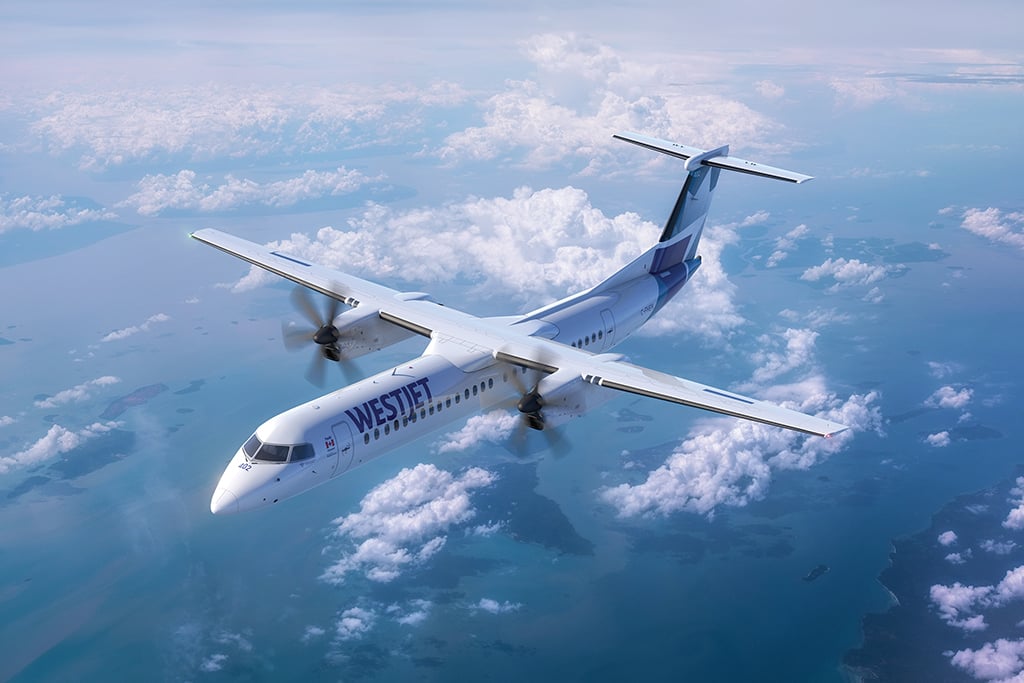
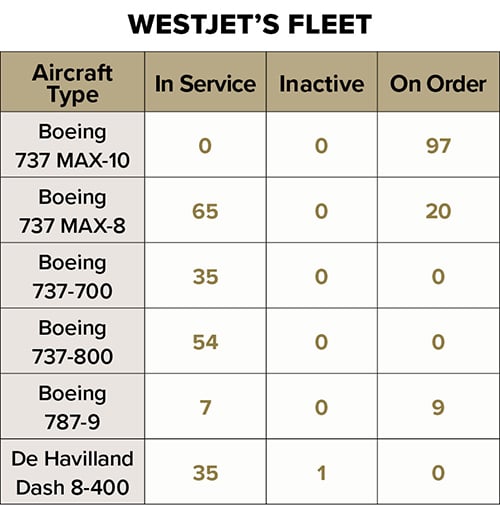
WestJet operates nearly 200 aircraft to up to 130 peak destinations during the winter, as far afield as São Paulo and Seoul. The network expansion is backed by an orderbook for a mix of growth and replacement, particularly for the 737-700s. The book with deliveries spaced into the middle 2030s includes 117 additional 737 MAXs, including 97 MAX-10s, along with nine more 787-9s. The new MAX-10s are scheduled to arrive in 2027 and become a key part of WestJet’s cost strategy as the airline increases average aircraft size. “It has been true through all aviation history that up-gauging is what’s happening and what’s driving profitability and what’s also driving ticket fares down,” von Hoensbroech noted. The airline has flexibility to switch between MAX variant orders depending on future demand, while additional 787 deliveries arriving in the next decade could replace existing leased aircraft, support growth, or do both. There are no plans to replace the relatively youthful fleet of Encore regional Dash 8 turboprops.
The range of the 737 MAX allows WestJet to create markets that previously would not have supported transatlantic flying and leverage the relatively short crossing from Atlantic Canada to Europe.
“What many people don’t know is a flight from Halifax to London is shorter than a flight from Halifax to Vancouver,” von Hoensbroech said. The aircraft can operate overnight to Europe and return early enough to continue flying domestically, increasing utilization. WestJet has rebuilt Halifax, Nova Scotia, transatlantic flying with routes including Amsterdam, Barcelona, Copenhagen, Edinburgh, Lisbon and Madrid, while also testing thinner markets such as Toronto to Cardiff, Wales.
PAIN AND PIVOTS
Amid the overhaul, the airline turned its attention to the customer experience and how to recapture some of the original company’s culture.
“To make an airline that makes flying human has been our DNA from day one, and it still is,” von Hoensbroech said. “I know we went through some turbulences, especially during the pandemic and the post pandemic with the rebuild and lots of things that were happening around it. But this core DNA has always survived.”
Earlier this year, WestJet’s customer-friendly brand took a big hit when the carrier decided to add more seats to some aircraft after integrating Swoop and Sunwing. The airline introduced a cabin configuration with some seats at a 28-in. pitch, arguing the additional density would support lower fares for price-sensitive customers while expanding premium options elsewhere in the cabin. The experiment was not popular. After being installed on 23 aircraft, WestJet reversed the decision after reviewing customer reaction.
“As we saw the data coming in from how the people were actually behaving, we saw that this was not playing out the way we anticipated. If we never reverse a decision, we are not pushing hard enough,” von Hoensbroech said.
Another major change came about from geopolitics and US-Canada tensions since President Donald Trump began a second term. WestJet saw demand weaken as those tensions affected travel patterns. The decline was most visible in discretionary leisure destinations. WestJet reduced capacity after seeing a significant drop in transborder demand, particularly to destinations such as Las Vegas and Orlando where Canadian leisure travelers had more flexibility to choose alternatives. “Transborder demand dropped by roughly 25%,” von Hoensbroech said. “There are lots of Canadians who essentially say that as long as this administration is in place, they will not put their foot on US soil. And we see that in our numbers.”
WestJet’s response was to pivot and redirect former “South of the 49th Parallel” capacity much further south from the US to Caribbean and Latin American destinations—growing 64% between August 2024 and August 2026.
Then, just as the carrier began to find smooth air, it confronted new twin crises in rapid succession. Similar to all airlines, WestJet had to navigate fuel volatility stemming from the Iran war, but the cloud of war has had an unintended silver lining. “We struggle with a high oil price, but our customer base here profits off high oil price because most of them live on the oil price,” von Hoensbroech noted. “So as our costs go up, the disposable income also goes up in Alberta, so we have a bit of a natural hedge there.
“It’s not in our control what happens to us on the geopolitical side, but it is in our control how we respond and do the right things to protect the business,” he said.
Then came the Cuban Blockade of 2026. The airline was once the largest carrier operating between Canada and Cuba with about 100 weekly flights and carrying between 15,000 and 20,000 passengers per week to the island. “Cuba has been our nicest and most affordable destination in the Caribbean, and we have been the strong market leader in that space,” he said. With all flights suspended, von Hoensbroech stressed that it was “a terrible situation” for Cubans and their passengers, who are often priced out of other Caribbean vacations costing twice as much.
PREMIUM PARTNERSHIPS
At the same time, WestJet is investing in areas that would have seemed far removed from its original low-cost roots. Premium demand has become increasingly important, with the airline expanding higher-end seating options and building its loyalty program. “We see that our premium products are performing better than our ‘non-prem’ products,” he said.
WestJet has introduced a larger premium cabin layout for the MAX-8, expanded extra legroom options and rolled out SpaceX Starlink connectivity across its entire 737 MAX-8 and 737-800 fleet.
As WestJet becomes more international, the airline is also taking a more contrarian approach to partnerships than its Canadian competitors. Air Canada is a founding Star Alliance member with major joint ventures, while Porter is expanding its partnership strategy through Air Transat and American Airlines. WestJet remains outside a global alliance after a planned Delta Air Lines joint venture was abandoned in 2020 following concerns from the US Department of Justice. “We cooperate with whoever it makes sense,” von Hoensbroech said. “We have partners in all three alliances. Probably the largest chunk is with SkyTeam, but we also have a fair chunk of oneworld and Star Alliance.” Fiji Airways and Icelandair are the newest of 16 codeshare partners.
Delta, Air France-KLM and Korean Air became minority investors in WestJet in October 2025, purchasing a combined 25% equity stake in the airline from its parent company, Onex Partners.
The question of whether WestJet will eventually return to public markets also remains open. Onex took the company private in 2019, and von Hoensbroech said an eventual IPO has always been a consideration, but the timing must align with market conditions.
“Since [2023] we have been profitable almost every single quarter and certainly each year,” he said. “Ultimately to do an IPO is something that has always been contemplated. You also need to get timing right.”
As the airline marks its 30th anniversary, WestJet is growing wiser without losing what made it distinctive in the first place. “We’ll see where the journey takes us. We’ll follow where our customers want us to go,” von Hoensbroech concluded.
SIDEBAR
WestJet CABIN CREW STICK to THEIR GUNS and WIN BETTER COMPENSATION
A long-running dispute between WestJet management and its flight attendants appeared to have been resolved in early August, though only after cabin crews conducted a brief strike.
The Canadian Union of Public Employees (CUPE), which represents WestJet’s approximate 4,400 cabin crew, confirmed on Aug. 3 that a tentative agreement had been reached, ending a weekend strike action that affected some of the Calgary-based airline’s mainline Boeing 737 and 787 flights but did not impact De Havilland Dash 8-400 regional flights.
According to WestJet, a new offer included a 13% wage increase effective Oct. 1 followed by 2.5% increases to start from Jan. 1 in 2027, 2028 and 2029. It also included a new duty pay premium that covers all duty hours. That was a major condition for CUPE, which wanted hourly pay to begin from when attendants start working, including during the boarding process and through any delays leaving the gate. WestJet said the additional pay for all hours worked would equate to an extra salary increase of 12%.
Other proposal terms include a fifth week of vacation at 25 years of service, more generous maternity leave conditions, a new, flexible part-time program, and scheduling and quality-of-life improvements, including one additional hour of rest at home base.
CUPE said in a statement that the short strike “helped bring the parties to a resolution” but ultimately the agreement was achieved through collective bargaining at the negotiating table.
–Karen Walker

Related Content