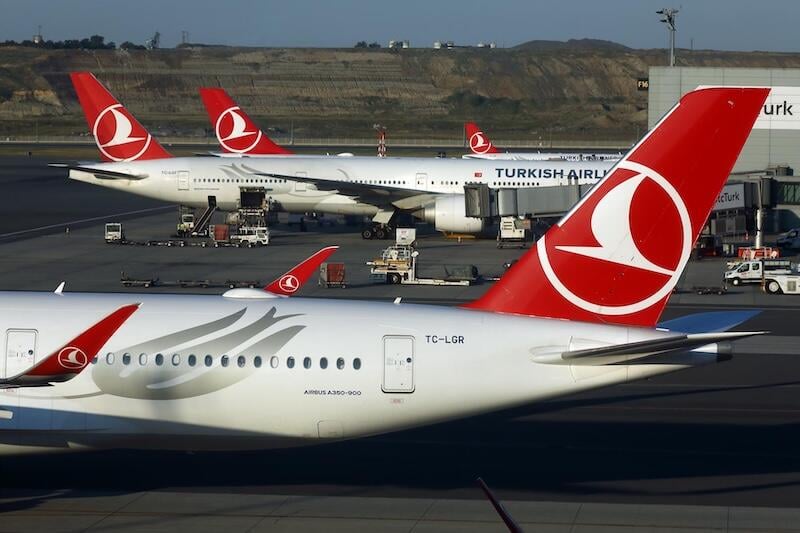
Turkish Airlines is shifting capacity toward Asia and Europe while scaling back flying in the Americas and Middle East as conflict and higher fuel costs squeeze profitability.
The carrier expects passenger capacity to grow by 1-3% in the fourth quarter. Chairman Murat Şeker said on the Nov. 4 earnings call that full-year growth would reach about 3.5-4%, down from an initial target of about 10%.
“This should be viewed not as a move away from growth, but as a more disciplined approach to growth,” Şeker said. Alongside the network changes, Turkish is reviewing staffing costs and investment spending.
Third-quarter revenue rose 19.3% to $8.3 billion, but profit from main operations fell 12.3% to $929 million. Net income for the three months through Sept. 30 declined 6.4% to $1.29 billion.
Turkish carried 28.5 million passengers during the quarter, up 4.7%, on capacity growth of 3.2%. Load factor increased 1.5 percentage points to 87.1%, while passenger yields rose 9.9%. Passenger revenue increased 15.4% to $6.8 billion.
However, the airline’s fuel bill climbed 58.5% to $2.61 billion. CFO Metin Gülşen said fuel costs per available seat kilometer could increase more than 80% year over year in the fourth quarter at current market prices. Nonfuel unit costs are expected to rise by a mid- to high-single-digit percentage.
Turkish has introduced a hiring freeze across the airline and almost all its subsidiaries. “We tried to limit recruitment and tried to limit the increase in personnel expenses,” Şeker said.
The carrier said it has continued to add capacity in Asia and Europe while reducing flying elsewhere. Third-quarter capacity to the Far East and Asia increased 18.1%, and European capacity rose 5.7%. Capacity fell 6.2% in the Americas and 21.6% in the Middle East.
Şeker said Turkish expected to resume services to Riyadh and Dammam in the second half of November after suspending flights following recent attacks in Saudi Arabia. Services to destinations in Iran, along with Basra and Kirkuk in Iraq and Aqaba in Jordan, remain suspended.
Some investment decisions have also been deferred until the airline has a clearer view of conditions in 2027, Şeker said. Liquidity stood at $10.2 billion at the end of September, while net debt was $9.7 billion.
Aircraft deliveries remain another constraint. “Currently, from both [original equipment manufacturers], we are seeing around 12 months [of] delivery delays,” Şeker said. The delays have helped limit capacity growth this year, but they have also slowed the replacement of older aircraft with more fuel-efficient models.
“While the supply constraints are incidentally supporting our capacity discipline in the short term, the planning uncertainty and delayed fleet renewal [are] outweighing the advantages,” Şeker explained.
Şeker said capacity growth could reach 5-6% in 2027, but the airline was still working on its plans. Turkish could restore flying quickly if conditions in the Middle East improved, but he said it would wait for clearer evidence of de-escalation before committing to substantial schedule changes. “We have the ability to adjust our capacity quickly, but we are not going to rush to do those drastic planning changes,” Şeker said.

Related Content