SkyWest Continues CRJ-450 Conversions, Extends Expected E175 Lifespan
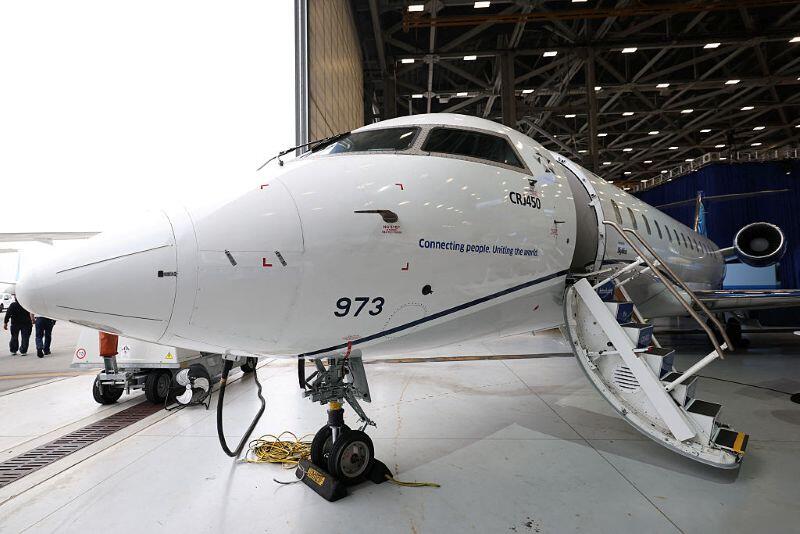
United Airlines Express CRJ-450
SkyWest remains in the process of converting the first two Bombardier CRJ-200s into CRJ-450s for United Airlines, expecting the variant to enter service by year’s end.
Reconfigurations are being performed primarily at the regional carrier’s Tucson, Arizona, base and, after a slower start, are expected to take roughly 2-3 weeks per aircraft.
“We are working with our OEM partners on the service bulletins to get those done ... the first airplanes just take longer, naturally, just because you are working through the first-time issues,” SkyWest President and Chief Operating Officer Wade Steel explained during the airline’s third quarter earnings call. “We will work through those; we’ve seen those before as we’ve done the -550 ... we anticipate that the CRJ-450 and the -550 conversions will be very similar.”
By 2028, SkyWest expects to convert approximately 50 CRJ-200s to the CRJ-450 configuration and has a multi-year agreement with United to fly 40 of the type. It also plans to retrofit its prorate CRJ-200s, optimistic the opportunity could reach as many as 100 aircraft. The carrier currently maintains 138 single-class CRJ-200s, according to filings.
Conversions will see the carrier pull down 3-4 lines of flying at a time, a temporary tradeoff CEO Chip Childs described as “a long-term investment in a high energy cost environment,” leading to a “long-term product.” Reconfigured as CRJ-450s, the jets will feature 41-seats including seven in first class, 16 in economy plus, and 18 in economy, offering larger luggage bins and Starlink Wi-Fi.
The concept was first unveiled by United in March to close a premium product gap, and will join a fleet of CRJ-550s, a variant based on the CRJ-700 that the mainline carrier debuted in 2019.
“Relative to what our partners have said [about] premium revenue, putting first-class seats on a CRJ-200 in a very good LOPA [layout of passenger accommodations] with an outstanding interior is a very valuable aircraft,” Childs told investors. “From a fuel perspective, it’s also a lot lighter than it is with 50 passengers in it.”
SkyWest is positioned for continued investments in CRJ conversions, for both the -550 and -450 type, as it works to achieve an all-dual class fleet, executives said. Meanwhile, it has revised the estimated useful lives of its E175 fleet from 22 years to 30 years—a third-quarter decision the carrier based on recent extensions of flying contracts, the operating longevity of its older CRJ fleet, and the absence of an alternative 76-seat regional jet currently in production. The company also revised the estimated residual value of its E175s from 20% to 18% of their original acquisition cost.
For the third quarter, SkyWest reported operating revenues of $1.1 billion, up 6% year-over-year, on a 5% increase in block hour production. Operating expenses jumped 7% to $941.3 million and the company recorded a net income of $119.5 million, versus the year-ago period’s $116.4 million.
It ended the September quarter with a fleet of 645 total aircraft including 522 aircraft in scheduled service or under contract, approximately 46.6% of which were operated for United; 26.4% for Delta Air Lines; 18.8% for American Airlines; and 8.2% for Alaska Airlines. SkyWest has 63 E175s on firm order with Embraer, including 16 for Delta, 11 for American, and two for United, expecting delivery of seven E175s during the fourth quarter and 18 E175s during 2027. It plans to return all Delta-owned CRJ-900s by mid-2027. Counting an American agreement announced in the second quarter, its E175 fleet is scheduled to reach 300 by the end of next year.
“We believe we are in an important window to continue to invest in our fleet, including the new E175s in our orderbook under contract, as well as the 33 delivery slots beginning in 2027 for future opportunities,” Childs said. “We believe the investments we’re making today will deliver economic benefits in 2028 ... as the industry evaluates capacity in 2027 and beyond, we’re in the best position to respond to market demands and our partners’ needs in a dynamic environment.”

Related Content