Royal Jordanian Airlines remained profitable in the first half of 2026 despite mounting cost pressures and regional instability, with government support for rising fuel prices helping the carrier offset higher operating expenses.
Royal Jordanian Vice Chairman and CEO Samer Majali credited the Jordanian government’s decision to continue subsidizing part of the fuel cost increase for helping the airline maintain positive financial and operational performance amid what he called “exceptional regional circumstances.”
Majali said RJ’s results nevertheless fell short of its internal 2026 budget targets because of geopolitical tensions across the Middle East, pointing to the military escalation between the U.S. and Iran, repeated regional airspace closures and their effects on travel demand.
Inbound travel to Jordan weakened, tourism slowed and the airline became increasingly reliant on transit traffic, Majali said. Supporting businesses—including ground handling, cargo operations and maintenance services—also suffered as several international and regional carriers reduced services to Jordan. Airspace restrictions forced Royal Jordanian to suspend some flights temporarily, reroute others and operate longer flight paths, adding to fuel burn, operating expenses and insurance costs.
Despite the challenges, the airline continued investing in growth. During the first half, it launched services to Hamburg; Alexandria, Egypt; Dallas; Misrata, Libya; Munich; Sharjah, UAE; Tashkent, Uzbekistan; and Vienna. It also invested JOD30 million ($42 million) to expand and modernize the air cargo terminal at Queen Alia International Airport.
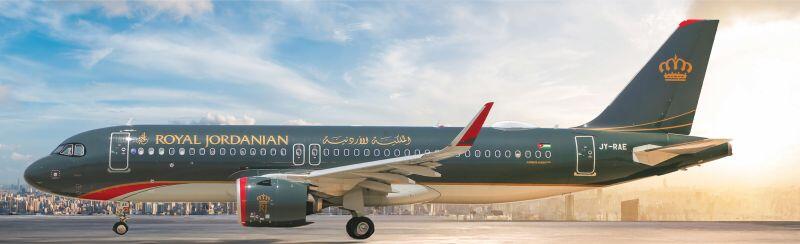
Fleet renewal also continued, with Royal Jordanian taking delivery of seven aircraft—two Boeing 787-9s, four Airbus A320neos and one Embraer regional jet—bringing the total number of new aircraft added over the past 12 months to 19.
The airline is targeting a fleet of 41 aircraft by 2028 and 52 by 2032, which would require the acquisition of 11 additional aircraft. The plan is still pending approval.
Royal Jordanian reported a net profit of JOD1.4 million for the six months to June 30, down sharply from JOD12.7 million a year earlier. Revenue rose 23% to JOD86 million as the airline expanded its network and increased flying activity.
Operating costs rose by JOD69.5 million, driven largely by a 37% jump in fuel expenses amid higher global oil prices. Financing costs climbed by JOD18 million on increased interest charges related to aircraft leases, while earnings from a subsidiary fell by JOD6 million.
Royal Jordanian carried 2 million passengers in the first half of 2026, up 5% year over year. The airline operated 19,066 flights and logged 60,443 flight hours, increases of 14% and 19% respectively, while cargo volumes grew 36% to 21,460 metric tons. Seat load factor fell to 71.8%, down 8.6 percentage points on the year.
For 2025, the airline reported a full-year net profit of $30.5 million.

Related Content