This article is published in Air Transport World part of Aviation Week Intelligence Network (AWIN), and is complimentary through Aug 24, 2026. For information on becoming an AWIN Member to access more content like this, click here.
(L-R): Benoît de Saint-Exupéry, Airbus EVP Sales of the Commercial Aircraft; Lars Wagner, CEO Commercial Aircraft Airbus; Lucio Tan III, CEO of PAL Holdings; Richard Nuttall, president of Philippine Airlines.

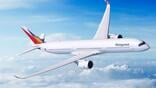
FARNBOROUGH—Philippine Airlines (PAL) has signed an MOU for nine additional Airbus A350-1000s as the carrier seeks to strengthen its North American network.
The agreement, announced on July 21 at the Farnborough Airshow, would take PAL’s total A350-1000 order to 18 aircraft once finalized. The carrier has received the first two aircraft from its initial nine-aircraft order, with another five expected to arrive by year-end. PAL expects the second batch to be delivered between 2034 and 2036.
PAL president Richard Nuttall said the airline’s fleet planning was based on projected economic and passenger growth, as well as markets where it believes it has a competitive advantage. “This industry can very easily go through boom-and-bust cycles, so we have been very meticulous,” he said. “We’ve looked at the markets we serve, GDP growth and what that means for passenger demand. We’ve also looked at where we believe we have a competitive advantage, and off the back of that we have made our fleet decisions.”
Most of the aircraft covered by PAL’s recent widebody commitments will replace existing aircraft—although some could support expansion.
The latest agreement follows PAL’s commitment at Farnborough on July 20 for up to 20 Boeing 787-10s, comprising 15 aircraft and five purchase rights. Once finalized, those aircraft are scheduled to arrive from 2031 and will largely replace the carrier’s Airbus A330-300s and Boeing 777-300ERs.
The 787-10s are expected to serve medium- and long-haul markets currently operated by the A330s, including Australia, the Middle East and nearer North American destinations. The A350-1000s will sit at the upper end of PAL’s long-haul fleet, supporting higher-demand and longer-range services.
“North America is very important for the 5.5 million Filipinos living there,” Nuttall told ATW. “The GDP per capita in the Philippines is growing at just over 5% a year. There is a brief hiatus at the moment because of what is going on in the Gulf, but we see growth as being very strong.”
Nuttall added that PAL is seeking to retain rather than materially increase its share of the market. “We’re not looking to expand market share, but we’re looking to maintain market share,” he said. “We believe that with our cost advantages, if we have the best product, get our distribution sorted out and join oneworld, we’re in a really strong position.”
PAL plans to join the oneworld global alliance in 2027, giving it access to feed from members including American Airlines and Alaska Airlines in North America. The carrier currently serves Guam, Honolulu, Los Angeles, New York, Saipan, San Francisco and Seattle, and will add Chicago O’Hare on Nov. 9. The Chicago route will operate 3X-weekly using A350-900 aircraft.
However, competition is also set to increase on PAL’s largest US route. Delta Air Lines will begin 3X-weekly Los Angeles-Manila flights in March 2027 before increasing the service to daily in June.
“Delta has a great network, but we also have a major cost advantage,” Nuttall said. “Joining oneworld links us into the American network, and we’ve got the Alaska network, so we’re in a strong position to compete.”
OAG Schedules Analyser data shows PAL accounts for about 72% of nonstop seat capacity between the Philippines and the US during summer 2026. United Airlines operates the remaining 28% through its San Francisco-Manila service.
Nuttall said PAL considered the smaller A330neo for its long-term fleet requirements but concluded that larger widebodies offered better economics given expected passenger and cargo demand.