This article is published in Aviation Week & Space Technology and is free to read until Nov 21, 2026. If you want to read more articles from this publication, please click the link to subscribe.
Opinion: Aviation Gives Orbis’ Sight-Saving Mission Lift
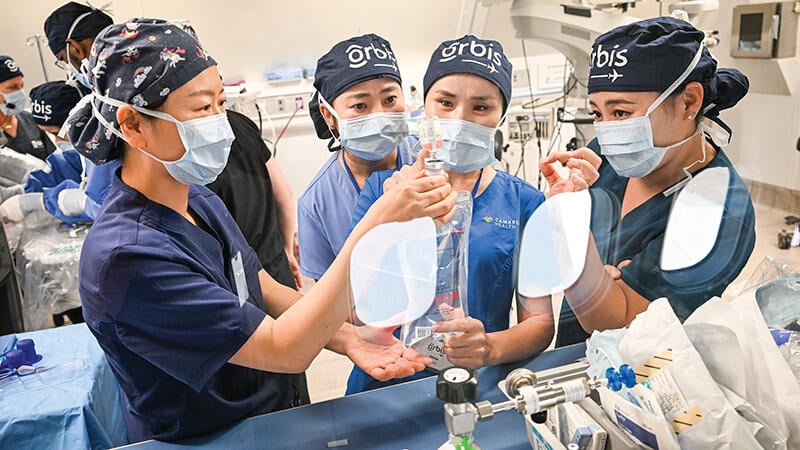
Ophthalmic nurses in Ulaanbaatar, Mongolia, train in the Flying Eye Hospital’s operating room, which looks like any in a typical U.S. hospital, except for its aircraft windows.
Aviation depends on vision. Pilots, air traffic controllers and mechanics rely on sight to work safely. For millions of people around the world, however, access to quality eye care remains out of reach.
Some 1.1 billion people worldwide live with vision loss, and 90% of it is avoidable. The vast majority of avoidable blindness occurs in low- and middle-income countries, where eye care is often scarce or difficult to access. The aviation industry has demonstrated its power to help address this challenge.
For more than 40 years, Orbis International, a global nonprofit based in New York, has worked to expand access to quality eye care around the world, with a focus on building the skills and capacity of local teams. At the center of this work is the Flying Eye Hospital, the world’s only fully accredited ophthalmic teaching hospital on a McDonnell Douglas MD-10 aircraft. The facility brings together advanced technology, state-of-the-art aviation and surgical equipment, clinical training, volunteer pilots and leading eye care experts. By training eye care professionals in settings where access is limited and extending the reach of expertise through new artificial intelligence (AI)-powered features, Orbis empowers local providers to deliver care in their own communities for decades to come, multiplying the impact of each Flying Eye Hospital visit many times over.
From its earliest days, Orbis has received support from aviation industry leaders like Betsy Trippe DeVecchi, daughter of Pan American World Airways founder Juan Trippe, and Albert Lee Ueltschi, founder of FlightSafety International. FedEx has been a steadfast supporter for more than four decades. The company provides comprehensive support for the Flying Eye Hospital, from volunteer pilots who fly the aircraft to each destination to critical maintenance, shipping, aircraft parts and other resources that keep it ready for flight.
Other aviation companies support the Flying Eye Hospital through funding and advocacy. These include GE Aerospace, Woodward, Hexcel, Embraer, AirAsia and others. Operating and maintaining a specialized aircraft like the Flying Eye Hospital requires the expertise and services of the broader industry, from engines and components to maintenance and other essential services. The current aircraft is the third-generation Flying Eye Hospital, following a Douglas DC-8 provided by United Airlines that launched in 1982 and a McDonnell Douglas DC-10 funded by private benefactors that entered service in 1994.
One of the Flying Eye Hospital’s most distinctive engineering features is its modular design, which allows the hospital to operate inside an aircraft originally designed to carry cargo. The hospital is made up of separate modules that are treated as freight during transit, which allows the aircraft to meet both medical and aviation requirements as it travels from country to country. Once on the ground, the modules function as a self-contained hospital: The operating room has its own heating, cooling, electrical, emergency and fire warning systems, all powered by nine pieces of ground equipment unloaded on the tarmac after landing. This innovative design allows the hospital interior to meet rigorous medical and freight standards without being part of the airframe or requiring direct FAA certification as an aircraft structure.
The Flying Eye Hospital brings innovative medical training to eye care professionals worldwide, advancing Orbis’ mission to restore sight and prevent blindness. However, this is just one way that Orbis builds lasting eye care capacity, which also includes long-term country programs, advocacy work, school vision screenings, vision centers and more. Each Flying Eye Hospital visit is complemented by hands-on training at local partner hospitals. Live surgeries and teaching sessions on the aircraft are streamed through Cybersight, Orbis’ telemedicine and e-learning platform, around the world. With more than 150,000 registered users, Cybersight extends the reach of Orbis expertise through online courses, telemedicine, remote consultation and mentorship. The platform also includes proprietary AI capabilities that support timely detection of eye disease, helping Orbis provide expertise and training far beyond the physical reach of the Flying Eye Hospital.
As the aviation community gathers in New York City in October for the Orbis Aviation Gala, we will celebrate more than four decades of support. The Flying Eye Hospital has demonstrated what is possible when this community applies its ingenuity, expertise and resources to a challenge far beyond aviation itself. More than four decades ago, industry leaders helped an improbable idea take flight. Today’s leaders have the opportunity to help determine how far it can go.
John Slattery is global board chair and Kathleen Sherwin is president and CEO of Orbis International.
Related Content