This article is published in Aviation Daily part of Aviation Week Intelligence Network (AWIN), and is complimentary through Mar 02, 2026. For information on becoming an AWIN Member to access more content like this, click here.
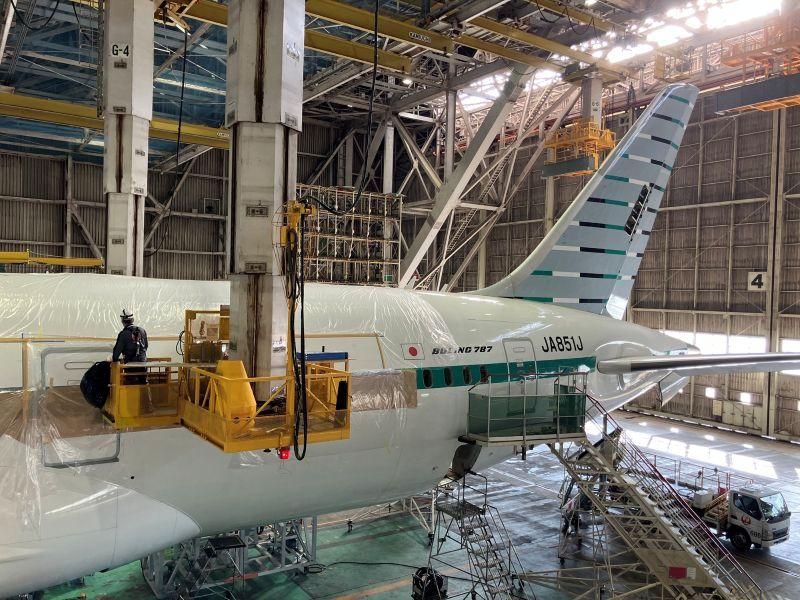
Riblets were applied to areas on the sides of a Zipair 787’s fuselage using O-Well’s paint-to-paint process.
Japanese LCC Zipair Tokyo, a wholly owned subsidiary of Japan Air Lines (JAL), has begun operating a Boeing 787-8 with a drag-reducing riblet coating applied to areas of the fuselage.
Riblets are microscopic grooves aligned with the airflow that reduce skin-fiction drag by limiting the surface area in contact with airflow over the fuselage. Using a process developed by Japanese company O-Well, the riblets are directly applied to the aircraft paint, reducing weight and improving durability compared with adhesive films.
Using this process, riblets have previously been applied to most of the lower fuselage of a JAL Boeing 737-800 in 2023 for flight tests. The coating was then applied to most of the forward fuselage and upper rear fuselage of a JAL 787-9 for operational evaluation on international flights in 2025.
In O-Well’s paint-to-paint process, developed in cooperation with the Japan Aerospace Exploration Agency (JAXA), aircraft paint is applied to a water-soluble riblet mold layer. The coating is then bonded to the existing aircraft paint. The mold layer is flushed away with water, leaving a riblet-shaped coating layer on the aircraft fuselage.
Riblets were applied to four areas on the fuselage sides of the Zipair aircraft using a refined process developed by O-Well to improve quality and efficiency. The crimping jig for the riblet transfer sheet was improved and a new support jig for positioning developed. The installation was carried out in a JAL hangar at Narita International Airport.
JAL’s riblet-painted 787-9 has been in operation since January 2025, and the riblet area on the upper fuselage was further expanded in November. JAXA estimates this will increase the drag reduction in cruise from 0.24% to 0.31%, which is expected to result in an annual reduction in fuel consumption of approximately 154 metric tons.
The riblet demonstration is joint project within the JAXA Space Innovation Partnership for Arctic. The research agency says research and development is also underway on a new acute-angled, single-edged riblet shape that promises even higher drag reduction performance, with tests under way to confirm durability in a flight environment.