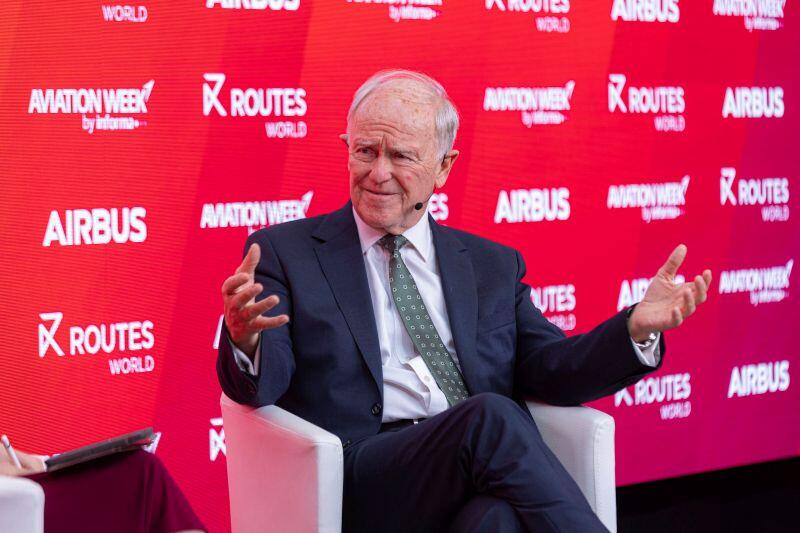
Emirates Airline President Tim Clark at Routes World 2026.
Emirates Airline is operating at 91% of its capacity before the Iran conflict, with revenues exceeding year-ago levels despite missile attacks, airspace closures and rising fuel costs across the Middle East, according to President Tim Clark speaking at Routes World 2026 in Frankfurt.
Clark said demand across much of Emirates’ global network remained strong despite the disruption, and he expects a significant snapback in travel once regional tensions abate. “Had it not been for the fuel, we would be ahead of last year,” he said, noting that revenues in the preceding week exceeded those of the same period in 2025, Emirates’ most profitable year on record. “The demand for our services, the revenue we got last week compared to the same week last year, was above,” he explained.
The airline’s performance contrasts with the wider regional picture, with International Air Transport Association (IATA) figures showing Middle Eastern airlines’ international passenger demand declined 14.2% in August compared to a year earlier.
For Clark, who has spent decades navigating geopolitical upheaval in the Gulf, the current crisis is another challenge for an airline whose business model was developed against a backdrop of regional turmoil. “We started Emirates in 1985 in the middle of the Iraq and Iran War. At that time, we used to see ships being blown up off the coast of Dubai and the UAE,” he recalled. That experience shaped the airline’s approach to risk and operational planning, recognizing from the outset that running a global hub in Dubai meant managing geopolitical threats both within the region and across its international network.
“The ingredients, the content of each of these crises is different. The effect tends to be the same,” he said, pointing to the recovery in passenger demand that has followed previous disruptions, including the global financial crisis and COVID-19 pandemic.
That history has been particularly important during the latest conflict, which has seen missile threats and attacks affecting Dubai and other parts of the UAE. Clark described how Emirates has used its operations control center to reposition aircraft, hold flights at different points across its network and tanker additional fuel to allow aircraft to return to their departure airports if necessary.
On some flights between Paris and Dubai, for example, aircraft carried sufficient contingency fuel to return to Paris rather than continue into potentially unsafe airspace. “[Regarding] all the cost of fuel, I said, ‘don’t worry about that. I need the assets safe. I need the people safe,’” he said, stressing that the additional fuel costs were secondary to maintaining safe operations.
More News And Analysis From Routes World 2026
Elevated oil prices remain a significant headwind, particularly when combined with longer flight routings and additional contingency fuel requirements, although Clark noted that Emirates had previously operated through periods when oil reached $140 per barrel. “So the fuel cost is an issue. We know that. We’ve been up $140 before. People have forgotten that,” he said.
Clark expressed frustration that several European carriers had not yet resumed services to Dubai. “Dubai is still operating perfectly normally, and Emirates is excelling in what it’s doing. So one wonders why they are not there,” he asked rhetorically. “I should be content that that is the case, but at the same time, I think it’s sending the wrong message.”
To reassure passengers concerned about becoming stranded overseas, Emirates has introduced additional protection measures Clark termed “insurance,” including extended hotel accommodation and arrangements to return travelers home in the event of disruption. Clark said this had helped restore confidence among leisure travelers, while demand from Asian markets, including China, remained particularly strong.
“The demand in the multiple segments that we have been in traditionally is still stronger,” he said. Ever the optimist, he expects another surge in travel once the conflict subsides, with passengers who have postponed journeys returning to the market. “There will be an end to this.”
Also speaking at Routes World, Grainne van den Berg, Airbus vice president and head of commercial aircraft sales for the Middle East, said the region’s geographical position and global connecting networks are powering its resilience. She noted that an 8-hr. flying radius around the Gulf reaches about 80% of the world’s population, connecting established European markets with the growing populations of South Asia and Africa, as well as major Asian commercial centers.
Hubs such as Dubai and Doha, Qatar, are particularly important in connecting secondary cities across continents, creating traffic flows that might otherwise not support direct services. “Because these airlines have such global connections, they have by default quite a resilient network,” she said, explaining that carriers can adjust capacity across different markets when individual routes are disrupted.
Nevertheless, the operational challenges are significant. Van den Berg said airspace closures across the Middle East added between 45 and 90 min. to some flights, increased fuel consumption, reduced aircraft utilization and, in some cases, made routes commercially unviable. Airport closures have also removed capacity from the market even where underlying passenger demand remains. She cited the 57-day closure of Kuwait Airport and Jazeera Airways’ response: temporarily relocating operations to an airport in northeastern Saudi Arabia and maintaining connectivity through onward ground transportation.
Van den Berg said maintaining flexibility would become increasingly important as airlines adapt to further airspace restrictions and changing demand patterns. She, too, left things on a buoyant note: “Be ready for rebound.”

Related Content