
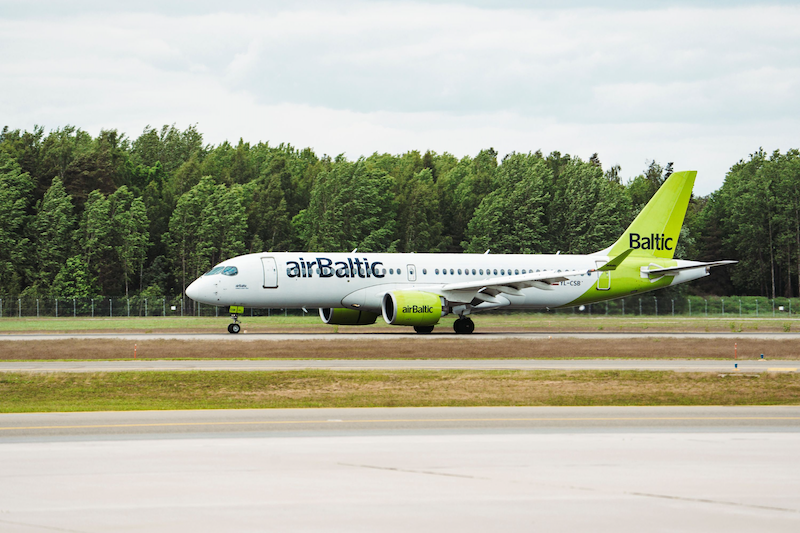
Latvian carrier AirBaltic plans to reduce its Airbus A220-300 fleet by one-third before the end of the year and concentrate its network more heavily around Riga while seeking €225 million ($260 million) in interim financing.
A revised business plan calls for the airline to operate about 36 aircraft by year-end, compared with 54 currently. Its fleet would then grow gradually to 40 aircraft by the end of the decade—a substantial climbdown from the previous ambition to operate 100 aircraft by 2030.
“The previous business plan, developed in preparation for the planned initial public offering, envisaged sustained growth in passenger volumes and ticket revenue across the Baltic region and wider European markets, supporting expansion towards a 100-aircraft fleet,” a statement from airBaltic says. “Since then, the operating environment has changed materially. Demand and revenue growth have moderated, geopolitical developments in Ukraine and the Middle East have increased uncertainty and operating costs, and prolonged Pratt & Whitney engine availability constraints have affected the airline’s ability to deploy its full fleet.”
AirBaltic is seeking €225 million in interim financing to meet near-term liquidity needs, with the funding set to be secured against assets already backing bonds due in 2029, which the airline values at €506 million on a going concern basis.
The interim loan would bridge AirBaltic to a permanent recapitalization comprising up to €225 million of new debt and €100 million of new equity. Part of the existing bonds would be converted into equity, with the remainder replaced by up to €125 million of reduced debt.
None of the proposed financing has been completed, and implementation remains subject to stakeholder agreements, bondholder resolutions and other approvals. A reconvened bondholder vote is scheduled for Aug. 17.
Under the new network plan, Riga International Airport will remain the airline’s primary hub through a “demand-driven” strategy that prioritizes frequency and depth in established markets over adding destinations. The airline says secondary bases will provide “selected point-to-point services,” while tactical and seasonal flying will be used to improve aircraft utilization rather than drive long-term expansion.
The strategy marks a shift from AirBaltic’s recent expansion. OAG Schedules Analyser data shows that the airline is offering about 4.45 million scheduled seats across its network during summer 2026, up 5.1% from 4.23 million a year earlier. The number of airport pairs served has increased from 109 to 122.
Departing capacity from Riga has risen by 4.7% to approximately 1.7 million seats, with the airline serving 73 destinations compared with 68 in summer 2025. AirBaltic accounts for 63.9% of all scheduled departure capacity from Latvia this summer, up from 62.2% a year earlier.
Across Latvia, Lithuania and Estonia, the airline is offering approximately 2.55 million departure seats, an increase of 4.6%. However, its combined share has slipped from 38.8% to 37.5% as the wider Baltic market has expanded more quickly, led partly by growth from Wizz Air.
The revised business plan sets out an initial contraction in AirBaltic’s network. Scheduled-service available seat kilometers (ASK) are projected to fall by 9.4%, from 9.6 billion in 2026 to 8.7 billion in 2027. Capacity would then recover gradually to 10.5 billion ASKs by 2031.
The airline adds that it plans to increase its ACMI (aircraft, crew, maintenance and insurance) flying to reduce the fixed-cost burden during winter, lessen seasonal volatility and provide greater flexibility to deploy aircraft where demand is strongest. The carrier is already a capacity provider for Lufthansa Group, operating 21 aircraft on its behalf during summer 2026. Lufthansa owns 10% of AirBaltic, while the Latvian state holds approximately 88%.
Fleet, network and operational changes are expected to generate about €45 million in recurring annual benefits, primarily through lower costs. The airline described its new priorities as “financial stability first, growth second.”
“Every successful airline must continuously adapt to a changing market,” AirBaltic President and CEO Erno Hildén says. “Thus, this business plan is about making disciplined choices that strengthen AirBaltic’s long-term competitiveness while preserving what matters most—reliable connectivity and operations, together with financial sustainability.”
The process follows a warning in July from Fitch that AirBaltic faced an “increased probability of default in 2026” and a “high likelihood” of default or debt restructuring without further shareholder or external funding. Latvia provided the airline with a €30 million short-term loan in April, but the government has said a strategic commercial investor is needed.
Under the revised projections, revenue is expected to fall from about €900 million in 2026 to €800 million in 2027 as capacity contracts, before reaching €1 billion in 2031. EBITDAR is forecast to rise from €158 million in 2026 to €192 million in 2027 and €300 million by 2031.
AirBaltic stressed that the restructuring is not affecting current operations, with its published flight schedule, passenger bookings and services continuing as planned.
The carrier operates a primary hub at Riga, alongside bases in Tallinn, Estonia; Vilnius, Lithuania; and Tampere, Finland. It also has winter-season bases in the Canary Islands, Spain. The airline has 40 A220-300s on order, CAPA Fleet Database shows.

Related Content

Comments
Important to add that Brussels Airlines ended its agreement for wet leases for four airBaltic Airbus A220-300s. Once the A220s currently in service finish their contracts at the end of October 2026 they will be returned to AirBaltic.