TALLAHASSEE, Florida—U.S. airlines’ mid-year decision to reduce capacity growth stabilized the domestic market, which was subsequently boosted by an unexpected rebound in corporate travel, according to Airlines for America (A4A) Chief Economist John Heimlich.
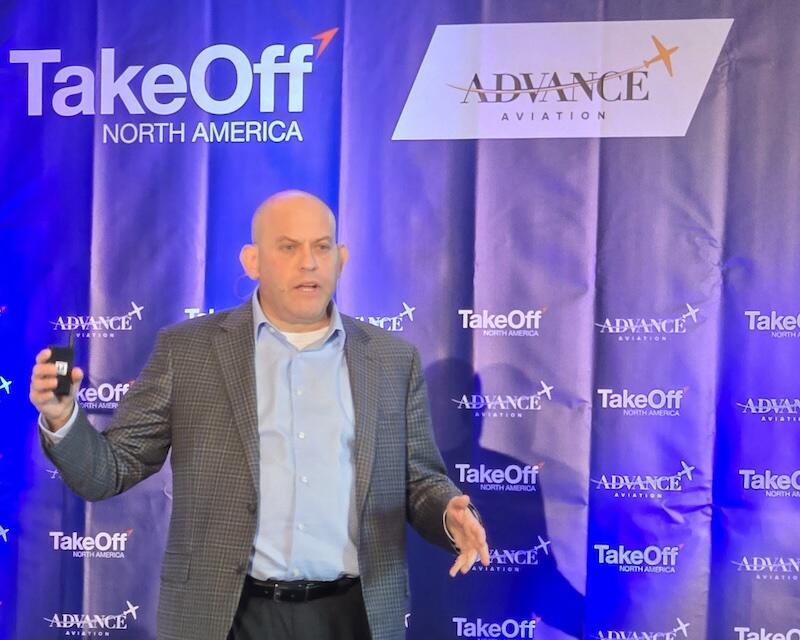
“We started to see airlines scale back their growth plans beginning in the back half of July, and lo and behold, many airlines started to see yields and load factors stabilize in the third quarter,” Heimlich said in a Nov. 5 interview with Aviation Week on the sidelines of Routes’ Takeoff North America 2025 conference here in the Florida capital.
U.S. airlines grew domestic capacity 2.5% year over year in the second quarter, but scaled back to just 0.4% year-over-year growth in the third quarter, he noted. Airfares, adjusted for inflation, were down 10% year over year in April, down 9.5% in May and down 6% in June. But fares stabilized after the July reduction in capacity growth, with August showing a 0.4% year-over-year increase and September seeing a 0.2% rise.
After scaling back capacity, U.S. airlines “had a pleasant surprise with some material return of corporate travel demand, so high-quality demand,” Heimlich said. “Domestic premium is growing faster than domestic main cabin. To the extent there has been weakness this year, it's heavily predicated on domestic main cabin, irrespective of business model.”
Shutdown Woes
The rise in corporate travel has helped airlines facing the headwind of a U.S. government shutdown that has lasted over a month. Corporate passengers “compensate for weakness elsewhere,” Heimlich said. “If you're missing some government-related travel, corporate helps a lot. Those folks spend money, possibly on your branded credit card. They use your lounges. They enjoy premium cabins. They might travel internationally.”
While the impact to demand related to the government shutdown was “muted” in October, a failure to quickly resolve the impasse over federal spending will start to weigh on carriers, Heimlich said.
Airlines have “exposure to federal government travel and government-associated travel, which includes contractors, consultants, people who would be meeting with government workers who are furloughed—those meetings are not happening,” he explained. “It's not just the federal workers themselves who are affected. That exposure varies significantly depending on where your hubs are and where your focus cities are.”
If the shutdown persists, airlines’ finances are likely to be affected, Heimlich said, “in large part because of the uncertainty over the system's reliability. Also, the longer it drags on, the longer workers—federal or otherwise—are going without pay and are therefore likely to pull back their spending more sharply. It might impact their future vacation decision.”
Spirit Cutting
By far the largest capacity adjustment in the U.S. airline market has been made by Spirit, which filed for Chapter 11 protection in August just five months after the company emerged from its prior bankruptcy restructuring. The carrier’s fourth-quarter capacity will be down 34.3% year over year, Heimlich noted.
Multiple U.S. airlines are taking advantage of “tactical opportunities” to secure airport gates Spirit has abandoned or fill gaps in service on routes the ULCC has cut, he said. “To say that the competition is opportunistic would be an understatement.”
Heimlich noted JetBlue Airways executives have said Spirit’s situation opened up a “generational” opportunity to add gates at Fort Lauderdale-Hollywood International Airport (FLL). The south Florida airport serves as Spirit’s base, but the struggling carrier has been forced to cut back at FLL.
Low Margins
Despite a stabilizing market, U.S. airlines continue to operate at low profit margins compared to other sectors such as technology, Heimlich noted. Headwinds include elevated maintenance costs and air traffic control inefficiencies.
“I would emphasize that even before the shutdown, we were confronting major air traffic control issues, most notably chronic staffing shortages,” Heimlich said.
He said main cabin sales weakness continues to be a concern, driven by “a weakening jobs market and the fact that those who fly in domestic main cabins are more exposed to overall U.S. inflation, which ticked up over the last few months. And they’re less likely to benefit from a healthy stock market.”
While U.S. airlines’ financial performance is expected to be mixed in 2025, with some carriers profitable and others losing money, in aggregate the industry “should be in the black for the year,” Heimlich said. “But we're not talking Apple's profit.”

Related Content