This article is published in Air Transport World part of Aviation Week Intelligence Network (AWIN), and is complimentary through Aug 24, 2026. For information on becoming an AWIN Member to access more content like this, click here.
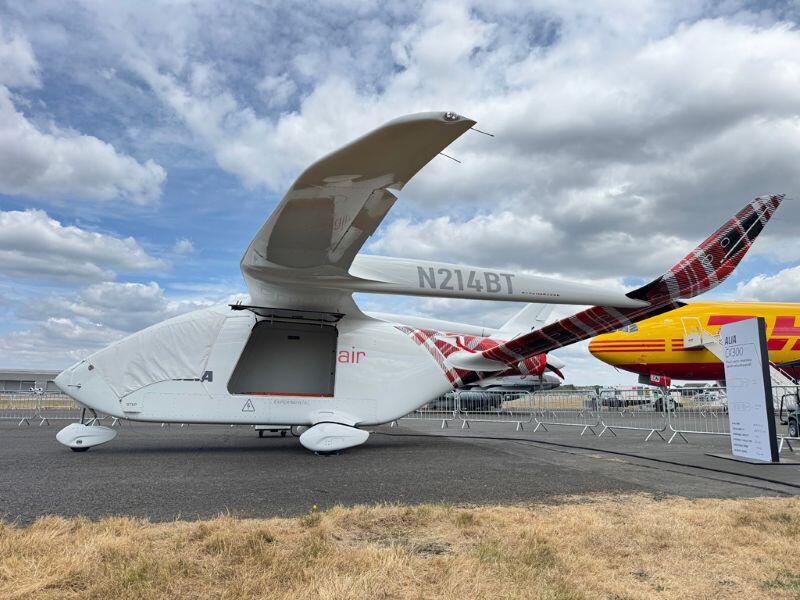
A BETA Technologies ALIA CX300.
FARNBOROUGH: UK regional carrier Loganair has signed an agreement with US-based BETA Technologies to become Europe’s first airline to operate an electric aircraft fleet.
The agreement between the two companies is for five of BETA’s ALIA conventional takeoff and landing (CTOL) CX300 aircraft. The deal includes five options.
The CX300 can carry up to five passengers or 5.7 m3 of cargo. Powered by a single H500A electric motor, it has a demonstrated range of 336 nm and a cruising speed of 153 kts. Importantly, a recharge takes only around 35 minutes.
Loganair, the UK’s largest regional airline, operates a network of services throughout the north and west of Scotland, as well as flights throughout the wider UK.
BETA and Loganair say that the UK, and Scotland in particular, is a natural first market for commercial electric flight, with island and remote communities depending on ultra-short air services.
Most of Loganair's regional sectors are under 100 mi., well within the CX300's mission profile. The aircraft operates from existing runways.
Entry into service with Loganair is scheduled for 2029.
The agreement builds on the UK’s first electric flight demonstration program that was completed in March, when a BETA CX300 flew 23 flights in 10 days across Loganair’s network, connecting Aberdeen, Dundee, Glasgow, Inverness, Kirkwall and Wick. The aircraft covered more than 1,000 nm in operational conditions, validating performance, ground handling, charging and integration into existing airport and airspace systems, as well as demonstrating a model for short regional routes across the UK.
The aircraft will support passenger and cargo operations across Loganair's network, delivering greater operational flexibility with lower operating costs and zero in-flight emissions. The agreement also includes plans for technical support and integration to ensure the aircraft can be introduced seamlessly into Loganair's existing fleet.
"This is a truly historic moment for Loganair and for European aviation,” Loganair CEO Luke Farajallah said. “Our demonstration program earlier this year proved that electric aviation is no longer a future concept, it is a viable commercial opportunity. The aircraft demonstrated the potential to reduce operating costs by up to 80% while maintaining the reliable regional connectivity our customers and communities depend on.”
"Loganair has spent six decades connecting communities that rely on air travel, so their standard for new technology is appropriately high,” BETA founder and CEO Kyle Clark said.