This article is published in Aviation Daily part of Aviation Week Intelligence Network (AWIN), and is complimentary through Dec 26, 2025. For information on becoming an AWIN Member to access more content like this, click here.

Emirates’ Tim Clark Pushes 777-10, A350-2000

Tim Clark

Tim Clark, president of Emirates, holds court at a Dubai Airshow briefing.

Credit: Jens Flottau/Aviation Week Network

DUBAI—Emirates Airline President Tim Clark believes his desired stretched version of the Boeing 777X dubbed the “777-10” would only be available well into the 2030s, while he is also pushing Airbus to look at a larger variant of the A350.

Emirates placed a follow-up order for 65 777-9s on Nov. 17, a deal that included the option to convert to a larger version of the 777X, should Boeing launch one. 

“We want them to take a good hard look at a stretch,” Clark told reporters at the Dubai Airshow Nov. 18. At the same time, “Boeing has their hands full and we all know that.” 

Clark pointed to the precedent of previous aircraft iterations that would have seen gaps of 5-6 years between the different versions, “even in in normal conditions,” but acknowledges it would take longer now.

For Emirates, the key is to be able to replace the Airbus A380 fleet in the late 2030s and early 2040s with an aircraft that is as large as possible. Worsening hub congestion will add to the pressure to keep seat count high. 

However, the planned move to the new Dubai World Central (DWC) airport, which is readying its next expansion for 2032, will make it easier for Emirates to increase frequencies than at the very constrained Dubai International Airport (DXB). DWC will be able to handle 190 aircraft on the ground at the same time, Clark said.

The strategic planning of Emirates is currently focused on what the airline will look like after the airport has opened and how it can grow into 2040.

Clark believes the 777-10 is technically feasible. “A maximum takeoff weight increase is coming anyway, the wing will be standard for the -9 and everything else. The GE engine has growth in it as well,” he said.

Clark is convinced that, if Boeing launched the 777-10, Emirates would be not the only customer. He has told the manufacturer that “if you do this, we will not be alone.”

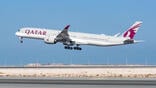
Emirates also wants Airbus to launch an “A350-2000” stretch. “My phone is full of messages between me and [Airbus Commercial CEO] Christian Scherer,” Clark said. However, he thinks it will be harder for Airbus to do a larger version of the aircraft than for Boeing to stretch the 777, partly because it would have to be “a new engine for the -2000.” The Rolls-Royce Trent XWB-97 “does not have the capabilities under our conditions,” noting the hot and dusty environment Emirates operates in.

Clark believes that Airbus and Rolls-Royce have “a conundrum in their hands, but it is all fixable.”

As for the 777-9 delays, Clark said that “Boeing is aware of the staggering effect” they have had on his airline and “Boeing is accommodating,” while declining to go into details of arrangements between the two companies. He stressed that Emirates was not buying aircraft “for the sake of offsetting compensation” but “we know 16 years out what we are going to do.” As average aircraft size comes down with the A380s being retired over time, “you have to get the frequency up.”

“The most important thing is to get the aircraft up and flying,” he said. Clark also does not expect any serious issues at entry-into-service. “The 777-9 has got to be the most tested airframe and engine in the history of aviation. I would be very surprised if it would give us major problems.” 

Emirates was supposed to have received the first 777-9 in 2020, but is now expected delivery in 2027. The airline has 270 777Xs on firm order, also including the -8 and -8F variants.

Jens Flottau

Based in Frankfurt, Germany, Jens is executive editor and leads Aviation Week Network’s global team of journalists covering commercial aviation.