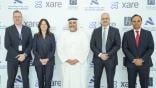
AACO Secretary General outlines key issues in his speech at the AGM
Abdul Wahab Teffaha, Secretary General of Arab Air Carriers Organisation, has outlined key issues in his address at the AGM in Cairo starting with the Global Economic Crises.
“The global economic crises refocused the attention on certain realties which perhaps became blurred during the modern times,” said Teffaha. “We have seen governments focusing on revitalising their national institutes and bailing them out of the crises, effectively creating the tools that would jump-start their national economics as a first priority. The second priority was for governments to deal with the immediate neighbourhood because any continuation of crises in that neighbourhood will adversely impact the economic stability of that region, as we have seen with how the European Union dealt with the Greek economic crises.
Teffaha went on: “In spite of the liberalisation principles and policies, we have heard that some air transport leaders are calling for the restraint of the growth of other airlines who have already extracted new opportunities from the global crises, advancing their global competitiveness. Those leaders based their restraining calls on nationalistic ideas which we in the industry believe are relics of the last century rather than valid ideas for the 21st century. This makes us wonder; are the calls for globalisation and freedom of market access and of ownership only valid when they fall in the interest of certain airlines, and invalid once other airlines benefit from them? Are these leaders actually calling for a return to providing customers with choices based on the flag that the airline carries rather than the value it delivers to them?”
Switching to another issue Teffaha said the AACO approved at its last general meeting a resolution calling for the support and implementation of the Istanbul Declaration, and the Agenda for Freedom, which IATA initiated.
“This agenda calls for the removal of obstacles from market entry and the national ownership of airlines. Many governments around the world, some Arab, have responded positively and signed the Montebello Declaration showing commitment to the principles of this agenda. On top of the list of countries that signed this agreement were the European Union and the United States,” said Teffaha.
Quashing rumours that Arab airlines are given subsidies Teffaha said: “Arab airlines continue to grow and to be profitable because they provide the consumer with value for money, a high quality product, convenient network, modern aircraft, and ease of transit in modern airports.
“Arab airlines are able to compete on price because our cost structure is much lower that our competitors due to our modern fleet which consumes less fuel, a lower cost for human resources which includes social cost simply because more than 50% of the Arab population is younger than 25 years old. The region also enjoys a friendly tax environment which again contributes to lower cost, and finally the Arab airlines do not have to spend almost 20 minutes on average to take off or land in Arab airports because we don’t suffer with congestion.”
Another topic high on the agenda was the challenges airlines’ are still facing with the environmental footprint. Teffaha said: “There were high hopes attached on COP 15 in Copenhagen under the UNFCCC. Perhaps the failure of this conference to reach a compromise between the historical and cumulative responsibility of the advanced economics in the climate change, and the needs and requirements of developing nations has provided a breathing space for aviation to deal with this issue through the only forum which can deal with the global issues of aviation, that being the ICAO.”
Related Content