This article is published in Aerospace Daily & Defense Report part of Aviation Week Intelligence Network (AWIN), and is complimentary through Oct 31, 2026. For information on becoming an AWIN Member to access more content like this, click here.
Army R66 Decision Will Not Influence Rotary-Wing Training Trend – Airbus Helicopters CEO
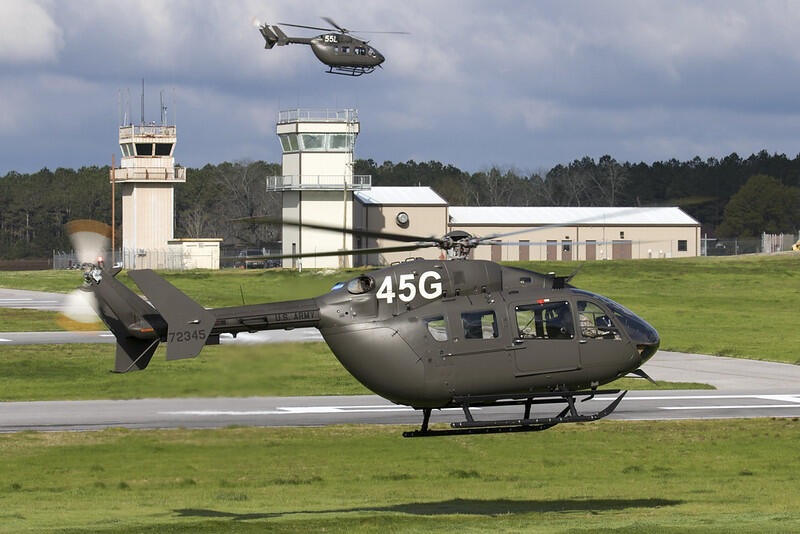
The U.S. Army is replacing its UH-72A Lakotas used for training with the Robinson R66.
MARSEILLE, France—Airbus Helicopters CEO Matthieu Louvot does not expect other countries to follow the U.S. Army’s move toward smaller, single-engine helicopters for rotary-wing training.
In August, the U.S. Army selected a proposal from M1 Support Services to use the Robinson R66 single-engine light helicopter as its new rotary-wing trainer, replacing the Airbus UH-72A Lakota at the Army’s flight school at Fort Rucker, Alabama.
Army leaders suggested that a series of mishaps involving front-line rotorcraft exposed deficiencies in fundamental piloting skills, including power management and recovery from spatial disorientation.
They concluded that introducing a trainer that emphasizes core rotary-wing flying skills rather than encouraging reliance on aircraft systems would lead to more capable pilots, trained at a lower cost.
Airbus had lobbied hard to retain the Lakota as the Army’s trainer, proposing a revised training syllabus, a hybrid training approach combining twin- and single-engine helicopters, and changes to contractual arrangements. The efforts were unsuccessful.
Several countries have adopted twin-engine helicopters for military flight training, with Airbus’ H135 entering service in Australia, Canada, Germany and the UK. Some operators see advantages in training pilots on aircraft with characteristics similar to the larger frontline helicopters they will eventually fly.
“I do not fear a new propagation of the American [training] concept in other customers,” Louvot told journalists at Airbus Helicopters’ MDays military rotorcraft event here on Oct. 8-9.
“Customers are making their own choices, and the U.S. has made theirs, we respect it,” Louvot said. “We still think the Lakota as it is, is a great aircraft to train in, especially when you transition to very large helicopters like the [Sikorsky] Black Hawk or [Boeing] Apache.
Airbus expects military training sales of its 3-metric ton H135 to continue and can also offer the smaller, 2.4-metric ton H125 single-engine helicopter.
However, Airbus no longer has a helicopter at the lower end of the market to compete with even smaller trainers, having ended production of the 1.7-metric ton EC120 in September 2017 after delivering around 700 aircraft.
The EC120, also known as the Colibri, remains in use as France’s primary rotary-wing trainer.
Louvot suggested Airbus could turn to Helicopteres Guimbal, the Aix-en-Provence, France-based helicopter manufacturer in which it holds a stake, if France or other countries seek a smaller training helicopter.
Guimbal revealed in March that it was advancing development of its new GrandCabri G5 rotorcraft, which could enter the market by the end of the decade.
“It’s true we don’t have an exact successor of the EC120; we do have sister companies we could work with as well, so we will see when the time comes if and when France wants to change their helicopters,” Louvot said.

Related Content