This article is published in Aviation Daily part of Aviation Week Intelligence Network (AWIN), and is complimentary through Nov 25, 2026. For information on becoming an AWIN Member to access more content like this, click here.
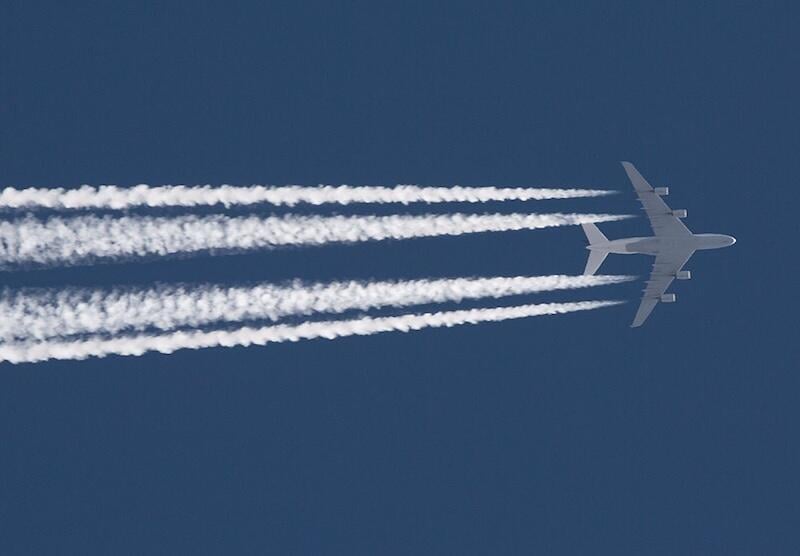
A road map targeting a significant reduction by 2040 in contrails formed in UK-administered airspace, including heavily used regions for transatlantic traffic, has been put forward in a new policy whitepaper.
Produced by the University of Cambridge’s Aviation Impact Accelerator (AIA) group, the road map builds on three major planks: aviation forecasts, new flight-planning standards and financial incentives. Together, the mutually reinforcing measures are aimed at making the UK the first country to include contrail avoidance as a routine part of flight operations.
The paper proposes that the Met Office, the British weather forecaster, should be mandated to include forecasts of contrail-forming ice supersaturated regions of the atmosphere as standard in the data it supplies to the aviation sector. Flight planning software providers, airlines, dispatchers, pilots and air navigation service providers such as the UK's NATS all rely on the Met Office data.
A second proposed measure recommends that the UK government, through the Civil Aviation Authority (CAA), should establish a minimum standard for flight planning software to offer a contrail avoidance option. In addition, it proposes the CAA should require airlines to consider contrail avoidance in flight-by-flight planning.
Third, and perhaps most controversially, the paper proposes a “modest surcharge and discount mechanism” be set up as an airspace charge incentive. The charge, it says, should be “applied through existing NATS route charges,” which would be targeted at making planned and evidenced contrail avoidance “the economically rational default.”
Although the initial plan is UK focused, AIA says the overall impact on reducing global contrail effects on atmospheric warming would be significant given the strategic location of the UK as a gateway for the bulk of North Atlantic traffic from and to Europe. In addition, it foresees the policy road map as paving the way for expansion into similar schemes connecting the UK with the European Union (EU), Canada and other parts of the world.
“The envisaged road map progresses through multiple phases, from foundation and capability building, through voluntary demonstrations, to economic incentives and the embedding of contrail avoidance in business-as-usual commercial aviation as part of an eventual global system,” AIA says.
“One possible expansion pathway runs as follows: from the UK to the EU and Canada, and finally to a globally coordinated system, potentially administered through ICAO or another international body,” AIA adds.
The paper recommends the UK take immediate action because research indicates contrails are likely to exceed aviation’s CO2 warming effect by 2050 if nothing changes. AIA says almost half of aviation’s climate warming impact can be avoided if contrail mitigation is phased in from 2035 to 2045. It warns that delaying that by 10 years could cut this potential benefit by around 75%.
Although the road map acknowledges that contrail avoidance can frequently result in extra fuel burn, the reduction in warming is forecast to overcome the penalty of the additional CO2 emissions by around 100 times.
“Even under pessimistic assumptions of an extreme 10% fuel burn penalty, low effectiveness and slow demand growth, a net warming reduction from contrail management activity remains overwhelmingly likely,” AIA says. “The study finds the mean contrail warming reduction is around 15 times the associated fuel burn penalty in 2050, even in the worst case, and over 400 times under the more realistic sub-1% penalty,” it adds.
From a technical feasibility perspective, the paper argues that the existing system for forecasting and avoiding turbulence already proves that a similar process could be adopted for contrail avoidance.
To work at all, the AIA says the road map depends first on the establishment of the common Met Office contrail formation data layer for flight planning purposes. Second, the data must be useable in existing flight-planning tools. Third, a surcharge-and-discount, or “feebate” scheme, needs to be designed to create incentives to make contrail avoidance into a business-as-usual practice.
As an example of how a fee and rebate scheme might work in 2030, the paper suggests that a flight flagged by the contrail formation forecast, but which kept to its route and was later confirmed to have crossed a contrail-forming region, should pay a flat fee that is five times the fuel cost of avoiding the region. The fee income would be paid back in the same year as an equal rebate to each flight confirmed to have avoided a region that was there, after a 10% share is kept toward running costs in 2030 to 2034.
Alongside this, the paper recommends that a small service charge be applied to every flight in UK-administered airspace to cover the rest of the running costs and the extra fuel burned on accepted avoidance plans. This would be repaid in full to 2035 and on a falling scale to zero in 2040. The cost of extra fuel would be repaid, capped at a published benchmark, and credited on the route-charge bill in the same settlement as fees and rebates.
“Avoidance means a change of flight level; lateral rerouting is neither rewarded nor charged. The scheme is designed to carry no net public cost in any year: fee income is spent within the scheme in the year it is collected, mostly as rebates, and the service charge is reset each year to cover the remaining running costs and fuel repaid,” AIA says.
The paper also outlines a five-phase implementation plan beginning immediately and running through 2028 with a period focused on improving upper tropospheric humidity data, developing accurate contrail forecasting and measurement capabilities, and establishing operational and policy building blocks.
Phase two, from 2028 to 2030, would cover a series of voluntary demonstrations involving the UK, airlines and transatlantic partners such as Nav Canada and AirNav Ireland focused on gaining operational experience and proving the basic feasibility of pre-tactical navigational avoidance procedures.
The third phase, from 2030 to the mid-2030s would focus on creating the economic incentives, while the fourth phase—running in parallel from 2030 onwards—would concentrate on an international expansion of the scheme. The following fifth phase, running to 2040, would expand the plan to include a global contrail avoidance system.

Related Content