This article is published in Aviation Week & Space Technology and is free to read until Aug 24, 2026. If you want to read more articles from this publication, please click the link to subscribe.
JetZero Moves To Higher-Thrust Engine Studies For Z4 Blended Wing Body
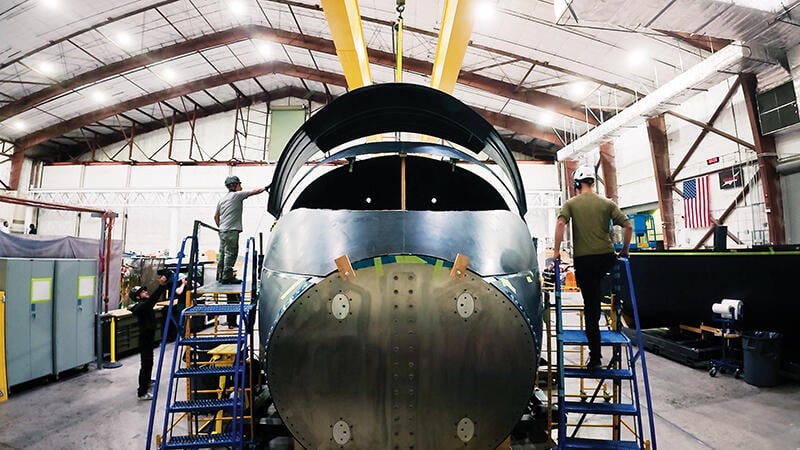
The build of JetZero’s blended wing body demonstrator is progressing at Scaled Composites in Mojave.
Blended wing body developer JetZero expects to make an engine selection for its Z4 production model within the next year as assembly of the demonstrator continues to track toward a late 2027 first flight.
Although originally baselined around 33,000-lb.-thrust-class engines, the Long Beach, California-based company selected more powerful Pratt & Whitney PW2000s for the demonstrator following input from the U.S. Air Force.
- JetZero adds Gulf Air and Japan Airlines to Advisory Group
- Engine studies include refreshed CF6 and PW4000
Even higher-thrust engines are needed for the Z4 version, says Daniel Da Silva, JetZero president and chief operating officer. “The aircraft evolved to a point where 40,000-lb.-thrust, which is what we are using for the demonstrator, didn’t seem like enough, so we’re definitely into a higher-thrust category.
“We haven’t publicly talked about what exact thrust category we’re in, but we have discussed that with the engine companies,” he says. “The Air Force has been tremendously helpful in using a commercial solutions opening process to solicit engine companies.”
Engine-makers are conducting concept studies for the Air Force Operational Energy Office with support from the 763rd Enterprise Sourcing Sqdn., which manages the JetZero contract. “They’re funding some deeper studies,” Da Silva says. “It is things like, ‘You talked about a new combustor; what combustor exactly is it? What is the schedule of that combustor? What’s your certification plan?’ ”
The engine companies expect to complete the studies by year-end. “We plan to make an engine decision over the next year,” Da Silva says. “So somewhere in that timeline, we need to firm up an engine and a schedule and move forward.”
JetZero says the aircraft’s higher design cruise altitude of 45,000 ft. and noise shielding of its blended wing body configuration enable the use of older engines—modified for current emissions regulations. “We can use a variety of different engines and quite a wide berth of bypass ratios, depending on the power of the core,” Da Silva says. Prospective engines could include refreshed versions of the GE CF6 and Pratt & Whitney PW4000.
As progress continues toward finalizing the Z4 design, market interest remains buoyant. Signing a letter of intent (LOI) for the commercial variant at Farnborough, Gulf Air CEO Martin Gauss nodded to the flag carrier’s future and its past.
“With the signature today, this is a big step forward, so that Gulf Air gets back into a position it used to have—to be a leader in innovation in the industry,” Gauss said.
The LOI covers an undisclosed number of Z4s with preferential delivery positions in the early 2030s.
In addition, Japan Airlines has newly declared “support and interest,” citing the Z4’s potential for gains in fuel efficiency and passenger experience. The airframer’s airline advisory group now grows to 17 members and is preparing for its fifth meeting in November.
Other carriers that have publicly announced support or partnership with JetZero include Alaska Airlines, Delta Air Lines, EasyJet and United Airlines.
Assembly of the demonstrator is underway at Northrop Grumman’s Scaled Composites site in Mojave, California (AW&ST July 13-26, p. 90). JetZero also broke ground in June on an 8-million-ft.2 factory in Greensboro, North Carolina. Under an LOI announced at Farnborough, JetZero and the U.S. Export-Import Bank (EXIM) intend to explore up to $3 billion in potential financing support for the manufacturing campus under its Make More In America initiative.
Project costs eligible for financing may include construction of manufacturing facilities, production systems and equipment, JetZero said. EXIM’s potential support remains subject to necessary review and approval by its board, although efforts are underway to fast-track to the next stage.
“Given all of the great progress JetZero has made, we want to advance this LOI as quickly as possible to a preliminary commitment,” EXIM Chairman and CEO John Jovanovic explained. “What we would have is outlined conditions precedent where, as these guys continue to perform and meet every milestone, the one thing they don’t have to worry about as a constraint is capital.”
JetZero described the LOI as an important step forward. The company plans to file for type certification this year and to enter commercial production before the end of 2030.