This article is published in Aviation Week & Space Technology and is free to read until Jul 23, 2026. If you want to read more articles from this publication, please click the link to subscribe.

Opinion: Celebrating Human Ingenuity And Technological Innovation
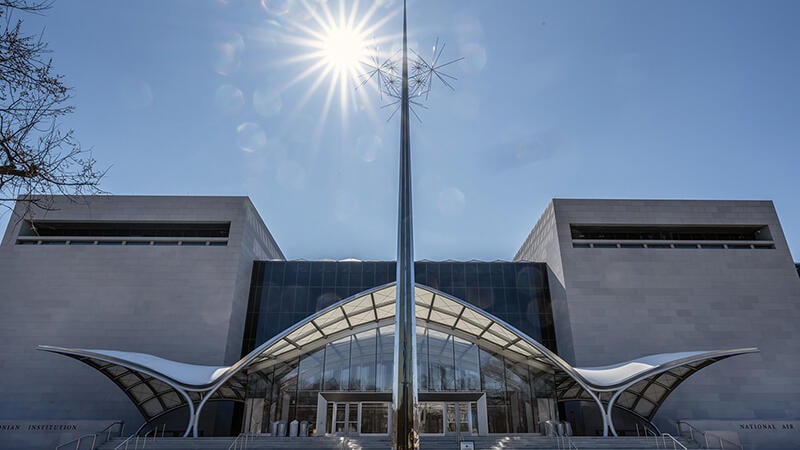
Smithsonian National Air and Space Museum
Credit: Smithsonian National Air and Space Museum

I was a sophomore at Dartmouth College when I made my first visit to the National Air and Space Museum in Washington. It was 1977, and the museum had opened a grand new building the previous year—on July 1, 1976.

While walking through the galleries, I noticed a large airplane hanging from the ceiling. It was a Douglas DC-3. I stood there for a long time—impressed by the sturdy landing gear, the streamlined nose and the long, tapered wings. I had flown in a DC-3 as a younger teenager and had long been fascinated by this storied aircraft. Seeing it so prominently displayed reminded me of the joys of flying, and I left the building that day determined to earn my private pilot’s license.

Soon thereafter, I changed my postgraduation plans by joining the U.S. Navy and logging more than 1,500 hr. and 320 carrier landings in the Grumman F-14 Tomcat. Then came a long career managing two airports in the U.S. capital: Ronald Reagan Washington National and Washington Dulles International.

In 2022, I became the director of the very museum that had first inspired me to purse a professional life in aviation. I have experienced firsthand the power of this institution, but my story is not unique. Numerous people have told me that their first visits to the museum were also life-changing, and many of them have taken up careers in aerospace.

Given the museum’s influence on my life and on countless others, I am pleased to announce that we will be celebrating the 50th anniversary of our flagship building this year with a series of programs and special events. Most important, we are completing an extensive renovation that began in 2018. Five galleries in the building’s east end will reopen on July 1, and the two remaining galleries will reopen by November. The ongoing renovation has granted us the rare opportunity to reimagine and modernize our galleries and exhibit spaces.

The museum’s 50th birthday coincides with an even more important one: the 250th anniversary of our nation’s founding. In my mind, the two anniversaries are beautifully intertwined. The museum has a responsibility, after all, to document American achievement in aeronautical engineering and space exploration. It is worth noting that powered, heavier-than-air aviation was born in the U.S. when Wilbur and Orville Wright flew their fabric-covered biplane, the Wright Flyer, over the dunes of Kitty Hawk, North Carolina, on Dec. 17, 1903.

What is it about the U.S. that makes it such fertile ground for invention? The Declaration of Independence, which marks the founding of the U.S. on July 4, 1776, famously mentions “life, liberty and the pursuit of happiness.” This statement affirms the U.S. as a land that recognizes self-determination and the rights of individuals, and the Wright brothers are indeed a shining example of self-determination. With the stability of American democracy as their bedrock, Orville and Wilbur had the freedom to pursue their dreams as pioneers of flight. The Wright Flyer is arguably the most seminal artifact in the museum’s collection, and we have built an entire exhibition around it in hopes that Wilbur and Orville’s story will inspire a new generation of aeronautical engineers.

Relatively speaking, the U.S. is a young nation, and part of being young is not accepting limitations. With youth comes a curiosity to discover the world and the belief that all things are possible. One of the museum’s most iconic airplanes, in fact, was born from the boldness of youth. In 1927, Charles Lindbergh was a 25-year-old air mail pilot when he made the first nonstop solo flight across the Atlantic. His New York-to-Paris crossing in a simple but robust monoplane named the Spirit of St. Louis changed the world, and it forever changed the life of the young man who had the courage to make that long, lonely flight over a vast ocean.

So, in this year of anniversaries, let us stay young in spirit. Let us never cease to preserve our nation’s independence. Let us not shy from the challenges that come our way. If we continue to do these things, we can be certain that 50 years from now, the National Air and Space Museum will be what it always has been: a monument to human ingenuity and technological innovation.

Christopher U. Browne is the John and Adrienne Mars Director of the Smithsonian National Air and Space Museum.