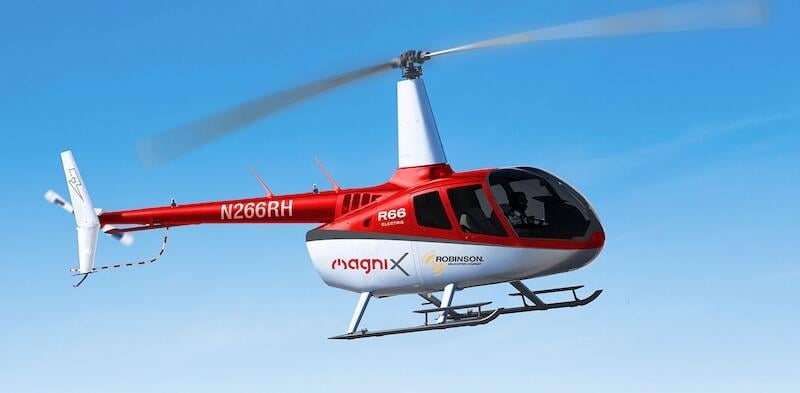
KULR’s battery pack will power MagniX’s Helistorm electric engine in the Robinson eR66.
Better known for its battery safety and thermal management capabilities, KULR Technology Group is moving into electric aviation with an agreement to provide the battery system for Robinson Helicopter Company's eR66 electric light helicopter demonstrator.
Powered by a MagniX Helistorm electric motor producing a peak 324 kW (434 shp) and continuous 221 kW, the eR66 demonstrator is planned by year-end. Robinson is targeting the electrified R66 at low-noise, zero-emission organ delivery and short-haul transport.
The battery system will be based on the KULR Air One (KA1) system, using KULR’s passive propagation resistant (PPR) architecture to prevent a thermal runaway spreading from cell to cell and module to module. KULR is already producing KA1 batteries for drone applications.
Passive propagation resistance is a key approach to developing a certifiable battery system for electric aircraft and an alternative to containing the fire resulting from a thermal runway at the module level.
“The KULR One platform is our end-to-end battery system,” says KULR CEO Michael Mo. “Our experience is that to build a passive propagation-resistant battery pack you need to understand the battery cell chemistry, the cell behavior, what happens when it goes into thermal runaway, how much energy is released, how it is released, in what timeframe, how the heat dissipation goes, how the eject air flows.
“Then you take that to do your design, from simulation to prototype testing, and you can produce a battery module that can be passive propagation resistant,” he says. “Then you can put those modules together and become module-to-module propagation resistant and create a safe system whether it’s 8 kWh all the way to megawatt hours.”
KULR has assembled a suite of tools for battery testing and thermal management. This includes internal short circuit technology licensed from NASA that enables thermal runaway to be triggered for testing, as well as fractional calorimetry technology to measure the heat generation and energy release from a thermal runaway, also licensed from NASA.
KULR has developed a thermal runaway shield to prevent cell-to-cell propagation. This is a thermal capacitor that vaporizes, absorbing excess heat and preventing adjacent cells exceeding 100C (212F), well below the 130C danger zone where propagation becomes likely. Swiss electric aircraft battery developer H55 uses KULR’s passive propagation-resistant technology, Mo says.
The company produces battery systems that meet NASA safety requirements for crewed spaceflight and is supplying a number of private space companies, Mo says. KULR is developing an energy-dense silicon-anode battery for a U.S. Army application. “Most recently our big push is into KULR One Air,” he says. While mainly targeting drones, these batteries are also aimed at autonomous land and sea vehicles.
“The Robinson engagement is built on top of all this safety and thermal-management-oriented battery design work we’ve done over all these years,” Mo says. KULR has looked at electric aviation before but was reluctant to engage with risky startups—and sees 53-year-old Robinson as a safer bet.
Robinson and KULR have agreed on an approach that aligns battery cycle life with the overhaul interval of the helicopter. “We’re designing a battery pack that will meet the customers’ need for the number of flight hours after which the airframe will be refurbished,” he says. Mo does not give a number, but the overhaul interval for the R66 is 2,000 hr.
When the battery reaches its first life cycle limit, it will be removed from the helicopter, returned to KULR and repurposed for a second life in stationary energy storage. “So X number of flight hours later, this battery pack is perfectly fine for many other applications, for many years to come,” he says.

Related Content