This article is published in Aviation Week & Space Technology and is free to read until Apr 09, 2026. If you want to read more articles from this publication, please click the link to subscribe.

Guimbal Eyes Grand Rotorcraft Family With Five-Seater Development

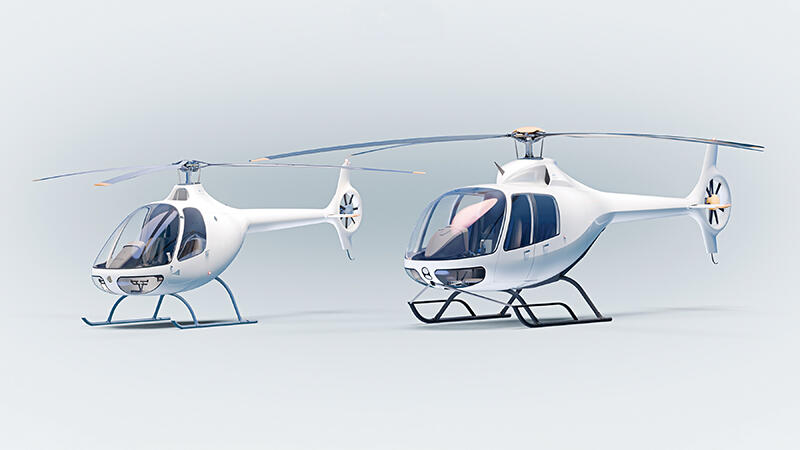
concept art of Guimbal Cabri G2 (left) and Grand Cabri G5 (right)

The new Grand Cabri G5 (right) takes numerous design cues from the two-seat G2, and founder Bruno Guimbal is confident it will generate interest among G2 owners and training providers.

Credit: Helicopteres Guimbal

Helicopteres Guimbal—France’s other major rotorcraft manufacturer besides Airbus—is finally growing its portfolio with the development of a five-seat turbine helicopter.

The Guimbal Grand Cabri G5—unveiled on the opening day of the Verticon rotorcraft industry exhibition in Atlanta on March 10—is the company’s answer to Robinson’s R66, Bell’s 505 and Hill’s emerging HX/HC50, which is due to make its first flight this year. It also is intended to address a gap in the market between Guimbal’s first product, the Cabri G2, and Airbus’ H125 single-engine helicopter. Airbus previously addressed this segment with its 1.7-metric-ton H120, which the airframer stopped producing in 2017.

  • Safran Arrius-powered design builds on the Grand Cabri G2
  • Guimbal G5 could also target the military trainer role
  • The airframer is not detailing a timeline for market entry

The new model emerges 26 years after founder Bruno Guimbal established the company and nearly 20 years after the two-seat Cabri G2 piston helicopter, was certified. Development of the G5 has been an open secret for several years. An artist’s rendering of a larger Guimbal concept rotorcraft circulated several years ago, hinting at the project.

Plans have now advanced significantly. Guimbal said his 10-person engineering team has frozen the configuration, finalized component specification and elastomeric main rotor system design and selected an engine—Safran’s 450-shp Arrius 2D turboshaft.

The company has also begun negotiations with potential suppliers and built tooling to support production at its Aix les Milles facility, located just a few miles from the Airbus Helicopters Marignane site, where Guimbal previously worked as a rotor system engineer.

Despite that progress, Guimbal was reluctant to commit to a development timeline or a first flight date. He told visitors gathered at Verticon that he wanted to achieve certification by the end of the decade. 

Guimbal acknowledged that existing Cabri G2 customers are eager for a larger aircraft. Some have even postponed purchasing the G2 to wait for a more capable model to appear. He said he is following a philosophy like the one Robinson Helicopter adopted during development of the R22, R44 and R66: The aircraft will be ready when it is ready.

At the same time, Guimbal hopes the G5’s development will not take as long as the G2’s. He first flew a Cabri G2 demonstrator in 1992 while still working at what was then Eurocopter, but a production model did not reach the market until 2007.

Since then, more than 400 Cabri G2s have been sold, and the type has become a popular training and light general aviation helicopter. The platform also forms the basis of the Airbus-Naval Group VSR700 uncrewed rotorcraft, which the French Navy ordered this year.

The importance of the Cabri G2 to Airbus is reflected in the aerospace giant’s recent minority investment in the company. Guimbal described the move as significant, although he said it is more consequential for him and his family than for the company itself. Airbus’ stake does not extend to the G5 program, he insisted, although he noted that Airbus likes the concept.

Guimbal intends to take a family approach to future products, meaning that the G5 incorporates design cues from the G2. These include a rear-mounted engine, a Fenestron ducted tail rotor and a low-aspect-ratio rotor blade of Guimbal’s own design.

Both gearbox and engine installation have been designed to be compact to preserve cabin space. Guimbal said that the G5’s cabin will have the same height (1.25 m [4.10 ft.]) and length (2.30 m) as that of the H120 but the rotorcraft will have much lower empty and maximum takeoff weights. He was coy on revealing the latter metrics, but said intensive early work is underway to remove mass from the helicopter.

Avionics selection has been simplified as well. Having developed around 20 different avionics configurations for the G2—not all of which were ultimately adopted—Guimbal said market demand clearly favors Garmin’s G500 suite. He expects the G5 will make a strong trainer, as the G2 has. Indeed, Guimbal officials are looking at positioning the G5 as a potential replacement for the H120 in French Army rotorcraft training, which is currently performed by commercial operator Helidax. Indonesia, Spain and Singapore also use the H120 for rotorcraft training.

Guimbal aims to make the G5 the quietest and smoothest helicopter in its class. “If God wanted us to fly helicopters, he would not have given us neighbors,” Guimbal joked. “But we do, so noise is a priority.”

Tony Osborne

Based in London, Tony covers European defense programs. Prior to joining Aviation Week in November 2012, Tony was at Shephard Media Group where he was deputy editor for Rotorhub and Defence Helicopter magazines.