ROME—More aircraft are urgently needed in Europe for aerial firefighting after wildfires caused more devastation in 2025 than in any previous year.
According to a report by European emergency services aviation operator Avincis, published ahead of the Aerial Firefighting Conference here on March 25–26, around 660,000 hectares were burnt annually between 2020 and 2025. That marks a steep rise on the 380,000 hectares per year recorded between 2014 and 2019.
Avincis reports a 135% increase since 2014 after last year’s wildfire season in Europe was the most destructive on record.
Avincis argues that while Europe’s firefighting system has evolved from a “loosely coordinated, reactive system” into a more “structured and proactive framework,” it remains constrained by the size of the available fleet. Some European countries still have no dedicated aerial firefighting capability.
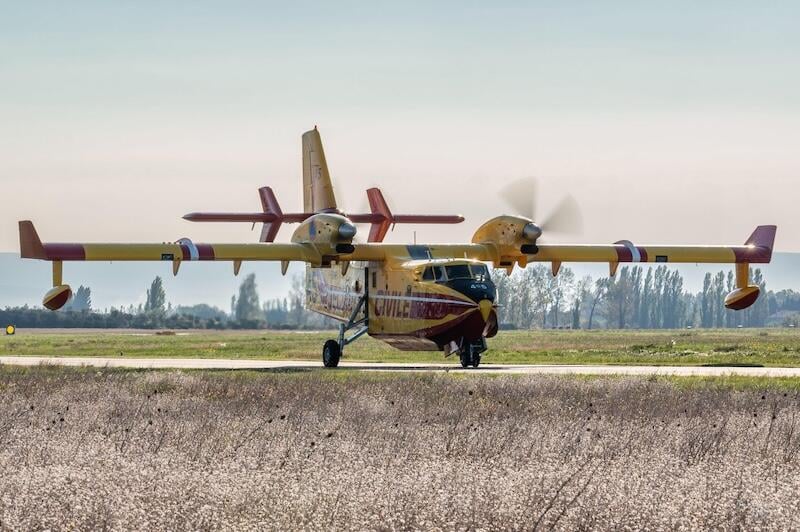
The European Union has supported several countries in acquiring new De Havilland Canada DHC-515 amphibious aircraft, but Avincis notes that deliveries have been slowed by bureaucratic hurdles. By the time they enter service, many will simply replace aging aircraft rather than expand overall capacity.
With fire seasons now stretching across much of the year, Avincis CEO John Boag argues that “year-round readiness is no longer optional.”
The company says Europe now requires firefighting capacity for all 12 months of the year.
“There is no longer an offseason,” says Ruben Garcia Medina, Avincis’ managing director for Iberia. “The wildfire period now runs from March to November, and in some years, every month. This is putting enormous stress on aircraft availability and crew training.”
This means Europe is also contending with a shrinking window to redeploy firefighting aircraft from other regions, as fire seasons lengthen globally and off-season fires become more common.
Capacity shortfalls have been exacerbated by the removal of Kamov Ka-32 coaxial helicopters from European operations due to sanctions on Russia following its full-scale invasion of Ukraine. These aircraft had been a “critical part” of Europe’s firefighting fleet, Boag says.
He argues that more heavy helicopters—such as the Airbus Super Puma, Bell 214ST and Sikorsky S-70 Black Hawk—are needed, as they can deliver water and retardant with greater precision and support night operations.
Spain and Portugal were the worst-affected countries in 2025, followed by Romania and Italy. However, wildfire risk is now spreading north into Central Europe and even the Nordic region. Sweden, for example, recorded 1,100 hectares burned in 2025.
“Europe is still spending far too much money reacting to fires, not preventing them,” Medina says. “The real question is not whether Europe can afford to invest—it is whether it can afford not to.”
Another major challenge is a shortage of personnel. As across the wider aerospace sector, the aerial firefighting community faces a scarcity of well-trained pilots.
“Making regulations more flexible to allow pilots from other regions to operate would go a long way toward solving the problem,” Boag says.

Related Content