This article is published in Aerospace Daily & Defense Report part of Aviation Week Intelligence Network (AWIN), and is complimentary through Mar 16, 2026. For information on becoming an AWIN Member to access more content like this, click here.

Bell Sees Rising Demand, Prepares Production Ramp-Up

bell 412

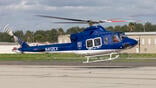
Bell CEO Danny Maldonado says there been increased interest in the company’s Bell 412 utility rotorcraft.

Credit: Tony Osborne/Aviation Week

ATLANTA—Bell is preparing for a ramp-up in production rates as it sees growth across both its commercial and military markets.

Aside from the widely publicized acceleration of the MV-75 Future Long-Range Assault Aircraft tiltrotor for the U.S. Army, the airframer has also seen market interest rise across its commercial, dual-use product portfolio—and the 505 JetRanger X and 412 medium-twin in particular, CEO Danny Maldonado told Aviation Week ahead of the Vertical Aviation International (VAI) Verticon rotorcraft expo in Atlanta.

Maldonado, who took over as CEO last October after Lisa Atherton was promoted to president and CEO of parent company Textron, said the company is now focused on building the foundation needed to support higher production rates.

“I am very upbeat,” he said. “Orders are coming in from every part of the world, every region and across all missions.”

Operators are also flying significantly more hours, which is boosting Bell’s support and services business.

However, as with other airframers, supply chain bottlenecks remain—even five years after the global pandemic.

“We have done well to increase our ramp in parts and production, but even then, there’s still opportunities to improve on the supply chain area,” he said.

Suppliers are “making strides” to expand capacity, he added, but demand remains high and some companies are struggling to keep up. Where possible, Bell is attempting to introduce second sources for critical components.

A particular pain point is casting, a crucial process in rotorcraft production, as it is used for high-strength components such as gearbox housings and transmission components.

“There are limited resources where you can go for casting houses,” Maldonado said. “There are some new entrants, but these are not sufficient to be able to service all the demand.”

Much of the surge in demand is being driven by geopolitical tensions and rising global defense spending following Russia’s full-scale invasion of Ukraine.

More recently, however, Bell appeared at risk of becoming entangled in a geopolitical dispute between Washington and Ottawa after U.S. President Donald Trump announced new trade tariffs against Canada, where Bell produces nearly all its commercial rotorcraft.

Maldonado said the company is shielded by the U.S.-Mexico-Canada Agreement (USMCA) that protects Canadian trade from many of the tariffs imposed by Trump. “As long as that [agreement] continues, we are covered where we produce aircraft and parts, so it has not been an issue,” Maldonado said.

Trump has reportedly considered scrapping the USMCA in favor of separate trade agreements with each country, although no further action has been taken.

Maldonado said Bell continues to monitor the situation and work with customers should it change.

Looking ahead, Maldonado said he is excited about the prospect of getting back into U.S. Army rotary-wing flight training. Bell’s proposal for the Army’s Flight School Next (FSN) program to refresh the service's rotary-wing training program with single-engine helicopters to replace the Airbus UH-72 Lakota is among several to have reached a third phase of the FSN contest. Bell is offering an updated version of its 505 JetRanger X. If selected, the Army could require more than 200 helicopters delivered within a relatively short time frame.

“We feel very confident,” Maldonado said. “The army has been training on Bell aircraft for many years, even decades … so we feel we have a good opportunity.”

Partners in Bell’s proposal for FSN include DigiFlight, V2X, Tru Simulation, A1A, Delaware Resources Group and Semper Fly.

Success in FSN could open the floodgates for even more sales of the 505 for military flight training, Maldonado suggested. Already, about 75 examples are being used by commercial and military flight schools globally.

Meanwhile the company’s push for FAA certification of the 525 twin-engine super-medium continues, with the program moving toward the final hurdles of function and reliability (F&R) testing. “We are in final discussions on that [F&R] area, if we can get that across the board, then …we feel we are making lots of progress,” Maldonado said.

Certification of the 525 has taken considerably longer than Bell estimated, in part because it is the first commercial helicopter to incorporate a fly-by-wire flight control system. Further delays were caused by the loss of the first prototype in July 2016, which halted flight tests for a full year, in addition to later disruption caused by the COVID-19 pandemic. Last year, Bell secured certification from the FAA for a 525 training device to help pave the way for future operations.

Orders placed in 2024 by Norwegian energy company Equinor remain in place, Maldonado said, and discussions are underway with the European Union Aviation Safety Agency to enable reciprocal certification in Europe once the FAA grants approval.

“We're responding as quickly as possible [to the FAA], to allow them as much time to be able to respond to us, but anything that we can do to accelerate [certification], we're doing it,” Maldonado said.

Certification of the 525 is a hurdle Maldonado wants to clear so he can get his engineers working on the next commercial products.

“We have had five clean-sheet designs over the last decade. Our engineers are well advanced with the latest technology, so once we certify [the] 525, we get past the MV-75, the idea is to leverage a lot of that learning and transition back into commercial products,” Maldonado said.

Tony Osborne

Based in London, Tony covers European defense programs. Prior to joining Aviation Week in November 2012, Tony was at Shephard Media Group where he was deputy editor for Rotorhub and Defence Helicopter magazines.