This article is published in Aviation Week & Space Technology and is free to read until Mar 12, 2026. If you want to read more articles from this publication, please click the link to subscribe.

Airbus Closes In On Decision To Stretch The A350

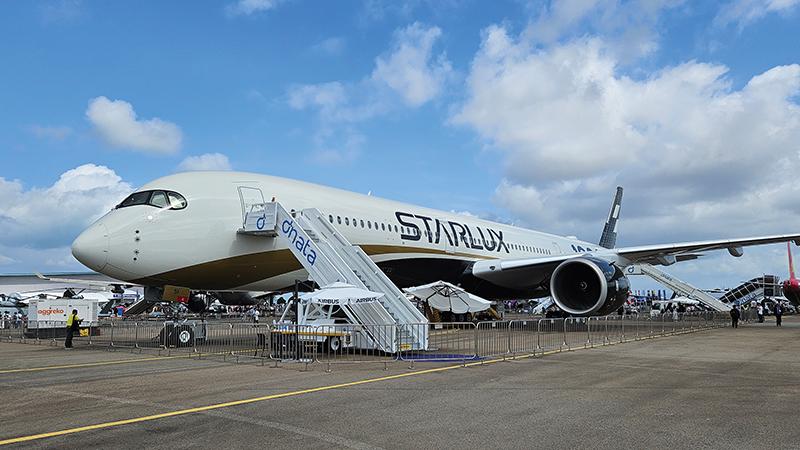
Starlux A350-1000

Airbus displayed a Starlux A350-1000 at the Singapore Airshow, demonstrating its widebody ambitions in the Asia-Pacific region.

Credit: Jens Flottau/AW&ST

Airbus has a long-established lead on Boeing in the global market for narrowbodies, but the airframer is still trailing its U.S. competitor in the widebody field. The new CEO of Airbus’ commercial aircraft division, Lars Wagner, is determined to change that.

“The focus was on single-aisle on both sides of the Atlantic, but I’m seeing the same momentum on a smaller scale coming up [for widebodies], and there is no single day on which I don’t talk about a widebody rate increase,” Wagner said days before the Singapore Airshow.

  • Airbus nears big decisions on widebody rates and an A350 stretch
  • The moves could trigger changes to industrial footprints
  • Boeing and GE investigate GE9X durability issue

“I believe the rate that we are planning right now is by far not enough,” he added. “We see further momentum, so I need to think about how to serve our customers.” Demand for widebodies is driven to a large extent by airlines in the Asia-Pacific region.

Airbus is targeting a rate of 12 A350s by 2028 to cater to the surge in widebody demand. The manufacturer delivered 57 A350s in 2025, a year in which it was heavily affected by supply chain constraints at Spirit AeroSystems and other companies. Boeing plans to increase the 787 production rate to 10 per month this year and is looking at further big production growth. The future 777X production rate is not clear yet, but Darren Hulst, vice president of marketing for Boeing Commercial Aircraft, indicated during a briefing at the Singapore Airshow that the monthly rate could ultimately exceed seven aircraft.

It is not clear what A350 production rate Airbus is considering, but it could ultimately exceed 20 per month, an unheard-of volume for widebodies. The rate increase will depend on two factors: a decision on a possible stretch of the aircraft and the results of a study into industrial capabilities of Airbus and its suppliers. The A330neo, by contrast, will remain relatively close to current rates and is unlikely to exceed five per month for the foreseeable future, industry sources say.

A decision about launching the A350-2000 is expected soon, possibly even this year. That would put the program, which has been under consideration for some time, on a timeline for service entry in the early 2030s. The aircraft’s market positioning is still being evaluated, and it has gained importance as Emirates presses Boeing to launch a larger version of the 777X, dubbed the 777-10. While no Boeing moves are imminent, Airbus will have to keep in mind the possibility of a larger Boeing 777 at some point.

Previous studies into the A350-2000 have assumed the addition of 3-4 seat rows, which would bring the aircraft more or less in line with Boeing 777-9 capacity. Making the -2000 even larger, possibly between the size of the 777-9 and a future -10, would enhance the A350-2000’s competitiveness and distance the model further from the A350-1000. Airbus must consider potential market cannibalization between the two Airbus models.

A stretched A350 would require a more powerful engine, too. The A350-1000 is equipped with the Rolls-Royce Trent XWB-97.

Expanding A350 production considerably would also likely exceed the limits of current industrial setups at Airbus and its key suppliers. Eliminating bottlenecks is an essential prerequisite for building up production volume. One bottleneck is cabin outfitting: Because many parts are arriving so late, Airbus has temporarily added so-called Station 20s—where cabins are typically installed—downstream of final assembly completion. It is an inefficient and expensive move that Airbus deems necessary to avoid clogging the final assembly line for the time being.

Airbus also could use the A350 growth plans to expand its industrial footprint to new sites, should it conclude that current bases, such as Toulouse, will not be able to cope or that moving some production elsewhere, potentially to high-growth markets in Asia, makes sense.

For its part, Boeing insists the long-delayed 777-9 remains on track for initial deliveries in 2027 despite the recent revelation of a newly discovered “potential durability issue” with the aircraft’s GE Aerospace GE9X engine.

News of the GE9X issue emerged during Boeing’s fourth-quarter earnings call on Jan. 27, when President and CEO Kelly Ortberg said the airframer was “working with GE to better understand that issue and finalize root cause and corrective action.

“Importantly, as we work through this issue, we continue our certification flight testing, and we don’t expect this to impact our delivery in 2027,” Ortberg added. As if to underscore this, Boeing has continued to conduct 777-9 test flights, and insiders say work under the latest phase of FAA Type Inspection Authorization (TIA-3) might wrap up in the fourth quarter.

GE Aerospace, meanwhile, remains tight-lipped about the ongoing investigation, which seems to be focused on the durability of an unspecified seal assembly within the engine. “We have an on-wing inspection program in place to support Boeing while we analyze the issue and define the corrective action, guided by our safety and quality systems,” a GE spokesperson says. GE also continues to conduct long-running endurance tests of the GE9X in the run-up to the 777X’s service entry.

Despite the engine durability issue, Ortberg said “the aircraft and engine continue to perform well.” Under TIA-3, for which Boeing received approval in the fourth quarter, the company is focusing on tests of avionics, environmental control systems and the auxiliary power unit.

While 777-9 production slowly ramps up in anticipation of certification, Boeing is awaiting U.S. Transportation Department approval to extend the 777F freighter assembly line beyond Jan. 1, 2028, which it requested in late December. Boeing is asking for an exemption from compliance with International Civil Aviation Organization (ICAO) emissions regulations that would render the older GE90-powered model no longer eligible for FAA airworthiness certificates after Dec. 31, 2027.

Boeing has asked to build another 35 777F aircraft to cover a gap in new widebody freighter production capacity that opened up last year with the announcement of additional delays to the 777X program and the 777-8F cargo derivative.

Under Boeing’s original plan, production of the “metal wing” 777F version was scheduled to finish in late 2027 as production of the follow-on replacement 777-8F accelerated. Powered by more modern GE Aerospace GE9X engines, the 777-8F will comply with the ICAO emissions regulations. Production of the 767-300F freighter is also due to cease at the end of 2027 to comply with the ICAO regulations.

Airbus says production of the first A350F freighter, MSN700, remains on track, with first flight expected around midyear and service entry scheduled for the second half of 2027. The heavily modified A350-1000 derivative, designed to carry payloads of 111 tons across ranges up to 4,700 nm, has so far attracted orders for 81 aircraft, 35 of which were placed in 2025.

Production of theA350F’s main cargo door—at more than 14 ft. wide, the largest of its type—is underway at Airbus’ composites production facility in Illescas, Spain. The door is expected to be completed and integrated into the aircraft in the second quarter. Assembly of the second A350F, MSN701, is also underway, Airbus says.

Jens Flottau

Based in Frankfurt, Germany, Jens is executive editor and leads Aviation Week Network’s global team of journalists covering commercial aviation.

Guy Norris

Guy is a Senior Editor for Aviation Week, covering technology and propulsion. He is based in Colorado Springs.

Singapore Airshow 2026

For all the latest news live from Singapore Airshow, visit our Airshow News site section.

Comments

1 Comment
I will never fly on the A350 as I have never flown on the A380 and A330neo.